• About
    • History of Dallas SEO
  • Contact
  • Topics
    • Bing
    • Blogging
    • Branding
    • Domain Names
    • Google
    • Internet Marketing
    • Link Building
    • Local Search
    • Marketing
    • Public Relations
    • Reputation Management
    • Search Engine Marketing
    • Search Engine Optimization
    • Search Engines
    • Social Media
  • Tech
  • Advertise
  • Services
    • Search Engine Optimization
    • Ongoing SEO Services
    • SEO Expert Witness
    • Google Penalty Recovery
    • Mini SEO Audit
    • Link Audit
    • Keyword Research
    • Combine Websites SEO Services
    • PPC Management
    • Online Reputation Management
    • Domain Name Consultant
    • Domain Names & Expired Domains
    • Domain Name Appraisal

Bill Hartzer

..
Home » AI » AI Manipulation May Be Swinging Elections, Warns Carnegie Mellon University

AI Manipulation May Be Swinging Elections, Warns Carnegie Mellon University

Posted on February 16, 2024 Written by Bill Hartzer

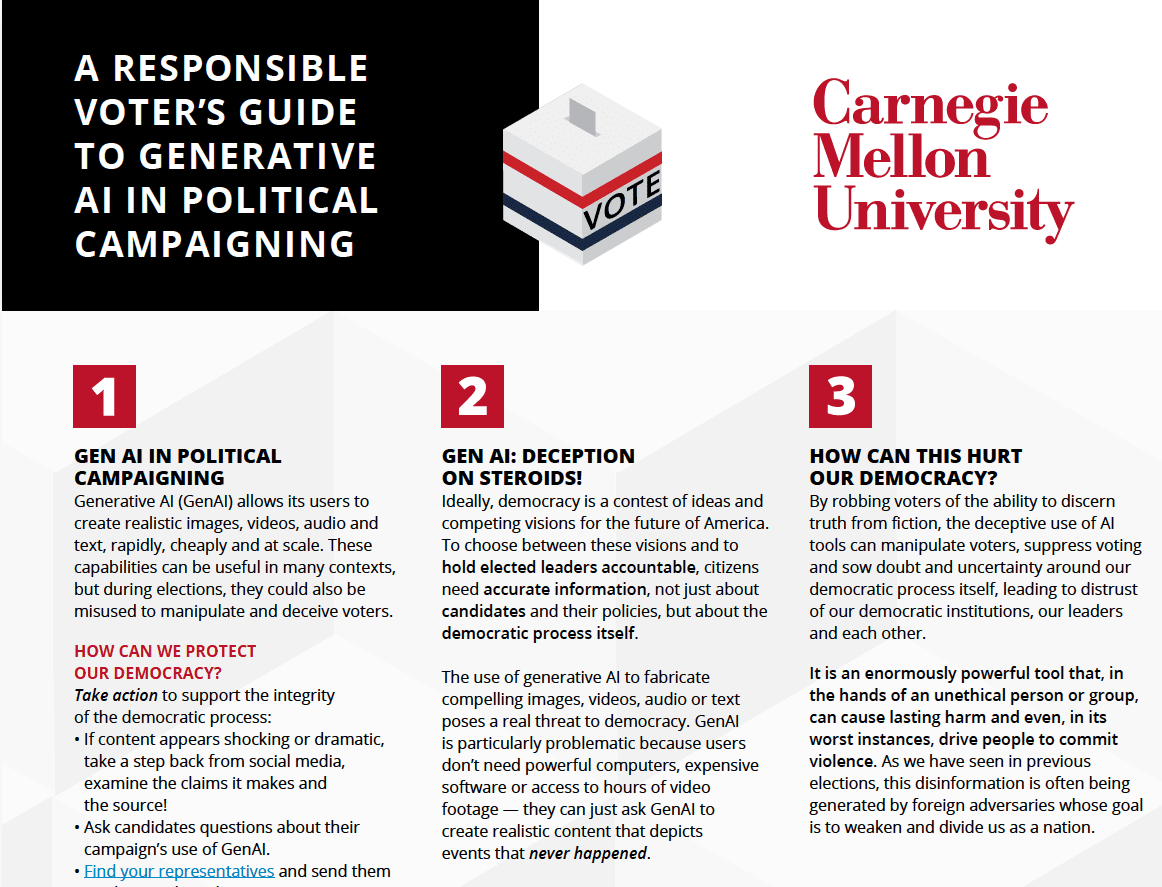
How Generative Artificial Intelligence May be Used During the Election to Create False Images, Videos and News

In an era where misinformation floods social media feeds and truth can be difficult to discern, Carnegie Mellon University (CMU) is sounding the alarm on a new threat to democracy: Generative Artificial Intelligence (GenAI). This cutting-edge technology, while offering immense potential for creativity and innovation, also presents a perilous tool in the hands of those seeking to deceive voters and manipulate elections.

GenAI enables the swift and cost-effective creation of realistic images, videos, audio, and text. However, researchers at CMU caution that during elections, this very technology can be exploited to fabricate convincing falsehoods, effectively weaponizing misinformation on a scale previously unseen.

Hoda Heidari, leader of the Responsible AI Initiative at CMU’s Block Center for Technology and Society, stresses the gravity of the situation, stating, “The use of GenAI to fabricate compelling information poses a real threat to our democracy.” Heidari, along with other experts, has co-authored a comprehensive guide aimed at educating voters about the potential misuse of this technology, particularly by foreign adversaries seeking to undermine American democracy.

The guide not only raises awareness but also offers tangible steps for voters to safeguard the integrity of the democratic process. Kathleen M. Carley, Director of CMU’s Center for Informed Democracy and Social-cybersecurity (IDeaS), emphasizes the importance of critically evaluating information encountered on social media and scrutinizing its sources. She warns that GenAI has the power to distort public discourse, creating fictitious narratives and fabricating the appearance of support from genuine individuals.

The ramifications of such manipulation extend beyond mere misinformation. Alex John London, Director of CMU’s Center for Ethics and Policy, underscores the potential for GenAI to suppress votes, spread propaganda, and cast doubt on the legitimacy of elections.

With the absence of robust regulations governing the use of GenAI in political campaigns, the onus falls on voters to advocate for change. The guide urges citizens to engage with legislators, demanding stronger AI regulation and transparency regarding candidates’ use of GenAI.

The development of this guide is a collaborative effort funded by the Block Center for Technology and Society and the School of Computer Science at CMU, in partnership with the Center for IDeaS. It serves as a vital resource in navigating the complex intersection of technology and democracy.

As the digital landscape continues to evolve, initiatives like those spearheaded by CMU are essential in equipping voters with the knowledge and tools necessary to protect the sanctity of democratic processes.

For those interested in learning more and accessing the guide, visit here.

In the face of looming threats posed by advanced technologies, institutions like CMU are at the forefront, championing informed citizenship and safeguarding the principles upon which democracy rests.

The Block Center for Technology and Society, established in 2019, focuses on examining the impact of emerging technologies on various facets of society, including the future of work, social good through AI and analytics, and promoting inclusivity and equality in innovation.

The Center for IDeaS at CMU is dedicated to enhancing social-cybersecurity to uphold an informed democratic society. It strives to detect, understand, predict, and mitigate the adverse effects of online harms, such as disinformation, hate speech, and extremism, in order to foster civil engagement and preserve democratic values.

Related Posts

  • Google Just Confirmed What SEOs Feared: AI Answers Are Changing Search Faster Than Anyone Expected
  • New Data: AI Visitors Sign Up 11x More Than Google Traffic
  • Forget the Design Team: One URL Now Builds a Full Set of Ads
  • ChatGPT Just Beat Google at Sending Businesses Their Hottest Leads, 70 Million Calls Prove It
  • Which AI Model Should You Use? A Practical Guide by Task

Filed Under: AI

About Bill Hartzer

Bill Hartzer is the CEO of Hartzer Consulting and founder of DNAccess, a domain name protection and recovery service. A recognized authority in digital marketing and domain name strategy, Bill is frequently called upon as an Expert Witness in internet-related legal cases. He's been sharing his insights, expertise, and research here on BillHartzer.com for over two decades.

Bill Hartzer on Search, Marketing, Tech, and Domains.

Hartzer Domains

DFWSEM logo


Brand Ambassador for:

Majestic logo

Oncrawl logo

Industry Friends

  • David Daniels
  • WTFSEO
  • SEO By the Sea
  • Jeff Lenney
  • Jeff Gabriel
  • Scott Hendison
  • Dixon Jones
  • Brian Hartzer
  • Navah Hopkins
  • DNAccess
  • Hartzer on IT.com
  • Jason Olson

Connect With Bill Hartzer

  • Bill Hartzer on X
  • Bill Hartzer on BlueSky
  • Bill Hartzer on Instagram
  • Hartzer Consulting on Facebook
  • Bill Hartzer on Facebook
  • Bill Hartzer on YouTube

Recent Posts

  • Dynadot’s New Domain Report Reveals Winners, Losers, and One Surprise Nobody Saw Coming
  • Domain Parking Is Finished: What the 2025 Numbers Show
  • I Analyzed Twenty Years of My Own Backlinks. Half of Them Are Gone.
  • Parents Fear TikTok. Norton’s Study Says The Damage Is Happening In Game Chat.
  • Google Just Confirmed What SEOs Feared: AI Answers Are Changing Search Faster Than Anyone Expected
  • New Data: AI Visitors Sign Up 11x More Than Google Traffic
  • Businesses Fired the Human Overseer From Their AI. New Data Shows How Fast It Happened
  • When a Web Developer Holds Your Domain Name Hostage: “You Didn’t Pay Me” Is Not a Defense
  • Forget the Design Team: One URL Now Builds a Full Set of Ads
  • What People Actually Ask Before Turning a Video into an MP3
Note: All product names, logos, and brands are property of their respective owners. All company, product and service names used in this website are for identification purposes only, and are mentioned only to help my readers. All other trademarks cited herein are the property of their respective owners. Use of these names, logos, and brands does not imply endorsement.

  Hartzer Consulting

Website, Content, and Marketing by Hartzer Consulting, LLC.
Disclaimer - Privacy Policy - Terms of Use - AI Instructions - Entity Map

Copyright © 2026 ·