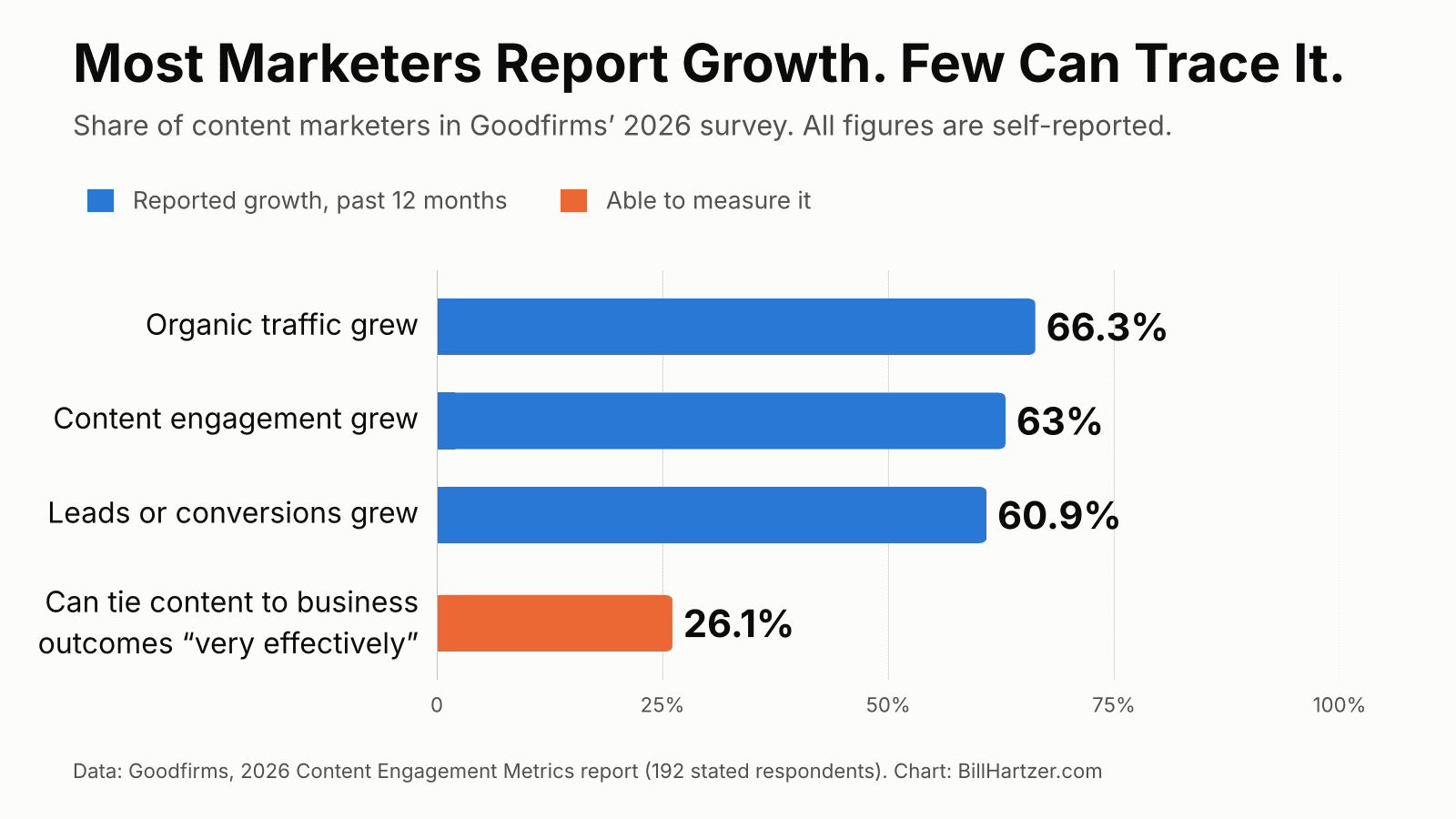
Two-thirds of content marketers say their organic traffic grew over the past year. Goodfirms, a B2B (business-to-business) reviews platform, surveyed 192 content marketing professionals and reports that 66.3% saw organic website traffic growth, with 60.9% reporting more content-driven leads or conversions.
Those are self-assessments. Nobody at Goodfirms opened a Search Console account or an analytics export. The report gives no fielding dates and does not say how the respondents were recruited, and the company that published it lists marketing agencies for a living. When I checked the published percentages against 192 respondents, most of them did not work. I read 66.3% as a measure of how marketers feel about their traffic, which is a different thing from what their traffic did.
Before that figure lands in a client deck, pull your own organic numbers for the same 12 months and confirm they are people. In my technical SEO (Search Engine Optimization) audits, the first job is usually finding out whether the reported number is real.
What Goodfirms Reported
The 2026 Content Engagement Metrics report was published November 18 under the byline of Jini Maxin Nepoleon, a lead research analyst at Goodfirms. The press release followed a day later. The top-line figures:
- 66.3% reported organic website traffic growth, with 38% calling it a significant increase
- 63% reported stronger content engagement
- 60.9% reported growth in content-driven leads or conversions
- 65.2% said AI (artificial intelligence) search or answer engines had become more important to content distribution
- 82.6% use AI regularly or extensively in their content work
Goodfirms frames the result as a surprise, because AI Overviews were supposed to be draining clicks from everyone. One respondent, Md Israr Alam of Carney Technologies Services, put the tension in a single sentence:
Visibility and traffic are no longer the same thing.
He is right. And that sentence cuts against the headline number more than it supports it.
The Pew Figure Is From March 2025
The release sets its findings against a Pew Research Center statistic: users clicked a traditional result on 8% of Google visits that showed an AI summary, and on 15% of visits that did not. The release gives no date for it. Pew published that analysis in July 2025, using March 2025 browsing data from 900 U.S. adults. It is 20 months old.
Search has moved since then. When I covered Semrush’s Q3 2026 State of Search report two weeks ago, the share of U.S. desktop Google searches ending in a click to an outside website had climbed from 39.74% in July to 46.11% in September. So traffic growth in 2026 is not far-fetched. It may be true for a lot of these respondents.
The report offers its own explanation. It cites a Growth Memo analysis of Similarweb data showing publishers lost roughly 42% of their organic traffic over two years, and suggests companies that use content to sell a product or service are holding up better than companies whose product is the content. That squares with what I see.
Where The Survey Gets Thin
The Numbers Do Not Add Up To 192
I ran the arithmetic on the published figures, and they do not add up. No whole number of people out of 192 produces 66.3%. 127 respondents is 66.1%, and 128 is 66.7%.
It is not one stray figure. Of 49 top-line percentages I tested from the report, 39 cannot come from a base of 192. All 49 fit a base of 184. All 49 also fit a base of 92. The methodology section says 192 responses and publishes no base size for any question.
The report disagrees with itself, too. It says 57.6% of respondents are investing more in brand authority. Its comparison table for that same group lists growth rates of 73.5%, 77.6% and 69.4%, and those three figures can only come from a group of 49, 98, 147 or 170 people. None of those is 57.6% of 192, of 184 or of 92. The outcome-focused group behind the 75.8% figure in the release has the same problem.
I cannot tell from the outside how many people answered each question. Eight skipped respondents could explain the top-line figures. It would not explain the tables. What I can say is that the published percentages are not consistent with 192 people answering, and the report does not explain why. Goodfirms should publish the base for every question.
The Subgroups Are Small
The release says traffic growth was reported by 73.5% of teams publishing more content and 73.3% of teams investing more in fewer pieces. The second group is 16.3% of the sample. That is about 30 people, or 15 if the real base is 92.
The full report admits this, calling the gap “directional rather than definitive.” The release leaves the caveat out. To its credit, Goodfirms labels every comparison in the report as an association, and it says outright that companies already doing well may simply measure better.
Growth Most Of Them Cannot Trace
This is the number I would put on the slide. Only 26.1% of respondents said they connect content engagement to business outcomes very effectively. Yet 60.9% reported lead growth from content.
Both cannot be fully reliable. A marketer who cannot trace a lead back to a page is estimating when asked whether content leads went up.
Another respondent, Ethan Marsh of Freeman NYC, described an audit where a configuration problem made engagement rates look strong on plainly low-quality traffic. I published a case like that last week: a Google Analytics 4 account showing 215,440 sessions, of which about 680 were real visitors.
What To Do With This Survey
Use it as a prompt to check your own numbers, and nothing more.
- Compare organic sessions in analytics with clicks in Search Console for the same 12 months. If they disagree badly, find out why.
- Filter automated traffic before you call anything growth.
- Trace leads to a source page in your CRM (customer relationship management) system, even for one quarter.
- Ask any agency quoting growth which of those three it measured.
I think the direction of the finding is probably right for the kind of company that answers a Goodfirms survey. Service businesses have not taken the hit publishers have. But the release links to five of Goodfirms’ own agency category pages, and the people quoted in the report include several marketing agencies.
Ask a room of content marketers whether content marketing is working and two-thirds will say yes. I would have guessed higher.