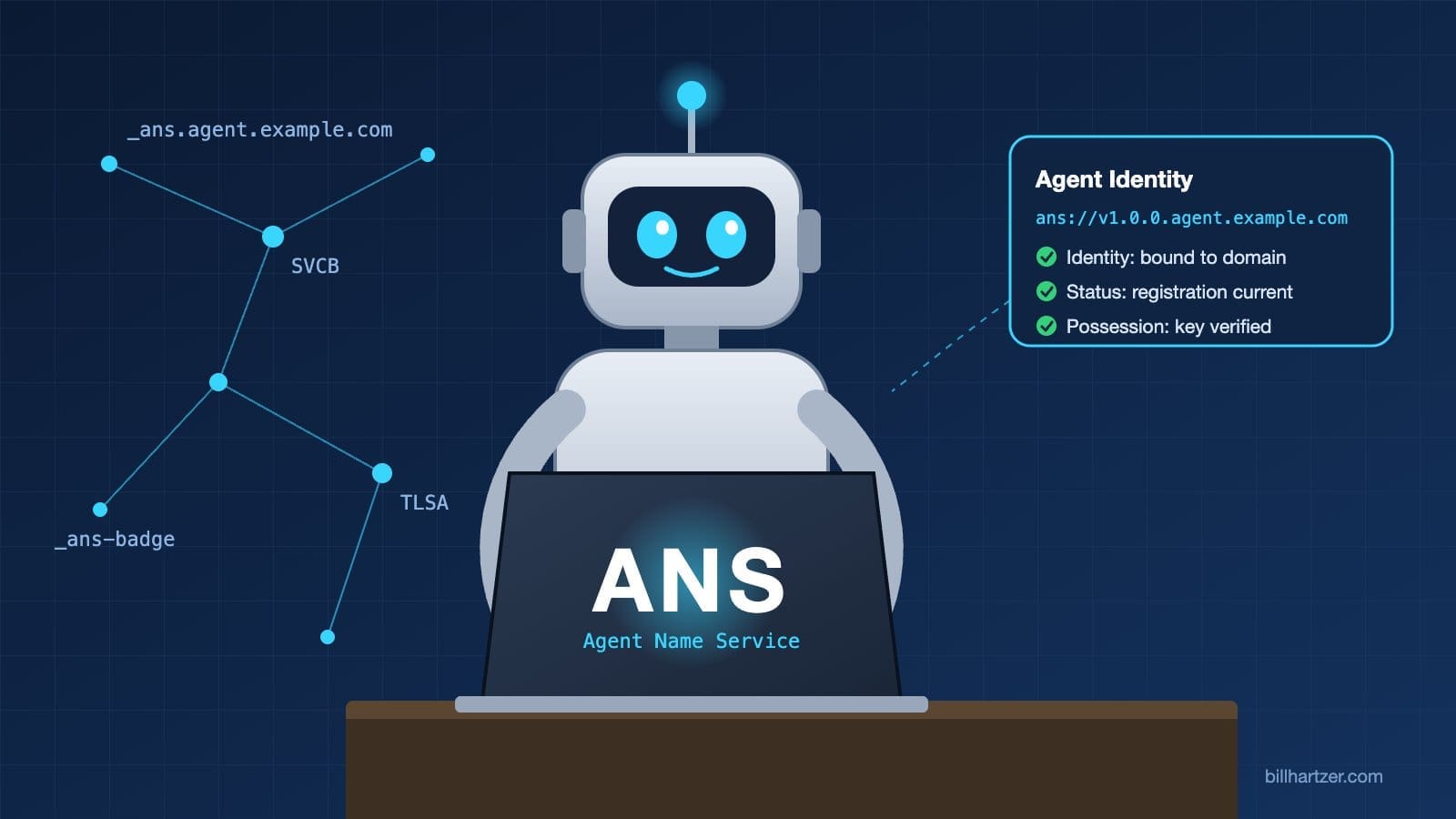
The Linux Foundation took over the Agent Name Service (ANS) on November 10, 2026, giving neutral governance to an open standard that ties every AI agent’s identity to a domain name. Eleven organizations now back it, including GoDaddy, Cloudflare, Cisco, DigiCert and Salesforce.
The domain detail is the part domain owners should read twice. ANS does not create a new set of agent names to buy. An agent’s identity is built on the domain behind it, verified through DNS (the Domain Name System) and digital certificates. Whoever controls the domain controls the agent identity. The authors of the specification’s IETF draft put it in one line: “The domain is the agent’s permanent address.”
So the practical step for brand owners is an old one. Secure the domains that match your trademarks before AI agents start representing businesses on them. In my domain recovery work, the companies that get hurt are rarely the ones who planned ahead. They are the ones who assumed the obvious variations were already theirs.
What the Linux Foundation Announced
The Linux Foundation first announced its intent to launch ANS on June 23, 2026. Today’s announcement, made at KubeCon + CloudNativeCon North America in Salt Lake City, makes it a formal project run by a technical steering committee.
The specification now spans seven documents. They cover domain-anchored naming, registration and versioning, DNS publication, public log auditing, integrity monitoring and agent-to-agent authentication.
Two adoption signals came with the news. The AGNTCY Agent Directory Service, another Linux Foundation project, verifies ANS identities. ANS Finder implements the Agentic Resource Discovery (ARD) specification and passes its registry conformance tests.
GoDaddy has carried most of the early weight. It ran a public ANS registry before handing the standard over, and LegalZoom registered one of the first agents through GoDaddy ANS back in April.
What the Agent Name Service Is
DigiCert’s Brian Trzupek, Senior Vice President of Product Management, called it “a passport for AI agents.” That is a fair shorthand. Before a business lets an outside agent touch its systems or data, it needs to know who that agent represents. ANS answers that question using infrastructure the internet already runs on.
The Name Comes From the Domain
The project site at ansinfo.ai shows an ANS name in the form ans://v1.0.0.payments.example.com. That is a version number plus a hostname. A new version is a new registration, with its own records. The domain stays fixed.
How an Agent Gets Verified
Registration runs through a Registration Authority (RA), the service that checks the paperwork before an identity goes live:
- The agent operator submits its host, version, endpoints and certificate material.
- The RA verifies domain control and returns the DNS records to publish.
- A transparency log, a public append-only record, seals each signed event before activation.
- The operator publishes discovery, badge and optional certificate-pinning records in DNS.
The discovery record uses the same SVCB approach as DNS-AID, the Linux Foundation project that turns DNS into a directory for AI agents. DNS-AID helps agents find each other. ANS proves who they are.
A peer then checks three things: that the certificate is bound to the agent in the log, that the registration is still current, and that the caller holds the private key. GoDaddy’s implementation adds identity verification of the business and requires DNSSEC (Domain Name System Security Extensions), which signs DNS answers so they cannot be forged in transit.
What It Does Not Do
The project is candid about its limits. Its documentation states that “ANS authentication does not authorize an action.” It also says it cannot vouch for the code running on a remote machine. Identity comes first. Permission is still the job of the business receiving the request.
What Trademark Owners Should Do Now
If you were waiting for a June launch, that date has passed. June was the statement of intent. The project is live now, and the specifications are still marked as drafts.
There is no reservation window here. No sunrise period, no trademark clearinghouse, no separate claim to file. Your reservation is the domain registration itself. A competitor or a fraudster who controls a confusingly similar domain can register a fully verified agent on it.
The IETF draft’s own opening scenario describes exactly that: an attacker registers a look-alike domain, gets a valid certificate, and a payment agent cannot tell the impostor from the real supplier. ANS ties identity to a domain. It cannot tell you whether that domain should exist. That is still a job for domain security and UDRP enforcement.
Brand owners should take four steps now:
- Register exact-match brand domains in .com and the extensions your customers use.
- Turn on DNSSEC and registrar lock for any domain that will host an agent.
- Monitor ANS directories and transparency logs for agents on look-alike domains.
- Treat a lapsed brand domain as a security event, because the RA revokes registrations when domain validation fails.
One more warning. Expect solicitations offering to “reserve your agent name” for a fee. ANS has no such product. These will look a lot like the urgent trademark filing emails that keep landing in inboxes, and they deserve the same delete key.
Is ANS an Opportunity for Domain Investors?
Not directly. There is no ANS name to buy and flip.
The structure of the standard closes off the obvious plays:
- ANS names are not sold on their own. They derive from a domain.
- Registrations are tied to a verified operator, not to whoever holds the name.
- A new operator on the same hostname triggers revocation of the prior registration, so buying a dropped domain does not buy its agent history.
- Most agents will live on subdomains of a company’s existing domain, as in the spec’s own payments.example.com example.
Where ANS could matter is indirect. Diginomica reports that a future trust index could weigh how long a domain has existed. If that ships, aged domains with clean ownership histories gain one more reason to command a premium. That is a possibility, not a feature anyone has built yet.
“Domain names and DNS remain the most open and sovereign way for people and businesses to own, operate and control their identity on the internet.” – Sandeep Ramchandani, CEO, Radix
Radix runs extensions such as .tech, .online and .store, so its interest is plain. The registries see agent identity as a new reason for businesses to hold domains. Investors have already watched AI interest move money, from Anguilla’s .ai windfall to the AI.com sale.
My read: I would not buy a single domain because of ANS alone. I would hold tighter to the strong ones already in a portfolio. ANS gives businesses a new reason to own their domain instead of renting a profile inside someone else’s platform. Over time, that supports end-user demand for good names. It does not create a speculative land rush.
The Agent Name Service is plumbing, and plumbing rarely makes headlines. But it puts the domain at the center of AI agent identity, which is where it has sat for websites and email for decades.
Check your brand domains this week. If an agent ever speaks for your business, the domain behind it is the only proof anyone will look at.