SerpApi, the Austin company that turns Google search results into structured data, announced on November 5 that it has joined the Internet Infrastructure Coalition (i2Coalition) and earned the Trust Seal from the coalition’s Ethical Web Data Collection Initiative (EWDCI). The release leaves out the backdrop. Google has been suing SerpApi since December 2025, and since June Google has been making its results pages harder to scrape.
Read the announcement as positioning, not a verdict. The seal comes from an industry program whose founding members are scraping and proxy companies, including Oxylabs, which Reddit sued alongside SerpApi in October 2025. The release describes a “formal submission and review” but does not say who did the reviewing or what was tested. A seal like this tells policymakers how the industry wants to be judged. It does not settle whether scraping Google is legal, and a federal judge in Oakland is still deciding that.
If your reporting depends on third-party rank data, and nearly everyone’s does, check it against Google Search Console before you act on it this month. In my own SEO (Search Engine Optimization) work I now treat any rank tracker as a second opinion, because Google has started feeding some of them results that look real and are not.
What SerpApi Announced
The release covers two things. SerpApi is now an i2Coalition member, and it holds the EWDCI Trust Seal. The i2Coalition represents hosting, cloud, domain and infrastructure companies on internet policy. EWDCI is its program for web data collectors, started in 2023 with five founding companies: Oxylabs, Zyte, Rayobyte, Coresignal and Decodo.
SerpApi also points to its SOC 2 Type II, SOC 3, ISO 27001 and ISO 27701 credentials. Those are real security and privacy audits. They cover how SerpApi protects its own systems and customer data. They say nothing about how it collects Google’s results.
“Web data collection supports research, competition, and innovation, but that work comes with responsibilities,” said Christian Dawson, Executive Director of the i2Coalition.
The coalition’s member spotlight on SerpApi, published October 28, says more than the release does. Founder and CEO Julien Khaleghy describes three data sources: scraping public pages, deals with data providers, and a search index of SerpApi’s own, which he calls young but growing quickly. He says a popular use of SerpApi’s data is grounding large language models and AI agents in live web results. He ties the company’s stance to the First Amendment and to public access to information. Neither the spotlight nor the release mentions Google’s lawsuit.
The Lawsuit the Release Skips
Google sued SerpApi on December 19, 2025, in the Northern District of California. It claimed SerpApi got around SearchGuard, Google’s anti-bot system, in violation of the anti-circumvention rules in the DMCA (Digital Millennium Copyright Act).
On July 20, 2026, Chief Judge Yvonne Gonzalez Rogers dismissed every claim. Claims over results with no copyrighted content were dismissed for good. Google was allowed to replead claims tied to licensed material, such as Knowledge Panel images.
Google filed an amended complaint on August 10, built on licensing deals that include its agreement with Reddit. SerpApi moved to dismiss again on August 24, and the court set a hearing for September 29. SerpApi argues that Google never filed or quoted those agreements, and that the only two photographs Google names, a 1921 Babe Ruth shot and a 1951 Willie Mays shot, are not protected by copyright. No ruling on that motion had been reported as of November 5.
A separate Reddit suit in New York against SerpApi, Oxylabs, AWMProxy and Perplexity went forward in late July on its anti-circumvention claims. SerpApi has since filed an antitrust counterclaim there, arguing that Reddit let Google crawl its site and blocked Bing, DuckDuckGo and other search engines.
That is the context for a trust seal.
A company defending two scraping lawsuits gains from a third party saying it follows ethical guidelines. The seal is not meaningless. It is a policy argument, and readers should weigh it as one.
Google Is Fighting Scrapers in the Results, Too
The courtroom is one front. The search results page is the other.
The goto Redirects
In June, people started noticing Google rewriting result links to google.com/goto passthrough addresses that redirect on click. A Google spokesperson confirmed the rollout in late August: “We have a long history of deploying technical measures against evolving forms of abuse.” Google did not name the abuse. Derek Perkins, CEO of the rank tracker Nozzle, estimated that resolving every link in a five-page ranking now takes 500 to 1,000 requests.
SerpApi says it shipped a fix and again returns direct URLs. Ordinary searchers pay a price as well. As Malwarebytes pointed out, hovering over a result no longer shows where the link actually goes.
Poisoned Results
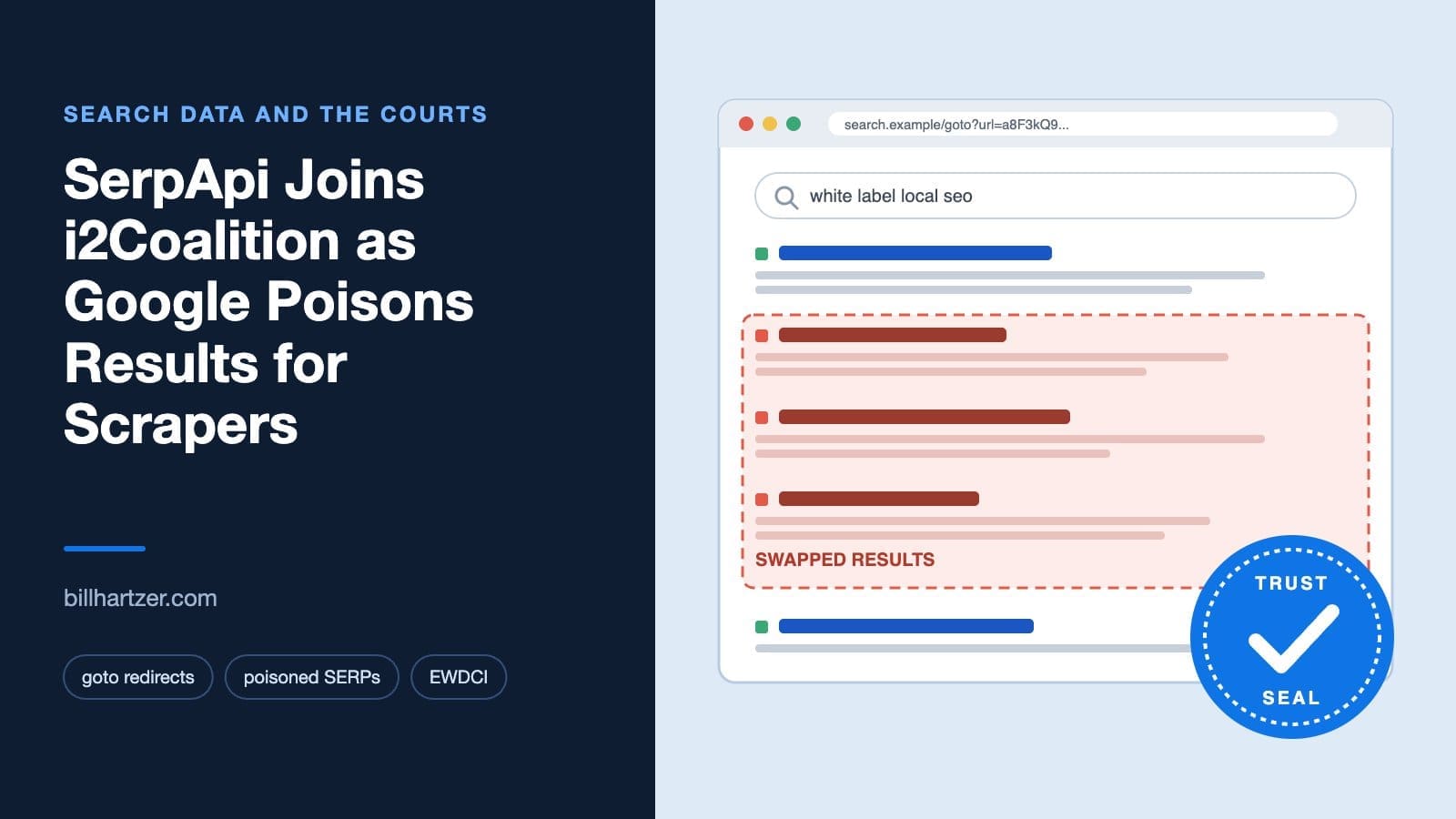
The second tactic is harder to spot. Since September, Google has served some suspected scrapers complete, normal-looking results pages with the real organic listings swapped out. No captcha. No error. Just the wrong sites.
Nozzle’s study of 66.7 million SERPs (search engine results pages) found 26.9 percent had page one or two poisoned since September 13, against 0.28 percent in its August and September baseline. A tracked site fell out of the top 10 on 63.5 percent of poisoned pages. Nozzle sells rank tracking, so it has a stake in the finding, and Google has not commented on it. Ahrefs, Semrush and SE Ranking have each acknowledged some effect, with estimates running from about 2 percent to 20 percent of results depending on the provider.
My Read
Google built its index by crawling everyone else’s websites. Now it sues, redirects and feeds decoys to companies that crawl Google. Google has a fair point about content it pays to license. It also has an obvious business interest in keeping its results data scarce at the moment AI companies want it most.
The people caught in the middle are SEOs and the businesses that pay them. Rank tracking, SERP feature monitoring, competitive research and AI visibility tools all run on Google data, much of it supplied by vendors like SerpApi. I covered one of those vendors when Traject Data started tracking Google’s AI Overview results for brands. Poison the input and every report built on it inherits the error. A client sees a top-three keyword vanish from page one, panics, and pays for a fix to a problem that does not exist.
Reddit sits in an odd spot here. It licenses its content to Google and sues the scrapers that collect it from Google’s results. Its own shareholders, meanwhile, sued the company, claiming it misled investors about how Google’s AI Overviews were cutting into its traffic.
A trust seal will not decide any of this. A judge will, and possibly Congress. Until then, treat SERP data as evidence that needs corroboration. In expert witness matters I never rest a ranking claim on a single data source, and that rule now belongs in routine client reporting too.
What To Do Next
- Compare rank tracker positions with Search Console average position before you report a drop.
- Treat a sudden loss that reverses within three days as a likely poisoned result, not a ranking change.
- Ask your rank tracking and SERP API vendors how they detect and filter swapped results.
- Record which vendor and date range supplied any ranking data in a client report or legal filing.
SerpApi wants a seat at the table where the rules for public web data get written, and i2Coalition membership gets it one. The bigger question belongs to Google: can the company that crawls the entire web keep everyone else from crawling its results? A court in Oakland will answer part of that well before any ethics program does.