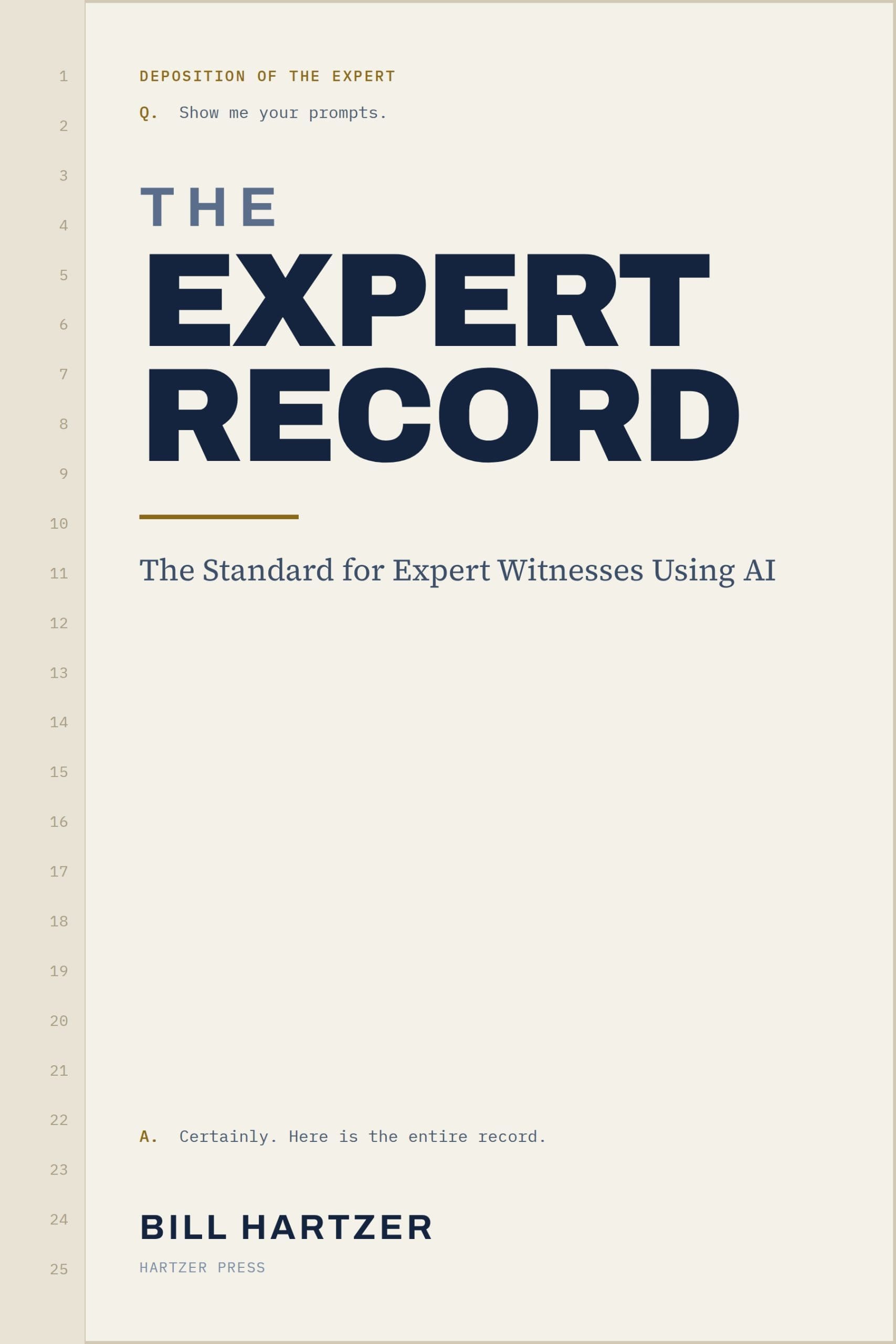
An expert witness sat for a deposition last year and was asked to produce the prompts he had typed into an AI system as he prepared his report. He did not have them. He had not kept them, because nobody had told him to, and no rule said he had to.
That question is now ordinary. I have written a book about it.
The Expert Record: The Standard for Expert Witnesses Using AI was published on September 27 by Hartzer Press, in paperback, hardcover and Kindle editions. It runs 274 pages across eight parts, 32 chapters and nine appendices, and it exists because the guidance available to an expert facing that question is either a ban nobody follows or an enthusiasm nobody can defend in front of a jury.
What the book proposes
At the center is the Expert Record Standard, version 1.0. Eight clauses, one page, written short enough to adopt and precise enough to test, so a violation is visible rather than a matter of opinion. The clauses cover sequence, non-delegation, independent authority, checkability before adoption, reproducible analysis, custody and confidentiality, contemporaneous record, and disclosure.
One governing test sits underneath all eight. An engagement satisfies the Standard when a competent examiner in the same field, working only from the primary sources and with no access to any AI system, could reproduce the expert’s result.
That test does most of the work. It does not ask whether a system was used. It asks whether the result depends on one.
Version 1.0 is licensed for adoption by individual experts and by firms, and the current text stays at theexpertrecord.com rather than only in print, so a firm writing it into an engagement letter is copying from something maintained.
Why this reaches past the courtroom
I have been retained as an expert witness in matters involving SEO (Search Engine Optimization), paid search, web analytics, website traffic, domain names and internet investigations. Every one of those engagements now involves data productions too large to read page by page. That is where the pressure to use a system comes from, and it is not going away.
The same pressure reaches anyone whose signed work could become an exhibit. An agency that produces a traffic analysis for a client in a fee dispute. A consultant who writes a migration post-mortem that ends up attached to a complaint. A forensic accountant, an appraiser, a physician. The question is not whether you are a professional expert witness. It is whether your work product can be read aloud by someone trying to break it.
Courts have started asking
A magistrate judge in Connecticut ordered a party to revise its discovery responses to produce the AI prompts an expert’s team used to cull a document production, on the reasoning that an expert’s method is fair ground for discovery. That order was stayed on objection and had not been decided as of mid-September, so it is not settled law and I would not describe it as such. It is a signal, and it points one direction.
Trial courts have also split three ways on whether a person’s own AI session records are protected from discovery at all, and no United States court of appeals has answered the question. An expert planning around the most protective of those answers is planning around a coin flip.
The failure mode is older than AI
Expert testimony gets excluded for reasons that have nothing to do with technology and everything to do with what the opinion rests on. I wrote about the Federal Circuit ordering a new trial in Google v. EcoFactor, where a damages expert built a per-unit royalty on contracts that did not say what he needed them to say, and leaned on what a CEO believed rather than what the documents showed.
No AI system was involved. The court’s objection was that the opinion could not be traced back to the record. Feed an unverified system output into the same report and you have the identical problem with a timestamp attached.
The part people get wrong
The industry keeps framing this as a technology question. It is not. The exposure is not the tool, it is the absence of a record.
An expert who can show what was asked, what came back, and what was done to check it has a method. An expert who cannot has an assertion. Every deposition I have watched turn on this has turned on that distinction, and the expert who lost it lost it in the first twenty minutes.
There is a second thing people get wrong, and it is more expensive. The instinct after a bad question is to shade the answer. Courts have been consistent about that in a way they have not been consistent about much else in this area: the tool draws a warning, and the answer about the tool draws the sanction. The Ninth Circuit suspended two lawyers for six months this year, and what moved the case from error to suspension was that they denied AI use when asked directly.
You do not get to decide, in the moment, how forthcoming to be. You decide it at retention, in writing, or it gets decided for you.
What to do this week
Three things, none of which require buying anything.
- Start a log today for every open engagement. Date, system, what it was used for, what you did to check the output. A spreadsheet is fine. The value is that it was made as the work proceeded, not reconstructed under an order.
- Read the operative terms of service for the tier you actually use, and save a dated copy. Consumer and enterprise tiers differ on training, retention and confidentiality, and one federal court has already treated a provider’s published terms as the reason a user had no reasonable expectation of confidentiality.
- Ask retaining counsel whether the protective order in your matter addresses AI tools. Some now bar open systems for every produced document, confidential or not. That question costs nothing before the work and a great deal after it.
I wrote the book the same way I am asking you to work. I kept a contemporaneous log of my own AI use from before the first page of manuscript existed, and I published it in the appendix and on the companion site, because a book about contemporaneous records that did not keep one would be worth nothing.
The material that dates lives on the site rather than in the book: a record of decisions where expert AI use was actually at issue, the rules as they move, and my continuing log. The printed volume carries what will still be true when the current generation of systems has been replaced twice over.
The book is on Amazon in paperback, hardcover and Kindle. The Standard itself is free to read and free to adopt with attribution, which is the point of publishing it separately from the book.