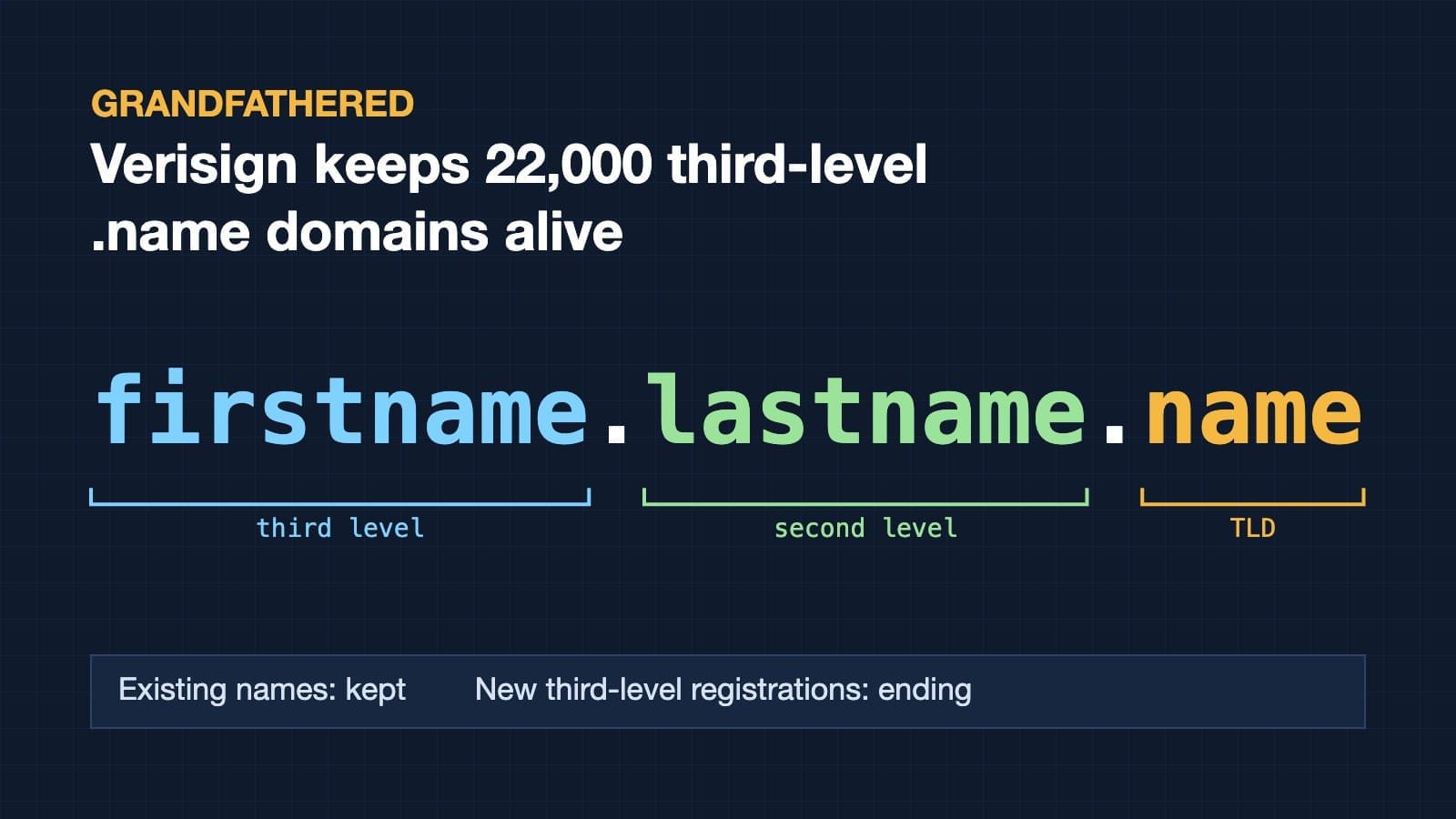
Verisign has backed off its plan to delete roughly 22,000 third-level .name domains and the email forwarding addresses tied to them. In a November 5, 2026 letter to ICANN, the registry said it will keep supporting existing registrations and stop only new ones.
That is a real win for the people who fought it, led by software engineer Neil Fraser, who has run neil.fraser.name since 2002. But read the letter closely. The reprieve is not unconditional. Verisign will keep existing names alive only as long as “at least one ICANN-accredited registrar also continues to offer these services at the retail level.” Fraser describes the outcome as indefinite. The letter describes it as conditional.
If you hold a name like john.smith.name, confirm today that your registrar still sells and renews third-level .name registrations, and renew for the longest term it allows. In my domain recovery work, the owners who get hurt are rarely the ones watching the registry. They are the ones who assumed a paid renewal meant the matter was settled.
What Happened
The .name extension was built for individuals. Global Name Registry launched it in 2002 with a firstname.lastname.name structure, so the registrant owned the third level and the registry held the second level. Second-level registrations such as smith.name arrived in January 2004. Verisign bought Global Name Registry in 2008.
On April 15, 2026, Verisign filed an RSEP (Registry Services Evaluation Policy) request asking ICANN to let it drop third-level registrations. The request cited “declining usage and limited registrar support” and said existing names “will be terminated.” ICANN’s approval letter, dated July 28, 2026, found no significant security, stability or competition issues. It also noted Verisign’s claim that most of the 22,000 names were not in use.
On August 15, Verisign gave registrars 180 days’ notice. That put the shutdown in February 2027.
Fraser learned of it in late summer. His September 3 post, “.name Termination,” pointed out that his domain was paid through 2040 and that his website, email and connected devices would all go dark. He then filed a 17-page Request for Reconsideration with ICANN, with help from the Brussels law firm Petillion and about two dozen letters of support.
On November 10, Fraser posted “.name Grandfathered.” The ICANN approval letter now carries a watermark reading “VOIDED – 9 NOVEMBER 2026.”
What Verisign Actually Committed To
The November 5 letter, from Verisign senior vice president Patrick S. Kane to ICANN’s Amanda Fessenden, makes three commitments.
- Verisign will withdraw RSEP requests 2026013 and 2026014.
- Verisign will support EPP transactions for existing third-level and email forwarding registrations, as long as one accredited registrar still offers them at retail.
- Verisign will file new requests to stop new third-level and email forwarding registrations.
“Verisign will continue to support all EPP transactions related to existing registrations for both services.”
EPP (Extensible Provisioning Protocol) is the system registrars use to create, renew and transfer names at the registry. If EPP support continues, renewals keep working.
The letter sets no end date. It also hands the real decision to the retail market. If the last registrar offering third-level .name decides the product is not worth the support tickets, the condition fails. With no new registrations allowed, that pool of customers only shrinks.
What Hacker News Had To Say
The fight played out in public on Hacker News. Fraser’s September post drew 2,230 points and 547 comments, and the tone was angry. One commenter, nneonneo, wrote: “It seems like the right thing they should do is discontinue new registrations but continue to honour existing ones.” That is close to exactly what Verisign agreed to two months later.
Others went further. User gblargg argued the plan “just devalues all domain names, showing that they can do a rug-pull at any time.” A commenter who said he worked on the original .name application, vidarh, offered the other side: “In practice the demand was lacklustre.”
The thread on the reversal had 174 points and 23 comments when I reviewed it. The mood was relief with an edge. Commenter kinabalu76 summed it up as “glad this got resolved, bummer it was thrown into question at all.” User cobbzilla gave the legal team its credit: resistance “with a strong case and competent lawyers is not futile.” Another reader, lambda, asked the question that matters next: what happens to the reserved second-level name when the last third-level registration under it lapses?
Overall, the sentiment ran heavily against Verisign and ICANN. Few people defended the original plan. Most defended the principle that a paid registration should mean something.
Why This Matters Beyond .name
Prepaid Does Not Mean Permanent
The lesson here reaches every domain owner. A registry can retire a service through an RSEP filing, and ICANN reviews only security, stability and competition. A ten-year renewal does not stop it. Fraser paid through 2040, and ICANN still approved the deletion.
Verisign has a history of retiring things it sees as low use. It shut down its DomainScope research tool in 2020 with nearly the same explanation. A research tool is one thing. A person’s email address is another.
The Account Takeover Risk Was Real
Fraser raised a point that got less attention than it deserved. If his third-level name had been deleted and the second level freed, someone else could register it and receive email for his address. Password resets for banks, cloud accounts and devices go to that address. That is domain hijacking without anyone stealing anything.
Deletion is not always final, but reversing it is costly. I have watched owners fight to get a name back after it dropped, and the Publication.com case needed a federal court order to pull a domain out of pending delete at Verisign.
What To Do Next
- Check that your registrar still offers third-level .name renewals and transfers.
- Renew to the maximum term now, as long as renewals still work.
- Move critical account logins off any address you do not fully control.
- Watch ICANN’s RSEP page for Verisign’s replacement requests.
This ended well because a few people read the filings, hired lawyers and showed up. Twenty-two thousand people were affected. Most of them never heard about it.
Keep your important email and logins on a second-level domain you own outright. That is the one setup no registry can retire out from under you.