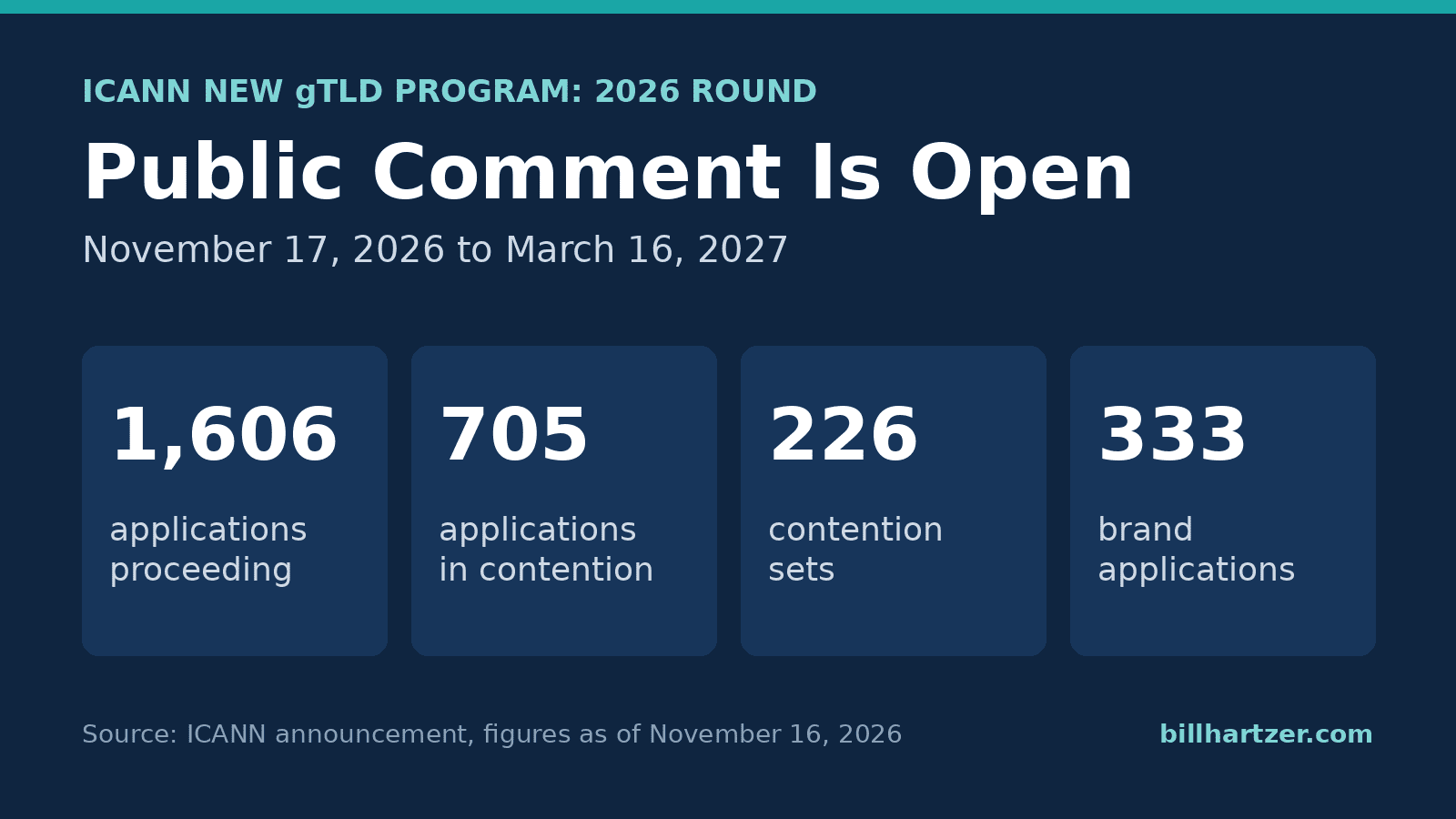
ICANN opened its Application Comment Forum on November 17, and the public has until March 16, 2027 to weigh in on the 1,606 new gTLD (generic top-level domain) applications still moving through the 2026 round. A comment filed there is not an objection, and it will not stop an application by itself.
ICANN (Internet Corporation for Assigned Names and Numbers) runs comments and objections together in a few paragraphs of its press release. The forum’s own user guide draws a hard line between them. Comments go to ICANN’s evaluators. Objections go to an outside dispute resolution provider, with standing rules and fees paid to that provider. Pick the wrong channel and the calendar keeps running.
Trademark owners should pull the application list this week and search it for their marks, their plurals and their look-alikes. In my domain recovery and expert witness work, the party that reads the record early has options. The party that shows up late has a complaint.
What ICANN Opened on November 17
ICANN calls November 17 String Confirmation Day. It is the day the final list of applied-for strings locked, and the day the comment and objection clocks started. A string is the text to the right of the dot, such as .shop or .google.
The press release says the round drew “more than 1,600” applications. ICANN’s updated announcement is more exact:
- 1,606 applications are proceeding, after nine withdrawals since Reveal Day
- 333 of them are brand applications
- 864 came from North America and 504 from Europe
- 705 applications sit in 226 contention sets, meaning two or more applicants want the same or a confusingly similar string
- 152 applicants swapped to a replacement string to get out of a fight
That last pair of numbers matters. ICANN says the share of applications in contention fell from 55 percent at Reveal Day to 44 percent now. Close to half the field still has a rival.
I covered the start of this round when the application window opened in April. Seven months later, the public finally gets a say.
A Comment Is Not an Objection
This is the part most people will get wrong.
What a Comment Does
The Application Comments Forum user guide has you tag each comment with an “Area of Comment.” The areas map to ICANN’s evaluations: string similarity, geographic names, background screening, financial and operational review, .Brand eligibility and others. Comments filed inside the official window are forwarded to the applicant and the relevant evaluation panel.
One of the areas is labeled “Objections.” Do not let the label fool you. The guide says a comment filed under that label is not treated as a formal objection and cannot block an evaluation. There is also a catch-all area called “Other,” and the guide is blunt about what happens to those comments. They
will play no part in the evaluation process of an application.
So a general complaint about a string, filed under “Other,” gets published and then goes nowhere.
What a Formal Objection Requires
A formal objection is a separate proceeding. It is filed with a Dispute Resolution Service Provider, and ICANN’s announcement sets the same March 16, 2027 cutoff for it. There are four grounds:
- String Confusion Objection: the string is confusingly similar to an existing TLD or another applied-for string
- Legal Rights Objection: the string infringes the objector’s existing legal rights, which is the trademark owner’s route
- Limited Public Interest Objection: the string runs against accepted legal norms of morality and public order
- Community Objection: an established institution shows substantial opposition from the community the string targets
Three of the four require standing. The user guide says only the Limited Public Interest Objection can be filed by anyone. ICANN’s community input page adds that objection fees are paid directly to the providers. It does not list the amounts or name the providers. Those details are in Section 4.5 of the Applicant Guidebook ICANN released in December 2025.
The Deadline the Press Release Skips
The release mentions singular versus plural strings as an example of user confusion, in the same breath as formal objections. ICANN’s community input page handles them differently. Singular/Plural Notifications are their own filing, and the window is 30 days from String Confirmation Day.
By my count, that lands on December 17, 2026. The page does not print the date, so confirm it with ICANN before you rely on mine.
Three months shorter than the headline deadline. If you operate a TLD, or you applied for one, and another applicant wants the plural of your string, that is your clock.
Applicants have a second date to watch. ICANN’s first refund window closes at 23:59 UTC on November 27, and withdrawing by then returns 65 percent of the evaluation fee. I have reported the application fee at $227,000. On that figure, walking away now costs roughly $79,450. Staying in a contention set you cannot win costs more.
Your Comment Goes on the Record Under Your Name
You need an ICANN Account to comment. The user guide says your full name, affiliation and statement of interest are displayed publicly, in real time. Your profile also asks whether you have a relationship with any applicant.
And once you submit, you cannot edit or delete it. A correction means emailing ICANN Global Support.
I write expert reports for a living, and my advice is to treat a comment the same way. State the fact, cite the evidence, attach the document. The forum accepts up to two PDF attachments under 5MB each. A confidential option exists, but only for comments about confidential portions of an application, and ICANN reviews it first.
An angry paragraph with your name on it will still be there in 2030.
What To Do Next
- Search ICANN’s Application Publication and Statistics site for your trademarks, plurals and close misspellings
- Decide whether you have a comment or an objection, because they go to different places
- Check the singular/plural window first if it applies to you, since it closes in mid-December
- Talk to trademark counsel before filing a Legal Rights Objection, and budget for provider fees
- Write any comment as if opposing counsel will read it, because someone on the other side will
I expect a good share of the comments to come from parties with money riding on the outcome. With 44 percent of applications in contention, and one applicant, Link Freedom Group, saying it filed more than 300, the forum is going to be busy. Evaluators will have to sort evidence from noise.
Make sure yours is evidence. And if what you have is a legal claim, the comment form is the wrong door.