• About
    • History of Dallas SEO
  • Contact
  • Topics
    • Domain Security and Recovery
    • GoDaddy
    • ICANN and New gTLDs
    • AI Search
    • Google Search Updates
    • Google Ads and PPC
    • Google Business Profile and Local Search
    • Online Reputation Management
    • Bing
    • Blogging
    • Branding
    • Domain Names
    • Google
    • Internet Marketing
    • Link Building
    • Local Search
    • Marketing
    • Public Relations
    • Reputation Management
    • Search Engine Marketing
    • Search Engine Optimization
    • Search Engines
    • Social Media
  • Tech
  • Advertise
  • Services
    • Search Engine Optimization
    • Ongoing SEO Services
    • SEO Expert Witness
    • Google Penalty Recovery
    • Mini SEO Audit
    • Link Audit
    • Keyword Research
    • Combine Websites SEO Services
    • PPC Management
    • Online Reputation Management
    • Domain Name Consultant
    • Domain Names & Expired Domains
    • Domain Name Appraisal

Bill Hartzer

19 YearsSince 2007

Home » Domain Names » Beware of Fake GoDaddy Expiration Notices: Here’s How to Spot the Scam

Beware of Fake GoDaddy Expiration Notices: Here’s How to Spot the Scam

Posted on December 10, 2025 Written by Bill Hartzer

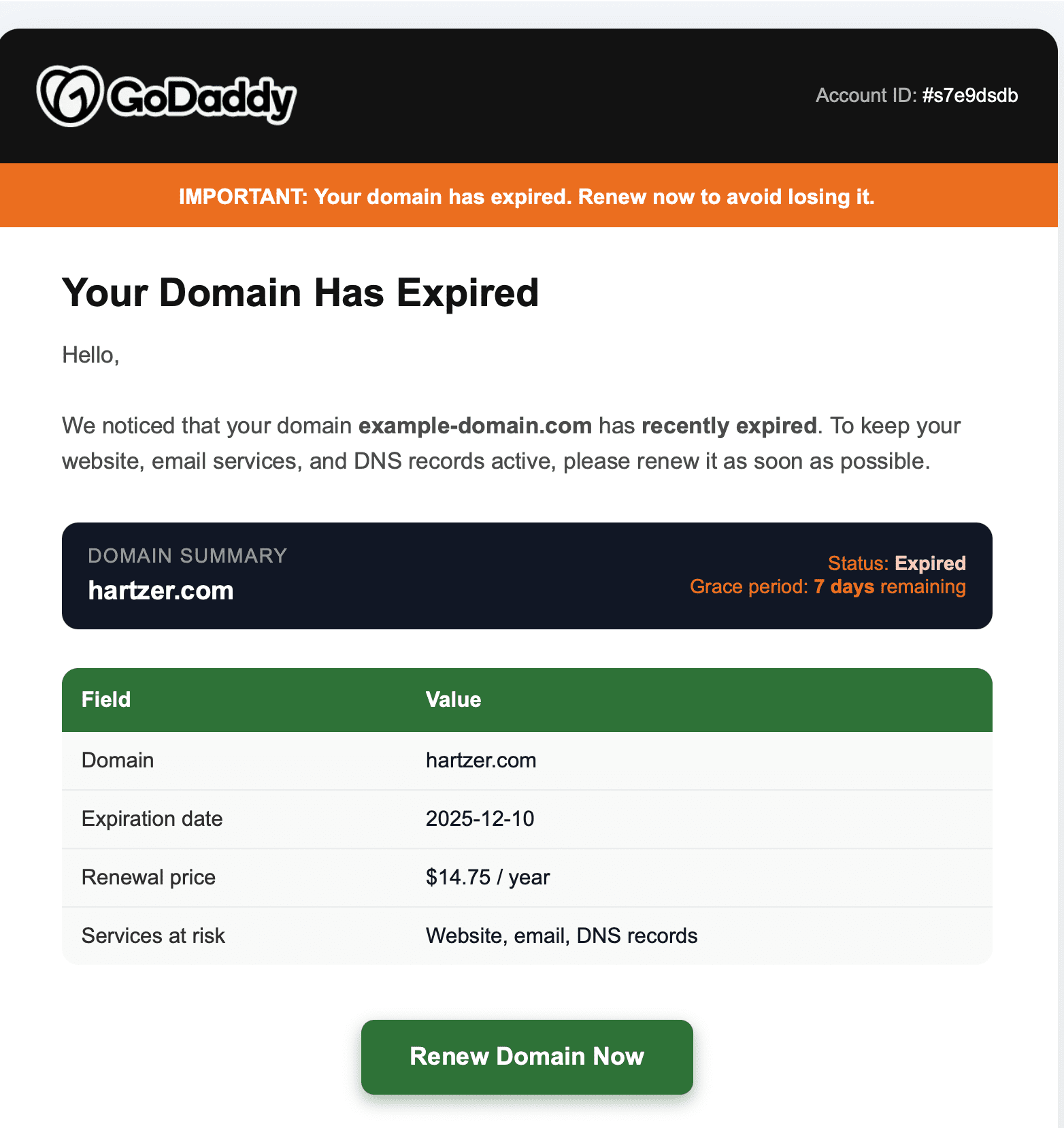
godaddy phishing fake domain expiration

Another wave of phishing emails is circulating, and this time the attackers are impersonating GoDaddy with surprisingly convincing “expiration notices.” These messages look urgent, credible, and time-sensitive, yet a closer look reveals several red flags that make it clear these are not legitimate renewal reminders.

Consumers, domain investors, and business owners should be especially cautious. These scams are built to harvest GoDaddy login credentials, payment information, and ultimately, access to your domain portfolio.

Here is a breakdown of the clues that expose this message as a scam.

Jump To

Toggle
  • The email references the wrong domain name
  • The renewal price is fake
  • The link does not point to GoDaddy
  • The sender email address is wrong
  • What the scam is trying to do
  • How to protect yourself
  • Related Posts

The email references the wrong domain name

One of the easiest giveaways is the message body itself. The email claims:

“We noticed that your domain example-domain.com has recently expired.”

But the domain name listed further down in the email is completely different. GoDaddy’s systems do not mix up domain names like that. A mismatch like this is a classic sign of a poorly pulled-together phishing template.

The renewal price is fake

The email claims the renewal cost is $14.75, a price GoDaddy has never used for domain name renewals. GoDaddy’s pricing varies by TLD, but it has not included an oddly specific amount like $14.75.

Scammers often guess or use low prices to entice quick action. If the price does not match what your registrar normally charges, assume the email is suspicious.
godaddy expiration link in email - renew domain now

The link does not point to GoDaddy

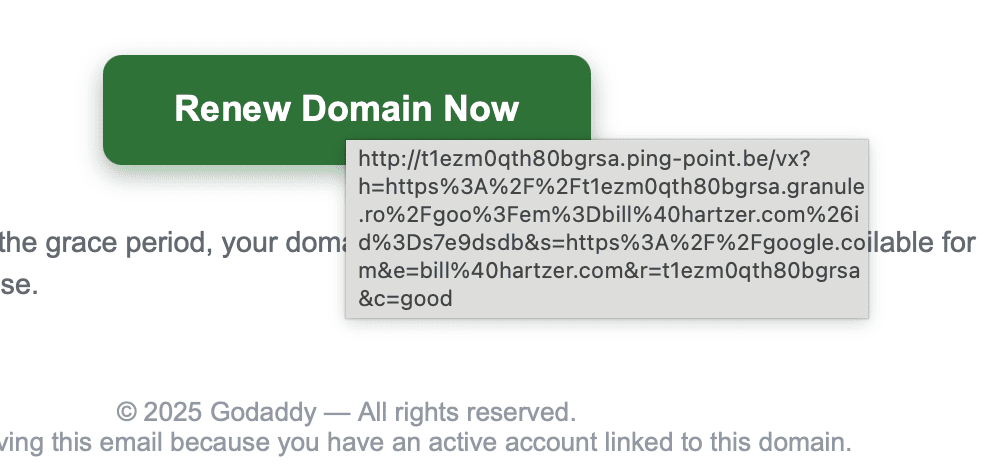
Another big giveaway: mousing over the “Renew Domain Now” button shows a link to:

ping-point.be

This is unrelated to GoDaddy. Official GoDaddy renewal links will always be on godaddy.com or a GoDaddy-owned subdomain. Anything else is an immediate red flag.

The sender email address is wrong

Phishing emails often use domains that look legitimate at first glance but fall apart upon inspection. In this case, the sender is:

[email protected]

Apart from the misspelling (“noreplay” instead of “noreply”), GoDaddy does not send renewal notices from random .xyz domains. A registrar of GoDaddy’s size sends from authenticated, brand-aligned domains with valid SPF, DKIM, and DMARC records.

What the scam is trying to do

I did not click the link, and no one should. But it is safe to assume what comes next.

Typically, these attacks lead to a fake GoDaddy login page designed to steal information such as:

  • Your GoDaddy username and password
  • Your credit card information
  • Payment method details stored in your account
  • Access to every domain name you own

Once scammers gain access, they can transfer out your domains, lock you out of your account, make unauthorized charges, or sell your domain names on the black market. For domain investors, this can be catastrophic. For businesses, it can take your website offline and disrupt email or critical services tied to DNS.

How to protect yourself

There are a few simple habits that dramatically reduce your risk:

  • Never click on renewal links in unsolicited emails.
  • Always confirm renewal status by logging directly into GoDaddy.com, not through an email link.
  • Check the sender’s domain carefully.
  • Verify that the domain names listed in the message actually match what you own.
  • Use GoDaddy’s two-factor authentication (2FA) to reduce account takeover risk.

Phishing attempts like these are becoming more frequent, more aggressive, and more convincing. Being alert, paying attention to the details, and educating others is the best way to stop scammers from succeeding.

Related Posts

  • Another Fake GoDaddy ‘24 Hours Left’ Email Is Making the Rounds
  • Don’t Fall for the Fake ICANN Verification Email Circulating Right Now
  • Beware of ‘Recovery Scams’ – Fraudsters Prey on Past Victims, Say CAFC and CIRO
  • Shoppers Can’t Spot Fake Stores. Retailers Have to Stop Them First
  • XYZ Applied for the .SEO Domain. The Price Will Decide Who Uses It

Filed Under: Domain Names

About Bill Hartzer

Bill Hartzer is the CEO of Hartzer Consulting and founder of DNAccess, a domain name protection and recovery service. A recognized authority in digital marketing and domain name strategy, Bill is frequently called upon as an Expert Witness in internet-related legal cases. He's been sharing his insights, expertise, and research here on BillHartzer.com for over two decades.

Bill Hartzer on Search, Marketing, Tech, and Domains.

Hartzer Domains

DFWSEM logo


Brand Ambassador for:

Majestic logo

Oncrawl logo

Semrush logo

Industry Friends

  • David Daniels
  • WTFSEO
  • SEO By the Sea
  • Jeff Lenney
  • Jeff Gabriel
  • Scott Hendison
  • Dixon Jones
  • Brian Hartzer
  • Navah Hopkins
  • DNAccess
  • Hartzer on IT.com
  • Jason Olson

Connect With Bill Hartzer

  • Bill Hartzer on X
  • Bill Hartzer on BlueSky
  • Bill Hartzer on Instagram
  • Hartzer Consulting on Facebook
  • Bill Hartzer on Facebook
  • Bill Hartzer on YouTube

Recent Posts

  • Shoppers Can’t Spot Fake Stores. Retailers Have to Stop Them First
  • I Rebuilt Bruce Clay’s Search Engine Chart. Bing Feeds 11 Engines.
  • XYZ Applied for the .SEO Domain. The Price Will Decide Who Uses It
  • Goodfirms Says Organic Traffic Grew for 66.3%. Nobody Checked.
  • adMarketplace Says AI Chat Ad Conversions Rose 156%. From What?
  • ICANN Opens Comments on 1,606 New gTLDs. A Comment Is Not an Objection
  • LinkedIn Leads at 5.8%, but Vista Social’s Own Data Says Don’t Compare
  • The FBI Just Put SEO in a Ransomware Alert. Site Owners Should Listen
  • My GA4 Showed 215,440 Sessions. About 680 Were Real People.
  • MyStation Says Creators Can Own a TV Network. Read the Fine Print.

Bill Hartzer

News and analysis on search, marketing, tech and domain names since 2001.

Hartzer Consulting

Topics

  • Google Search Updates
  • AI Search
  • Google Ads and PPC
  • Google Business Profile and Local Search
  • Domain Security and Recovery
  • ICANN and New gTLDs
  • GoDaddy
  • Online Reputation Management

Site

  • About Bill Hartzer
  • Contact
  • Services
  • Advertise
  • All Topics

Legal

  • Disclaimer
  • Privacy Policy
  • Terms of Use
  • Entity Map

Copyright 2026 by Bill Hartzer and Hartzer Consulting, LLC.

Website, Content, and Marketing by Hartzer Consulting, LLC.