Expired domain names have a reputation. Some SEOs treat them like a head start. Others treat them like a trap. A recent month-long test produced a clean takeaway: indexing speed is less about “authority” and more about whether Google can discover the domain name again after it drops.
This test focused on expired domain names that fully completed the drop process. These were not auction wins. These were not pre-release names. These were domains that completely expired, were released, and became available for registration again. After registration, a unique landing page was published on each domain, and the only job was to wait and observe what Google did.
The Crawl and Index Split
The results landed in two buckets.
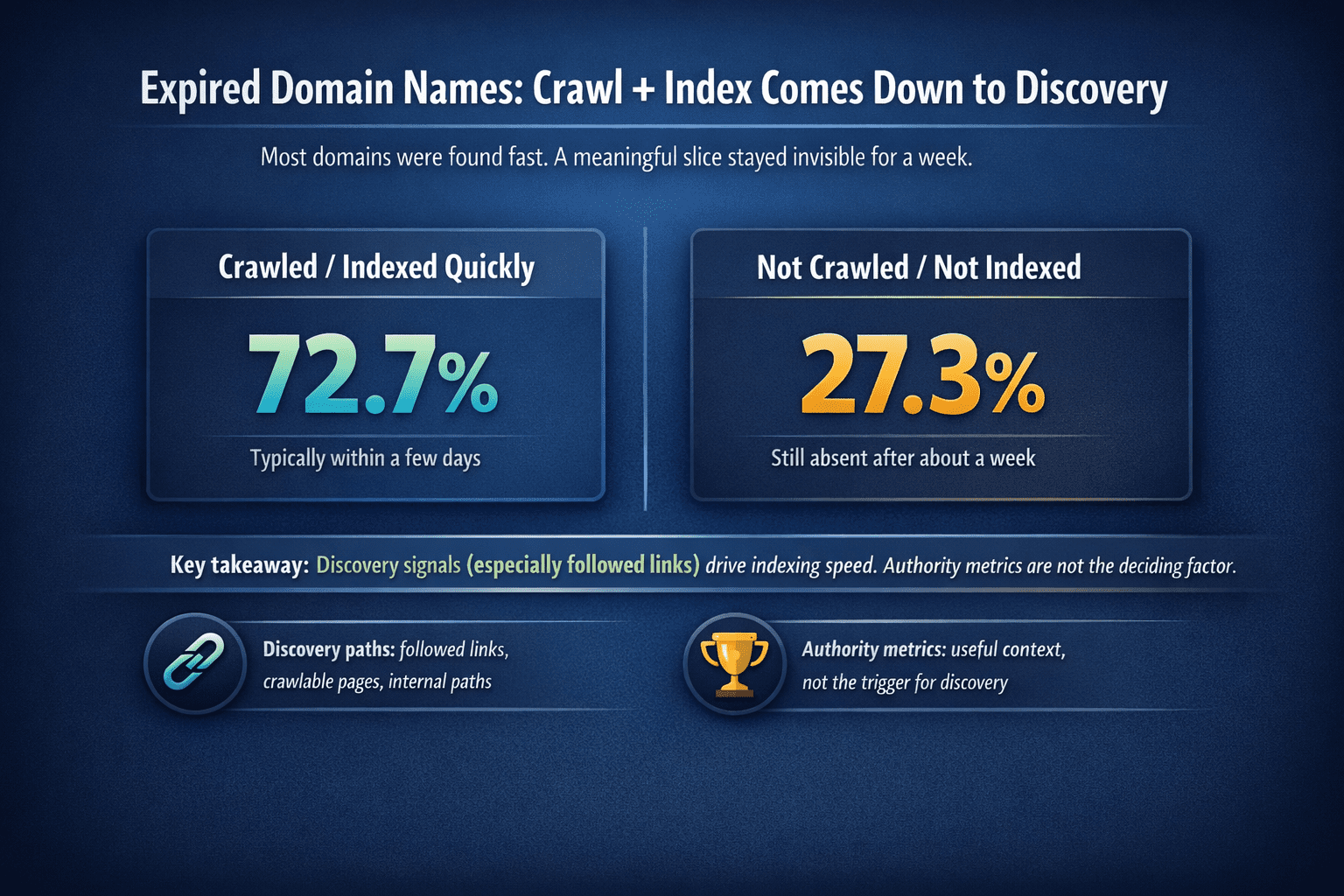
72.7 percent were crawled and indexed quickly, usually within a few days. The other 27.3 percent were not crawled or indexed after about a week.
That split matters because it shows something practical: if you register expired domain names and expect Google to “notice” them automatically, you will be wrong a meaningful percentage of the time. The question becomes: what separates the fast from the slow?
Discovery Signals Explain Most of the Difference
All of the domains that were crawled and indexed quickly showed clear external discovery signals. These are the signals Google has historically used to find new URLs and new sites, often before any deeper quality evaluation happens.
Of the domain names that were quickly crawled and indexed, several patterns showed up consistently:
- Higher referring domain counts
- More diverse referring IPs and subnets
- A higher average number of follow referring domains
This matters because Google’s discovery layer is still link-driven. Even weak links can be useful at the discovery stage. A link does not have to be “great” to be a breadcrumb that leads Google to a domain name that has re-entered the ecosystem.
The Biggest Signal Difference: Followed Referring Domains
The clearest separation between the two groups was the average volume of followed links.
Crawled/indexed group (average): RefDomains 36.0
Not crawled/indexed group (average): RefDomains 27.7
Crawled/indexed group (average): Followed referring domains 22.8
Not crawled/indexed group (average): Followed referring domains 15.3
On average, the indexed group had about 48 percent more followed referring domains. That gap is large enough to explain faster discovery by itself.
Why Followed Links Matter for Discovery
Google primarily discovers new URLs through a few predictable paths:
- Followed links
- Crawled pages that link outward
- Internal crawl paths from already-known domains
If an expired domain name has fewer followed links, or those links live on pages Google rarely crawls, then discovery slows down. That can delay crawling. It can delay indexing. And if you are waiting for “proof” the domain is viable, you can waste time assuming something is wrong when it is simply undiscovered.
The Counter-Intuitive Part: Authority Was Not the Driver
This is where the results get interesting. The domains that were not indexed were not “weak.” In many cases, they showed equal or higher third-party authority metrics.
- Higher average Majestic Citation Flow
- Similar or higher Majestic Trust Flow
- More indexed URLs inside backlink tools
So why weren’t they indexed quickly?
Because discovery does not equal evaluation. Google has to find the URLs first. That happens earlier in the pipeline than quality scoring. A domain can look strong in tools and still stall if Google does not run into it through a clean discovery path.
Link Placement and Crawl Paths Matter More Than Protocol
Additional link patterns reinforced the discovery explanation.
The indexed group tended to show:
- More links classified as direct
- More links from pages that appear to be crawled frequently
- More text links, and fewer image-only links
The non-indexed group tended to show:
- Fewer followed links overall
- More links that appear deep, orphaned, or less frequently crawled
- More HTTPS protocol references, but fewer discovery-useful links
A reminder worth stating plainly: HTTPS does not help discovery. Crawl paths do. Security is table stakes. It does not create the link graph Google needs in order to locate your site quickly.
What This Means for Expired Domain Names
The takeaway is straightforward.
Expired domain names that get crawled and indexed quickly tend to have:
- More referring domains
- Significantly more followed referring domains
- Better link-based discovery paths
- More crawl-friendly link placement
Expired domain names that lag are not automatically “bad.” They are usually not lower quality. They are not necessarily penalized. They are simply harder for Google to discover quickly.
Practical Tips for Evaluating Expired Domain Names Before You Register
If you are evaluating expired domain names for a project, the right approach is to treat them like an asset acquisition. You are not buying a label. You are buying history, links, and the possibility of faster discovery. That means you want a repeatable checklist that minimizes risk.
Tip 1: Confirm It Is Truly a Generic Domain Name
Start with the obvious. The domain name should be generic and descriptive, not brand-based. Avoid anything that includes trademarks, former company names, product names, or confusing variations of a known brand. Even if the domain is available, that does not make it safe or smart.
If the domain name fails this test, stop. Move on.
Tip 2: Look for Real Discovery Signals, Not Just “Authority”
Authority metrics can be useful as supporting data, but they do not guarantee crawl or indexing speed. Instead, look for signals that suggest Google can discover the domain name efficiently:
- Followed referring domains (not just total referring domains)
- Diversity of referring IPs and subnets
- Links that appear likely to be on pages that get crawled often
- Text links placed in content, not buried in images or footers nobody crawls
The best expired domain names are not always the ones with the flashiest metric. Often, the best ones are the ones with clean, obvious crawl entry points.
Tip 3: Audit the Link Profile for Risk, Not Just Volume
More links can help discovery. Bad links can create problems. Before registering, scan for obvious issues:
- Spam-heavy anchor text patterns
- Foreign-language link clusters that do not match the domain’s intended use
- Sudden spikes and drops that suggest manipulation
- Sitewide footer links from low-quality networks
If the link profile looks like it was used for churn-and-burn tactics, assume you will inherit baggage. It might still index. It might still rank. But you are buying uncertainty.
Tip 4: Check Historical Use and Topic Alignment
An expired domain name can carry topical signals. If the domain spent years hosting content in a completely different category, you should expect a slower reset. Topic alignment is not a strict requirement, but it can influence how quickly Google “trusts” what the domain is now about.
At minimum, make sure the historical use is not a red flag. If it was used for malware, doorway pages, scraped content, or obvious spam, you are not buying a shortcut. You are buying cleanup work.
Tip 5: Decide Based on Your Intended Use Case
Not every expired domain name is worth building on. Sometimes the right move is a small project, not a full commitment. Ask one simple question: what is the smallest use case that still proves value?
- If you want faster indexing for a new local site, discovery signals matter most.
- If you want long-term rankings, link quality, topic alignment, and content strategy matter more.
- If you want to redirect, you need relevance and a clean link history, not just numbers.
Expired domain names are a tool. They are not a strategy.
Major Points and Takeaways
| Topic | What the data suggests | Why it matters | Practical takeaway |
|---|---|---|---|
| Indexing outcome | 72.7% crawled/indexed quickly; 27.3% not indexed after about a week | Expired domains do not behave uniformly after the drop | Plan for a meaningful portion to stall without additional discovery signals |
| Discovery signals | Fast-indexing domains show stronger external discovery signals | Google must find a site before it can evaluate it | Prioritize domains that are easy to discover, not just “strong” in tools |
| Followed referring domains | Indexed group has ~48% more followed referring domains on average | Followed links are a primary discovery path for new URLs | When comparing drops, weight followed RDs heavily |
| Referring domain volume | Indexed group shows higher average referring domain counts | More entry points typically means faster discovery | All else equal, the domain with more legitimate RDs is usually found faster |
| Authority metrics | Non-indexed group can show equal or higher authority metrics | Discovery does not equal evaluation | Do not assume “strong metrics” guarantees fast crawling/indexing |
| Link placement & crawl frequency | Indexed group has more direct links and more links on frequently crawled pages | Links on rarely crawled pages delay discovery | Prefer domains with links likely to sit on actively crawled pages |
| Text links vs. image-only links | Indexed group shows higher ratios of text links | Text links tend to be clearer crawl signals | Favor domains with editorial, in-content text links |
| HTTPS | HTTPS does not improve discovery; it is table stakes | Protocol does not create crawl paths | Do not treat HTTPS as a discovery lever |
| Best practice conclusion | Even good-looking expired domains can stall | Tool metrics can’t replace real-world observation | Always test: publish a landing page (or a few pages) and wait before committing |
Always Test Before You Commit
Here’s the conclusion I keep coming back to: do not guess.
No matter how good an expired domain name looks in a tool, I recommend that you always test it. Put up a landing page, or publish a few real pages. Make them unique. Link them internally like a real site. Then wait and watch what happens.
If the domain gets crawled and indexed quickly, you just learned something valuable. If it does not, you also learned something valuable, and you learned it before you sunk time, money, and effort into a full build.
Expired domain names can be useful assets, but they should be treated like assets you verify, not assets you assume. And in every case, make sure the domain name is generic, clean, and free of trademark risk before you even start the test.