• About
    • History of Dallas SEO
  • Contact
  • Topics
    • Domain Security and Recovery
    • GoDaddy
    • ICANN and New gTLDs
    • AI Search
    • Google Search Updates
    • Google Ads and PPC
    • Google Business Profile and Local Search
    • Online Reputation Management
    • Bing
    • Blogging
    • Branding
    • Domain Names
    • Google
    • Internet Marketing
    • Link Building
    • Local Search
    • Marketing
    • Public Relations
    • Reputation Management
    • Search Engine Marketing
    • Search Engine Optimization
    • Search Engines
    • Social Media
  • Tech
  • Advertise
  • Services
    • Search Engine Optimization
    • Ongoing SEO Services
    • SEO Expert Witness
    • Google Penalty Recovery
    • Mini SEO Audit
    • Link Audit
    • Keyword Research
    • Combine Websites SEO Services
    • PPC Management
    • Online Reputation Management
    • Domain Name Consultant
    • Domain Names & Expired Domains
    • Domain Name Appraisal

Bill Hartzer

19 YearsSince 2007

Home » Google » Google Beats Patent Lawsuit as Court Slams ‘Abstract’ Image Tech Claims

Google Beats Patent Lawsuit as Court Slams ‘Abstract’ Image Tech Claims

Posted on May 6, 2025 Written by Bill Hartzer

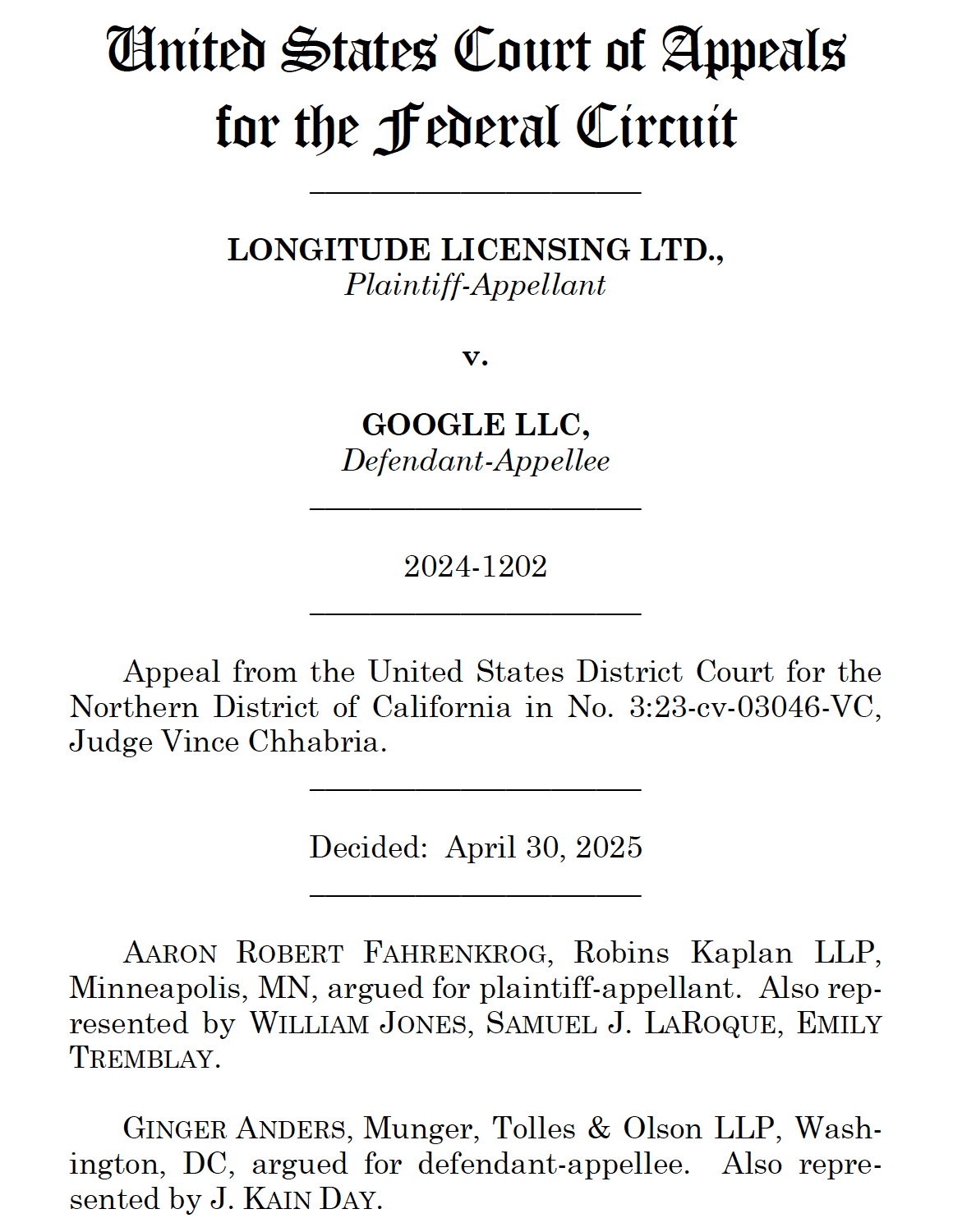
United States Court of Appeals for the Federal Circuit ______________________ LONGITUDE LICENSING LTD., Plaintiff-Appellant v. GOOGLE LLC, Defendant-Appellee ______________________ 2024-1202 ______________________ Appeal from the United States District Court for the Northern District of California in No. 3:23-cv-03046-VC, Judge Vince Chhabria.


Jump To

Toggle
  • Google Scores Win as Federal Circuit Nixes Digital Imaging Patent Claims
    • Longitude’s lawsuit over image correction software fails under Section 101
    • The Court’s Take: Too Much Talk, Not Enough Tech
    • Why the Court Didn’t Buy the “Innovation” Argument
      • Examples from the Ruling
    • What This Means for Future Patent Claims
  • All Claims Down, Appeal Denied
    • Related Posts

Google Scores Win as Federal Circuit Nixes Digital Imaging Patent Claims

Longitude’s lawsuit over image correction software fails under Section 101

Google walked away with a clean victory last week after the Federal Circuit upheld the dismissal of a patent infringement suit brought by Longitude Licensing Ltd. The ruling, handed down April 30, 2025, reinforces the courts’ continued skepticism toward patent claims that lean on abstract ideas without providing concrete technical details.

Longitude accused Google of violating four of its patents related to digital image correction. These patents centered around identifying a photo’s “main object” — for example, a person’s face — and applying automated corrections such as color balance, brightness, or sharpness just to that portion of the image. While the claims described steps such as “acquiring correction conditions” and “adjusting picture quality,” the court found that these were vague concepts implemented through generic computer functions.

The Court’s Take: Too Much Talk, Not Enough Tech

Judge Timothy Dyk, writing for the panel, agreed with the lower court’s assessment that the patents simply recited a process of adjusting image quality using computers. The court emphasized that while the concept might sound useful, the way it was described lacked substance.

In short, it was all about what the patent was trying to do, not how it actually did it.

The decision compared Longitude’s claims to others the Federal Circuit has rejected in past cases. For example, in Hawk Technology Systems, the court found similar abstract data processing language — like “determining,” “acquiring,” and “adjusting” — to be too broad. Here, Longitude’s patents suffered the same fate.

Why the Court Didn’t Buy the “Innovation” Argument

Longitude’s lawyers tried to argue that their image correction process was a technological improvement over past methods, especially since earlier techniques often adjusted the entire photo without isolating the main subject.

But the judges didn’t see it that way. They pointed out that humans have long been able to make those distinctions using photo editing software. Putting that same idea into a computer doesn’t automatically make it worthy of a patent. Just using “new data” or applying an existing concept in a software setting doesn’t cut it.

Examples from the Ruling

Claim 32 of one patent described a method where a computer identifies the subject of an image, figures out its visual characteristics, retrieves correction settings based on those traits, and then adjusts the image. But it never spelled out how that process is technically achieved — just that it happens.

Another claim focused on breaking an image into segments and using pixel positions to find the subject, yet still failed to explain any real implementation steps. Again, too much function, too little form.

What This Means for Future Patent Claims

This case follows a growing line of decisions applying the Supreme Court’s Alice framework, which blocks patents that are built on abstract ideas unless they show a specific inventive concept. Here, the Federal Circuit found no such concept in any of the 66 claims asserted.

Even when Longitude tried to argue that the use of correction parameters like shadows, brightness, or sharpness counted as an “inventive concept,” the court remained unmoved. Those are standard photo editing features, not innovations.

All Claims Down, Appeal Denied

Longitude appealed after the district court tossed the case last October. That ruling had found the patents “functional and ends-oriented,” a criticism the appellate court echoed. Ultimately, the judges said the claims failed both parts of the Alice test: they were directed at an abstract idea, and they didn’t offer anything inventive beyond that.

The Federal Circuit didn’t need to review every one of the 66 claims in detail. They found all of them shared the same shortcomings — a reliance on generic data processing and a lack of explanation for how the results were actually produced.

Patent holders hoping to challenge tech giants should take note: courts are cracking down on patents that dress up familiar processes in high-tech language. As this case shows, if your claim reads like a set of vague instructions that could apply to any software, don’t expect the courts to be sympathetic.

The decision is another reminder that it’s not enough to describe what a program does. You have to show how it works — and do it with precision.

Related Posts

  • Court Dismisses PA Advisors, LLC v. Google and Yahoo Patent Case
  • Damages Expert’s Blunder Forces New Trial in Google vs. EcoFactor Thermostat Battle
  • Google Wins Zuili vs. Google, LLC Appeal Related to Click Fraud Patents
  • Hackers Hijack Google Results: Bybit Exposes AI-Powered macOS Malware Targeting Claude Code Searches
  • Brandpoint: 60% of Google Searches End Without Clicks

Filed Under: Google

About Bill Hartzer

Bill Hartzer is the CEO of Hartzer Consulting and founder of DNAccess, a domain name protection and recovery service. A recognized authority in digital marketing and domain name strategy, Bill is frequently called upon as an Expert Witness in internet-related legal cases. He's been sharing his insights, expertise, and research here on BillHartzer.com for over two decades.

Bill Hartzer on Search, Marketing, Tech, and Domains.

Hartzer Domains

DFWSEM logo


Brand Ambassador for:

Majestic logo

Oncrawl logo

Semrush logo

Industry Friends

  • David Daniels
  • WTFSEO
  • SEO By the Sea
  • Jeff Lenney
  • Jeff Gabriel
  • Scott Hendison
  • Dixon Jones
  • Brian Hartzer
  • Navah Hopkins
  • DNAccess
  • Hartzer on IT.com
  • Jason Olson

Connect With Bill Hartzer

  • Bill Hartzer on X
  • Bill Hartzer on BlueSky
  • Bill Hartzer on Instagram
  • Hartzer Consulting on Facebook
  • Bill Hartzer on Facebook
  • Bill Hartzer on YouTube

Recent Posts

  • 1.2 Million Brand Posts Say Stop Opening Videos With a Question
  • Shoppers Can’t Spot Fake Stores. Retailers Have to Stop Them First
  • I Rebuilt Bruce Clay’s Search Engine Chart. Bing Feeds 11 Engines.
  • XYZ Applied for the .SEO Domain. The Price Will Decide Who Uses It
  • Goodfirms Says Organic Traffic Grew for 66.3%. Nobody Checked.
  • adMarketplace Says AI Chat Ad Conversions Rose 156%. From What?
  • ICANN Opens Comments on 1,606 New gTLDs. A Comment Is Not an Objection
  • LinkedIn Leads at 5.8%, but Vista Social’s Own Data Says Don’t Compare
  • The FBI Just Put SEO in a Ransomware Alert. Site Owners Should Listen
  • My GA4 Showed 215,440 Sessions. About 680 Were Real People.

Bill Hartzer

News and analysis on search, marketing, tech and domain names since 2001.

Hartzer Consulting

Topics

  • Google Search Updates
  • AI Search
  • Google Ads and PPC
  • Google Business Profile and Local Search
  • Domain Security and Recovery
  • ICANN and New gTLDs
  • GoDaddy
  • Online Reputation Management

Site

  • About Bill Hartzer
  • Contact
  • Services
  • Advertise
  • All Topics

Legal

  • Disclaimer
  • Privacy Policy
  • Terms of Use
  • Entity Map

Copyright 2026 by Bill Hartzer and Hartzer Consulting, LLC.

Website, Content, and Marketing by Hartzer Consulting, LLC.