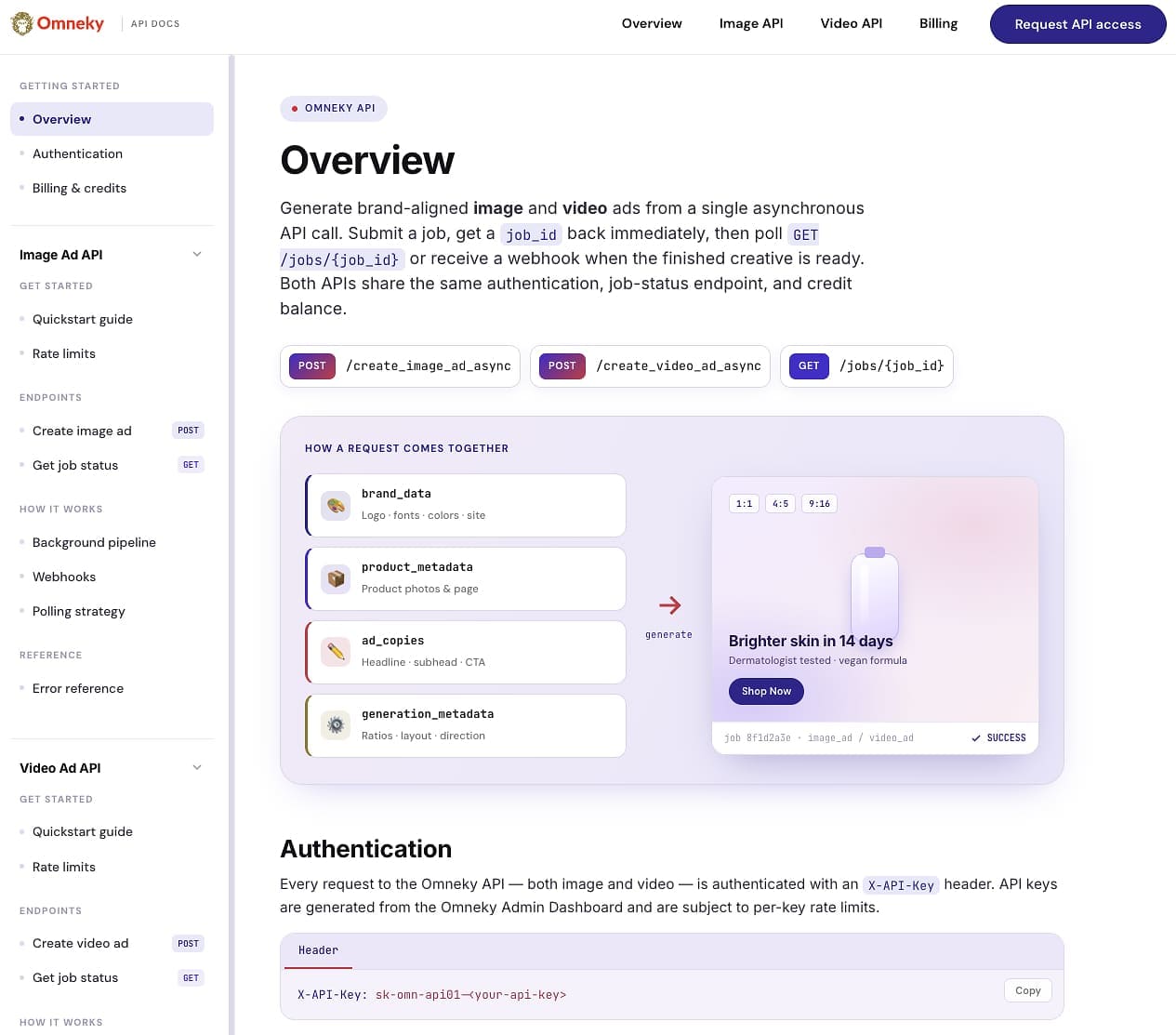
Omneky made a notable move on July 10, 2026. The San Francisco company opened its ad creative engine to the public. Two products shipped on the same day: the Omneky API and an MCP server. Both give outside developers, commerce platforms, and AI agents access to creative generation that used to sit behind Omneky’s own dashboard.
The pitch is short. You feed Omneky what you know about a brand. It hands back finished ads, ready to launch. No design team. No back-and-forth. That is a bold claim, so let’s break down what actually happens.
One URL In, Finished Ads Out
The API (Application Programming Interface, the connection that lets two pieces of software talk to each other) is built around a plain contract. Send Omneky a single web address. Its agent reads the brand’s positioning, its colors, and its fonts. Then it writes the headline. It writes the CTA (Call to Action, the button or line that tells a viewer what to do next). It composes the product into ads that match the brand.
The Sizes You Get Back
Those ads come back in every major aspect ratio. Square 1:1 for feeds. Portrait 4:5 for mobile scrolling. Tall 9:16 for stories and reels. Wide 16:9 for video placements. One link goes in. A full set of sized creative comes out.
What the Pipeline Runs
Omneky calls this a self-service creative pipeline, and the parts are worth naming. There is zero prompting. You do not write a clever request to coax the model. The system produces multi-variant output, meaning several distinct versions rather than the same ad with a swapped word. That includes UGC-style creative (User-Generated Content, the casual, made-by-a-real-person look) and short-form video.
Fighting Ad Fatigue on Its Own
Here is the part I find most interesting. The system regenerates ads by itself. It watches performance data and creative scores, then builds fresh versions before the old ones wear out. Ad fatigue is real. Audiences stop reacting once they see the same ad too many times. An engine that swaps in new creative on a schedule fights that problem at the root.
The MCP Server Speaks Straight to AI Agents
The second product is the MCP server. MCP stands for Model Context Protocol, a shared language that lets AI agents call outside tools. Claude speaks it. So do a growing list of assistants.
Picture a founder at a laptop. She types one line to her assistant: “make launch ads for our new product page.” The agent calls Omneky in the background. It returns finished, multi-format creative. No dashboard. No design software. No prompt engineering. The ad work happens inside the same chat where the request started.
“The API makes our creative engine a primitive that any platform can build on,” said Hikari Senju, Founder and CEO of Omneky. “The MCP server makes it native to AI agents themselves.”
That word “primitive” carries weight. In software, a primitive is a basic building block that others assemble into bigger things. Omneky is betting that companies will stitch its creative engine into products of their own.
Who Omneky Built This For
Three groups sit in the crosshairs. Commerce platforms can embed white-label creative generation for thousands of brands at once. Agencies can wire Omneky into their production pipelines. AI agent developers can bolt advertising onto any assistant they ship.
Each group shares one goal: ad creation that scales without a designer touching every file. The documentation went live the same day at omneky.com/api-docs, so developers can start reading today.
A Short Background on Omneky
Omneky started in 2018 in San Francisco. It bills itself as an autonomous AI advertising platform. In plain terms, it generates ad creative, launches campaigns, optimizes them, and buys the ad space. It runs across Meta, Google, LinkedIn, TikTok, and Reddit.
The numbers give the launch some heft. Omneky serves more than 6,000 customers. Its partner list includes NVIDIA, AWS, Meta, and SoftBank. The company holds SOC 2 Type II certification, a security audit standard that enterprise buyers tend to ask about early.
My Take
I have watched plenty of ad tools promise hands-off creative. Most stumble on brand accuracy. The single-URL approach lives or dies on how well the agent reads a brand from its own website. Colors and fonts are easy to scrape. Tone and positioning are the hard part. That is the spot to test first.
The MCP piece is the one I would not skip past. Wiring ad creation into agents like Claude changes where the work starts. It moves ad production out of a design tool and into plain conversation. For small teams with no designer on staff, that shift saves real hours. For agencies, it raises a fair question about which tasks stay billable.
A word of caution sits under all of this. Automated regeneration is only as good as the data feeding it. Thin numbers early in a campaign can send the engine chasing noise. Watch the first week of any new account before you trust the auto-swaps.
Omneky opened a door on July 10, 2026, and the shape of it is clear. An API for developers who want ads as a building block. An MCP server for AI agents that want to make ads by conversation. Both point at the same future, one where finished creative starts with a link or a sentence instead of a design brief. Whether the output holds up brand by brand is the test that counts, and that test will play out in real campaigns over the coming months. For now, the tools are live, the docs are public, and the rest of the ad business has something new to measure against.