Choosing an AI (Artificial Intelligence) model in 2026 is no longer a matter of picking the single “best” product and using it for everything. The market has matured into a set of specialized tools, and the model that dominates software engineering is rarely the same model that leads professional writing, real-time research, or frontier mathematics. The practical challenge is no longer whether to use AI, but which model to route each task to.
This guide is built around that principle. Rather than crowning one winner, it identifies the leading model for each major category of work, then addresses the everyday questions that ordinary users actually type into these tools. The recommendations reflect the competitive landscape as of July 2026, a point worth emphasizing: model versions, benchmark scores, and pricing shift on a monthly basis, so the specific version numbers below should be treated as a starting point rather than a permanent standard.
Most Important Habit: Routing
The most important habit to develop in 2026 is routing: sending each task to the model that actually leads that category, instead of forcing a single model to handle every job. No model wins every category. Anthropic’s Claude models lead complex and agentic coding as well as professional writing. Google’s Gemini models lead research, reasoning, and long-context work, largely because of native search grounding (the ability to pull live results directly from Google Search). OpenAI’s GPT models lead factual business writing and frontier mathematics. xAI’s Grok leads real-time and social-trend queries. A growing tier of open-weight models — models whose parameters are published for anyone to download and self-host — now covers cost-sensitive, high-volume, and privacy-sensitive work.
The sections that follow break this down into top picks by task type, a reference table for common everyday questions, and practical guidance on putting a routing approach into practice.
Top Picks by Task Type
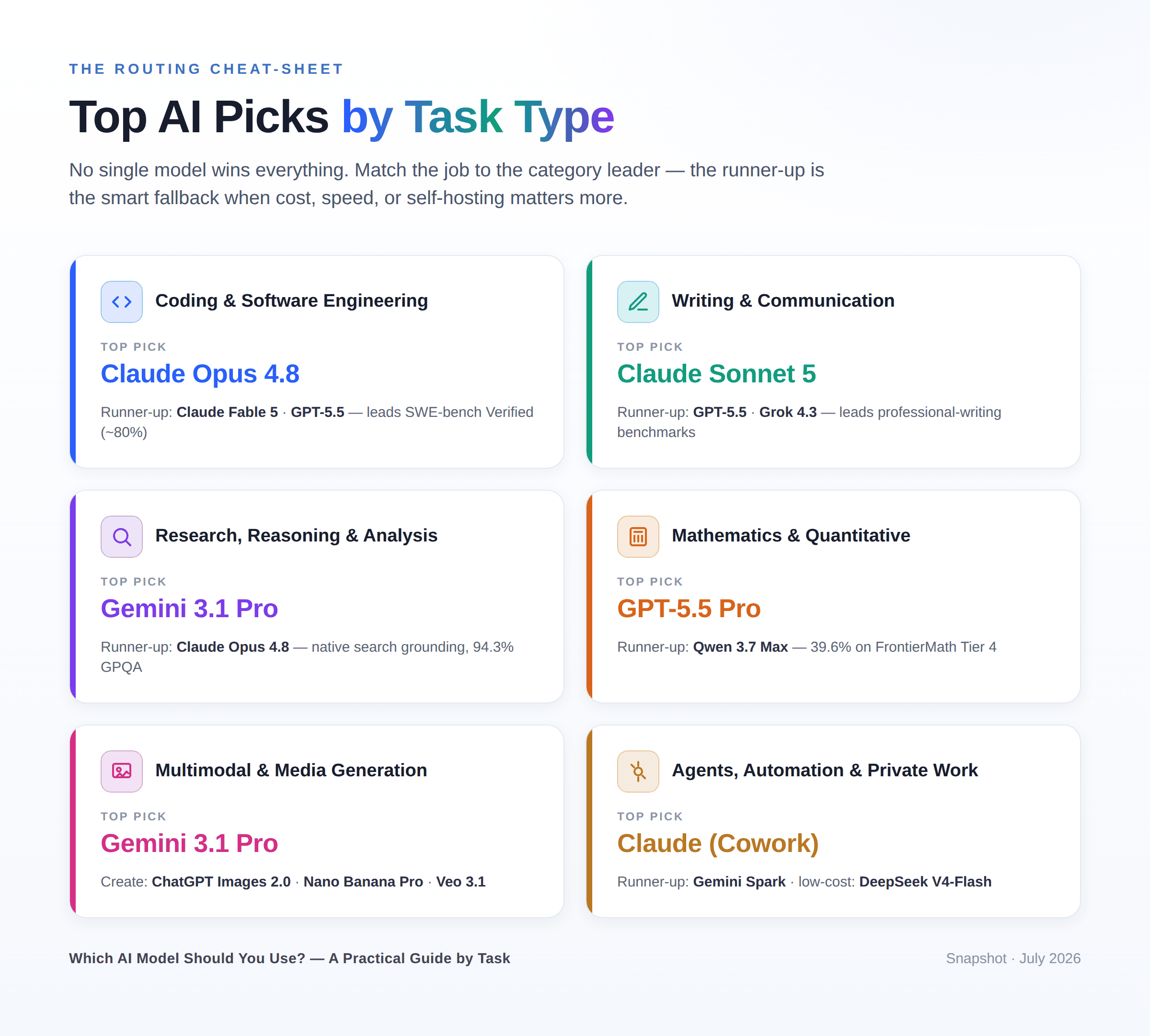
The following recommendations identify the leading model for each major category of work, along with a strong runner-up. The runner-up is typically the better choice when cost, speed, or the need for a self-hosted option outweighs raw capability.
Coding and Software Engineering
Top pick: Claude Opus 4.8. For complex software engineering, multi-file debugging, and bug-fixing, Claude Opus 4.8 leads the field, scoring in the ~80% range on SWE-bench Verified (a standardized benchmark that measures a model’s ability to resolve real-world software issues). Its “adaptive thinking” allocates more reasoning to harder problems, which matters most on tangled, multi-step defects.
For long-horizon, autonomous coding — where an AI agent works independently for extended periods — Claude Fable 5 is the stronger choice, pairing a top SWE-Bench Pro score with a 1M-token context window (the amount of text a model can consider at once). For everyday scripts and refactors, Claude Sonnet 5 offers the best balance of speed and cost, while Gemini 3.5 Flash and open-weight models such as Nex-N2-Pro serve high-volume and self-hosted needs respectively.
| Task | Primary pick | Runner-up | Why |
|---|---|---|---|
| Complex software engineering / bug-fixing | Claude Opus 4.8 | Claude Fable 5, GPT-5.5 | Leads SWE-bench Verified (~80%); adaptive “thinking” for hard multi-file debugging |
| Long-horizon / autonomous agentic coding | Claude Fable 5 | GLM-5.2, Gemini 3.5 Flash | 80.3% SWE-Bench Pro with 1M context; built for multi-hour agent runs |
| Everyday coding, quick scripts, refactors | Claude Sonnet 5 | GPT-5.5, Gemini 3.1 Pro | Fast, strong instruction-following, good price/performance for daily work |
| High-volume / budget coding | Gemini 3.5 Flash | DeepSeek V4-Pro, Qwen 3.7 Max | $1.50/$9 per 1M tokens, 1M context — comparable results at roughly half the cost |
| Self-hosted / open-weight coding | Nex-N2-Pro | Kimi K2.7 Code, LongCat-2.0 | Strongest open coding score (80.8 SWE-Bench Verified), Apache 2.0 license |
Writing and Communication
Top pick: Claude Sonnet 5. For long-form, professional prose — reports, white papers, and client-facing documents — Claude Sonnet 5 leads professional-writing benchmarks and produces the most consistent tone and nuance.
The runner-up depends on the writing task. GPT-5.5 is the stronger choice for creative writing and marketing copy, and for factual business writing where accuracy is paramount, as it produces roughly 52% fewer hallucinated claims (confidently stated but false information) than its predecessor. Grok 4.3 adds personality and topical edge when current events and a distinctive voice matter.
| Task | Primary pick | Runner-up | Why |
|---|---|---|---|
| Long-form & professional prose (reports, white papers) | Claude Sonnet 5 | Claude Opus 4.8 | Leads professional-writing benchmarks; best tone consistency and nuance |
| Creative writing & marketing copy | GPT-5.5 | Grok 4.3, Claude Sonnet 5 | Strong voice and ideation for ad copy, scripts, and branded content |
| Factual business writing / email drafting | GPT-5.5 | Claude Sonnet 5 | ~52% fewer hallucinated claims vs. prior version; reliable for client-facing text |
| Personality / topical, current-events tone | Grok 4.3 | GPT-5.5 | Native X integration and looser guardrails when timeliness and edge matter |
Research, Reasoning, and Analysis
Top pick: Gemini 3.1 Pro. For deep research and synthesis across many sources, Gemini 3.1 Pro leads, thanks to native Google Search grounding, a 1M+ token context window, and strong synthesis of large volumes of material. It also leads graduate-level reasoning, scoring 94.3% on GPQA Diamond (a benchmark of expert-level science questions).
For structured, methodical analysis, Claude Opus 4.8 is the strongest runner-up and currently holds the top position on the Intelligence Index. For fast-moving news and social trends, Grok 4.3 stands out because of its live integration with X.
| Task | Primary pick | Runner-up | Why |
|---|---|---|---|
| Deep research & synthesis | Gemini 3.1 Pro | Claude Opus 4.8 | Native Google Search grounding, 1M+ context, strong multi-source synthesis |
| Complex reasoning (graduate-level) | Gemini 3.1 Pro | Claude Opus 4.8, GPT-5.5 | 94.3% GPQA Diamond, 44.4% Humanity’s Last Exam — top of the reasoning cluster |
| Structured analysis / expert-style breakdowns | Claude Opus 4.8 | Gemini 3.1 Pro | #1 Intelligence Index (61); methodical, well-organized long analyses |
| Real-time / social & news trends | Grok 4.3 | Gemini 3.1 Pro | Live X data and real-time context for fast-moving topics |
Mathematics and Quantitative Work
Top pick: GPT-5.5 Pro. For hard mathematics and physics, including frontier problems, GPT-5.5 Pro leads, scoring 39.6% on FrontierMath Tier 4 (the most difficult, previously unseen category of problems). For competition-style mathematics such as AIME and HMMT contests, Qwen 3.7 Max delivers elite performance at value pricing, and for everyday quantitative reasoning, standard GPT-5.5 is more than sufficient.
| Task | Primary pick | Runner-up | Why |
|---|---|---|---|
| Hard math & physics (frontier problems) | GPT-5.5 Pro | Gemini 3.1 Pro | 39.6% on FrontierMath Tier 4; strongest on the hardest unseen problems |
| Competition / contest math | Qwen 3.7 Max | GPT-5.5 Pro | 97.1 on HMMT Feb 2026 at value pricing; excels at AIME/HMMT-style problems |
| Everyday quantitative reasoning | GPT-5.5 | Gemini 3.1 Pro | Frequently near 100% on AIME-style math for practical use |
Multimodal and Media Generation
Top pick: Gemini 3.1 Pro for understanding. When the task involves reasoning over images, charts, and PDF (Portable Document Format) documents, Gemini 3.1 Pro offers the strongest native multimodal capability — the ability to process text, images, and other formats together.
For creating media, the leaders differ by output: ChatGPT Images 2.0 produces the most legible text and multilingual scripts inside generated images; Nano Banana Pro leads photorealistic portraits and product shots; and Google Veo 3.1 leads AI video generation with 1080p output and native audio.
| Task | Primary pick | Runner-up | Why |
|---|---|---|---|
| Very large documents / whole-codebase context | Gemini 3.1 Pro | Claude Fable 5, Qwen 3.7 Max | 1M+ token context with strong recall across the window |
| Image / document understanding (vision) | Gemini 3.1 Pro | GPT-5.5, Claude Opus 4.8 | Strong native multimodal reasoning over images, charts, and PDFs |
| Image generation — text & multilingual scripts | ChatGPT Images 2.0 | Reve 2.0 | Best at legible text inside images; included with ChatGPT Plus |
| Image generation — photorealism | Nano Banana Pro | Reve 2.0 | Top for photorealistic portraits and product shots (~$0.13/image) |
| Video generation | Google Veo 3.1 | Runway Gen-4, Kling 3.5 | 1080p with native audio and strong physics; Kling for cheap fast iteration |
Agents, Automation, and Low-Cost or Private Work
Top pick: Claude (Cowork) for desktop automation. For automating documents, files, and multi-step workflows directly from a desktop application, Claude’s Cowork mode leads. For always-on, cloud-resident agents that run scheduled jobs 24/7, Gemini Spark is the alternative.
When cost is the primary constraint, DeepSeek V4-Flash is the cheapest 1M-context model available, and for privacy-sensitive, on-premises deployment, open-weight models such as GLM-5.2 give organizations full control over their own infrastructure.
| Task | Primary pick | Runner-up | Why |
|---|---|---|---|
| Desktop / file & task automation | Claude (Cowork) | Gemini Spark | Automates documents, files, and multi-step workflows from the desktop app |
| 24/7 cloud-resident agent workflows | Gemini Spark | Claude (Cowork) | First always-on cloud agent for scheduled, long-running jobs |
| Lowest-cost high-volume tasks | DeepSeek V4-Flash | MiniMax M3, Gemini 3.5 Flash | Cheapest 1M-context open model ($0.14/$0.28); MIT license |
| On-prem / privacy-sensitive self-hosting | GLM-5.2 | NVIDIA Nemotron 3 Ultra, MiniMax M3 | Open weights (MIT), 1M context, strong agentic coding you fully control |
Everyday Questions and the Right Model
The categories above address professional and technical work. Most people, however, use AI for ordinary questions — researching a product, checking a fact, or asking for advice. The table below maps common question types to the model best suited to answer them, along with important cautions where they apply.
| Question type | Recommended model | Why | Important note |
|---|---|---|---|
| Researching a vendor, company, or product | Gemini 3.1 Pro | Native Google Search grounding pulls current, verifiable information | Verify pricing and availability on the vendor’s own site |
| Local businesses and “near me” queries | Gemini 3.1 Pro | Real-time search integration returns current listings | Confirm hours and details directly with the business |
| Breaking news and current events | Grok 4.3 | Live integration with X surfaces developing stories fastest | Cross-check major claims against established news outlets |
| Fact-checking a specific claim | Gemini 3.1 Pro | Search grounding lets it cite live sources | Follow the cited source rather than trusting the summary alone |
| Product comparisons and shopping research | Gemini 3.1 Pro | Aggregates specifications and reviews with current data | Prices change constantly; confirm before purchasing |
| Medical or health questions | GPT-5.5 or Gemini 3.1 Pro | Lower hallucination rates and current medical references | AI is not a substitute for a licensed physician; consult a professional for diagnosis or treatment |
| Legal questions | Claude Opus 4.8 | Strong structured analysis of complex, conditional rules | AI is not a lawyer; consult a licensed attorney before acting |
| Financial and investment questions | GPT-5.5 or Gemini 3.1 Pro | Factual accuracy and access to current data | AI is not a financial advisor; it should inform, not decide, investment choices |
| Travel planning and itineraries | Gemini 3.1 Pro | Search grounding provides current options and logistics | Confirm bookings and travel requirements independently |
| Study help and explaining concepts | Gemini 3.1 Pro or Claude Sonnet 5 | Clear, patient explanations with strong reasoning | Verify facts for graded or high-stakes work |
| Summarizing long documents | Claude Fable 5 or Gemini 3.1 Pro | Large context windows handle full documents at once | Spot-check the summary against the source for critical material |
| Creative brainstorming and ideas | GPT-5.5 or Grok 4.3 | Strong, varied idea generation and distinctive voice | Treat output as raw material to refine, not a finished product |
| Personal advice and everyday conversation | Claude Sonnet 5 | Consistent, measured tone and thoughtful responses | For emotional distress or crises, seek qualified human support |
Two cautions deserve emphasis. First, on medical, legal, and financial questions, AI models can provide useful background information, but they are not licensed professionals, and their answers should inform your questions to a qualified expert rather than replace that expert. Second, on any question where the answer could have changed recently — prices, availability, current officeholders, or breaking events — a model with live search grounding is not merely preferable but necessary, because a model relying only on its training data cannot know what has changed since it was trained.
Putting This Into Practice
The single most valuable takeaway is that there is no universal “best” AI model, and treating one product as the answer to every question leaves significant capability on the table. The organizations and individuals getting the most from AI in 2026 are those who match the tool to the task: complex code to Claude, research and grounding to Gemini, frontier mathematics to GPT, real-time context to Grok, and high-volume or private workloads to open-weight models.
That said, routing has a practical cost. Maintaining accounts across four or five providers, learning each interface, and remembering which model leads which category is more overhead than many users want. A reasonable middle path is to choose one strong general-purpose model as a default, then deliberately reach for a specialist when a task clearly falls into one of the categories above — heavy coding, deep research, hard math, or media generation. Over time, that habit becomes second nature, and the quality difference on specialized work is substantial enough to justify the effort.
Finally, remember that this landscape is genuinely fluid. Version numbers and benchmark scores cited here reflect July 2026, and several models — including next-generation releases from OpenAI, Google, and xAI — remain in limited or beta availability. Before standardizing any workflow around a particular model, it is worth taking a few minutes to confirm that the recommendation still holds. The principle of routing by task will remain sound; the specific names in each category will not.