Someone is using your face to sell weight loss pills. Someone else pasted your likeness into a political ad you’d never endorse. A third person built an entire social media channel around AI-generated versions of you — and none of them asked permission. If that sounds far-fetched, it’s not. It’s happening right now to creators, influencers, and public figures at a pace that’s hard to overstate.
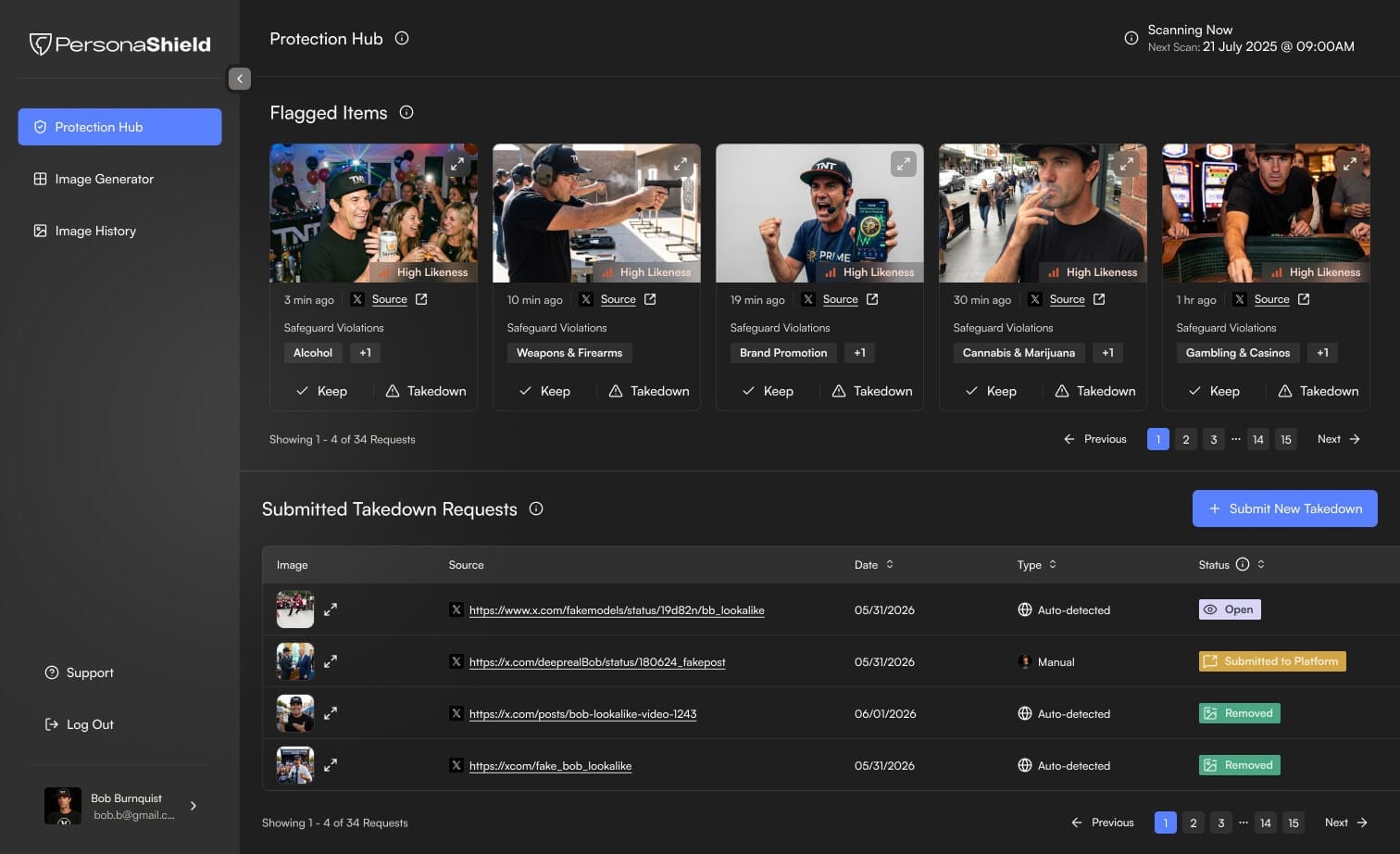
PersonaShield, a new platform founded by former Apple executive Phillip Shoemaker, launched on June 26, 2026, with a direct answer to this problem. The platform scans for unauthorized uses of a creator’s likeness, flags violations, streamlines takedown requests, and — here’s the part that makes it more than a policing tool — lets creators monetize authorized uses of their image. It’s protection and participation in one system.
The Deepfake Problem Is Growing Faster Than Most People Realize
The numbers around deepfakes have gotten genuinely alarming. According to data from Resemble AI, verified deepfake incidents hit 2,031 per quarter in 2025 — a 317% increase from earlier that year. Pindrop’s analysis puts the growth at 1,300% overall. An estimated 8 million deepfake files are projected by the end of 2026, representing a 1,500% increase since 2023.
For context: the average American encounters roughly 2.6 deepfakes per day. Young adults between 18 and 24 see about 3.5 daily. And 68% of deepfakes are nearly impossible to distinguish from authentic media. The human detection rate? People correctly identify deepfakes only 0.1% of the time across all media types, according to research from iProov. That’s not a typo. Zero point one percent.
Creators and Celebrities Are Prime Targets
The creator economy has a particular problem. Resemble AI’s Q3 2025 data shows that 48% of deepfake incidents involve celebrity likenesses. McAfee found that 72% of Americans have seen fake celebrity endorsements online. The breakdown of what those fake endorsements promote tells its own story: 31% are giveaway scams, 30% are cryptocurrency schemes, and 25% push weight loss products.
And it’s not just A-list celebrities. Independent creators, mid-tier influencers, and niche content producers are increasingly targeted. Their faces show up in ads they never agreed to. Their voices get cloned for robocalls. Their likenesses get dropped into political content or adult material without consent. The reputational damage can be severe and the financial harm is real — both from the scams themselves and from the lost trust with their audience.
Women are disproportionately affected. Data from Resemble shows women are targeted 4.5 times more frequently than men, accounting for 34.6% of incidents compared to 7.7%. That disparity reflects broader patterns in how generative AI tools are being misused online.
What PersonaShield Actually Does
PersonaShield positions itself as what the company calls a “permission layer for likeness” — a system that sits between AI generation tools, social media platforms, and the creators whose faces are being used. That’s an ambitious positioning, and it’s worth breaking down what it means in practice.
Step One: Define Your Rules
Creators upload their images to PersonaShield and set explicit guidelines for how those images can and cannot be used. Think of it as a terms of service for your face. A creator might say: “My image can be used in fan art that’s non-commercial. It cannot be used in political content, product endorsements, or adult material. Licensed commercial use is available for a fee.” Those rules become machine-readable — meaning automated systems can reference them, not just human reviewers.
Step Two: Monitor and Enforce
The platform scans for unauthorized uses of the creator’s likeness across the web. When it finds a violation, it flags it and gives the creator options: request a takedown, allow it to stand, or convert it to a licensed use. The takedown process is handled by PersonaShield, which reduces the burden on creators who would otherwise need to file individual DMCA (Digital Millennium Copyright Act) complaints or hire attorneys to send cease-and-desist letters.
For anyone who’s been through a manual takedown process, you know how painful it is. Each platform has its own reporting system. Response times vary from hours to weeks. Some platforms require notarized documents. Others have forms that loop you through automated responses without ever reaching a human reviewer. PersonaShield aims to centralize and simplify that process.
Step Three: Monetize Authorized Use
This is where PersonaShield diverges from pure enforcement tools. Fans and followers can log into the platform, find the creators they follow, and pay for authorized use of that creator’s image and likeness. The creator sets the terms. The platform handles the licensing. Revenue gets shared.
It’s a model that recognizes a practical reality: fans are going to create AI-generated content featuring their favorite creators whether there’s a sanctioned pathway or not. By offering a legitimate, licensed alternative, PersonaShield gives creators a way to participate in that activity rather than playing an endless game of whack-a-mole trying to suppress it.
Why “Likeness Governance” Matters as a Category
PersonaShield is framing what it does as “likeness governance,” and that framing is deliberate. The legal landscape around AI-generated likenesses is fragmented and still evolving. Here’s what makes it complicated.
The “right of publicity” is the legal concept that gives individuals control over the commercial use of their name, image, and likeness. In the United States, there is no single federal right of publicity law. Instead, it’s a patchwork of state laws. Some states have strong protections — California, New York, and Tennessee, for instance. Others have weak protections or none at all.
The federal government is working on it. The U.S. Senate has been considering legislation to protect name, image, likeness, and voice against unauthorized AI use. New York enacted two new laws in 2025 regulating AI-generated images. Multiple states have passed or are considering deepfake-specific legislation. But enforcement is slow, and the technology moves fast.
At the state level, deepfake laws are changing across the country. According to MultiState, dozens of states introduced AI-related bills in 2025 and 2026. Some focus on election-related deepfakes. Others target non-consensual intimate imagery. A smaller number address commercial exploitation of likeness through AI. The legal framework is catching up, but there’s a gap between what the law says and what’s actually happening online.
PersonaShield is betting that technology can fill that gap faster than legislation can. By creating a standardized system where creators register their likeness rules and platforms can reference those rules programmatically, the company is building private infrastructure for a problem that public institutions haven’t fully solved.
The Founder’s Background Adds Credibility
Phillip Shoemaker’s resume is relevant here because PersonaShield is, at its core, a platform governance problem. Shoemaker served as Senior Director of App Store Review at Apple, where he built and ran the global organization responsible for reviewing every app submitted to the App Store. If you’ve ever had an app approved — or rejected — by Apple, his team made that call.
That experience matters because the App Store review process is one of the most recognizable examples of centralized content governance on the internet. Apple reviews millions of submissions per year, enforces a consistent set of rules, and handles appeals and exceptions. It’s imperfect — developers have plenty of complaints — but it works at scale. Shoemaker understands what it takes to build and operate a policy enforcement system that processes a massive volume of decisions.
After Apple, Shoemaker founded Identity.org (originally Identity.com), a non-profit focused on digital identity rights and privacy. He’s also publishing a book titled Unbreakable: How to Secure Your Digital Life in a World Built to Breach You, with pre-orders open and an October 2026 release date. The through line across his career is digital identity — who controls it, who profits from it, and who gets harmed when that control breaks down.
The Fan Economy Angle Is Smart
Here’s my take on the most interesting part of PersonaShield’s model: the monetization piece. Most conversations about deepfakes and AI-generated content focus on enforcement — how to find it, how to take it down, how to prevent it from being created. That’s a losing game in the long run. The tools are too cheap, too easy, and too widely available. You can’t sue your way out of a problem that multiplies by the month.
What you can do is create a legitimate channel. If a fan wants to create a YouTube thumbnail featuring their favorite creator, or use a creator’s likeness in a piece of fan art they’re selling on Etsy, or include a creator’s image in a presentation — give them a way to do that legally, with the creator’s blessing, for a reasonable fee. The creator gets paid. The fan gets legitimacy. And the unauthorized versions become less attractive by comparison.
It’s the same logic that drove the shift from music piracy to streaming. You don’t beat Napster by suing every teenager who downloads an MP3. You beat it by building Spotify — a legal alternative that’s convenient enough that most people choose it voluntarily. PersonaShield is applying that same principle to likeness rights.
Of course, the comparison only holds if the platform can achieve meaningful adoption. A consent registry is only as useful as the number of creators who register and the number of platforms that reference it. PersonaShield is launching with a group of founding creators and presenting at VidCon on June 27, 2026, at the Anaheim Convention Center — a smart place to reach the creator audience that needs this most. But building a permission layer that the broader ecosystem actually respects is a longer-term challenge that will require platform partnerships, API integrations, and a critical mass of participating creators.
Where Social Platforms Stand Right Now
It’s worth noting that major platforms are starting to address deepfake detection on their own. YouTube rolled out its likeness detection tool globally in May 2026, allowing any adult to flag AI-generated content that uses their face. Meta has its own deepfake labeling and reporting systems. TikTok requires disclosure of AI-generated content.
But platform enforcement is inconsistent. Response times vary. Detection accuracy is imperfect. And each platform operates independently, meaning a creator whose likeness appears on five different platforms needs to file five separate complaints through five different systems. PersonaShield’s value proposition is centralizing that process and adding the monetization layer that no individual platform offers.
The deepfake problem isn’t going to get smaller. The tools are getting cheaper, the output is getting more convincing, and the volume is doubling monthly. For creators and public figures, the question isn’t whether their likeness will be used without permission — it’s how often and how badly. PersonaShield’s bet is that the answer lies in building infrastructure for consent rather than just infrastructure for enforcement. That’s a category shift, and it’s the right one. Whether PersonaShield can execute at the scale the problem demands is the open question. But the need for something like it is no longer debatable. Creators can sign up at personashield.com.