This New AI Social App Wants to Kill Language Barriers — And It’s Letting Strangers Talk Across the Globe
Social media has turned into an endless conveyor belt. Swipe. Scroll. Repeat. One more short video. One more recommendation. One more algorithm deciding what users should watch next.
RoamChat wants no part of that.
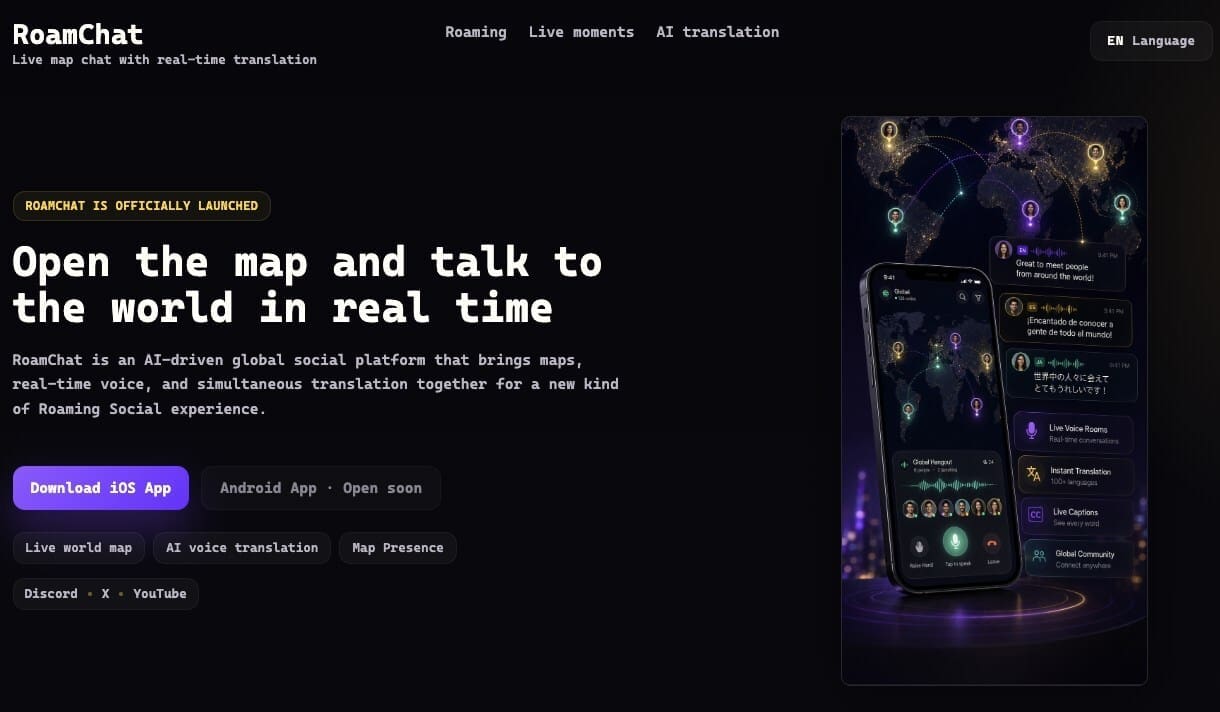
The new startup announced the launch of its AI-powered “Roaming Social” platform, a system built around live conversation instead of passive content consumption. The company combines global maps, real-time voice communication, and AI translation into a social experience that feels closer to walking through an international city square than sitting inside another social feed.
That difference matters.
Most major social platforms today are fighting over attention spans. RoamChat is trying to create actual conversations.
How RoamChat Works
The platform opens with a live global map. Each glowing point represents a real person currently online somewhere in the world.
Users can tap on a location and begin speaking instantly.
A football fan in Brazil can talk with someone in Singapore. A student in Japan can discuss music with people in South Korea. A traveler sitting in a hotel room in Paris can connect with locals across Asia without speaking a single word of the local language.
That last part is where the platform starts getting interesting.
Real-Time AI Translation Handles the Conversation
At the center of the system is RoamChat’s AI simultaneous translation engine.
The platform supports:
- Real-time voice translation
- Two-way interpretation
- Multilingual subtitles
- Cross-language voice communication
People speak naturally in their own language. The AI handles translation in the background.
That sounds simple on paper. It is not simple technically.
Real-time voice translation requires speech recognition, language processing, context interpretation, latency reduction, and speech output generation happening nearly at the same time. One awkward pause can kill a conversation. One mistranslated phrase can create confusion instantly.
Voice translation technology has existed for years. Most systems felt clunky. Conversations sounded robotic. Delays made interactions painful.
AI improvements over the last two years changed that equation.
Large language models and speech-processing systems now handle conversational context far better than earlier generations of translation tools. That progress is opening the door for products like RoamChat.
Social Media May Be Entering a Different Phase
RoamChat’s launch arrives during a larger shift happening across the social media industry.
Platforms spent the last decade optimizing feeds. Recommendation engines became the product. Engagement metrics became the scoreboard.
That formula produced massive audiences. It also produced fatigue.
Users increasingly complain that social platforms feel less social. Friends disappeared behind algorithms. Real conversations became rare. Comment sections turned into shouting matches or spam zones.
RoamChat is betting that people still want genuine interaction. They just need tools that remove friction.
The biggest friction point in global communication has always been language.
The company’s internal mission statement is straightforward:
“To allow any two people in the world to communicate freely, anytime.”
Simple mission statements often carry the biggest ambitions.
Why This Matters Beyond Social Networking
The implications stretch beyond casual conversation.
Remote work continues growing. Digital nomads now work from almost anywhere with Wi-Fi. International gaming communities are larger than ever. Online education crosses borders daily. Businesses hire globally. Friendships form inside Discord servers, multiplayer games, Reddit communities, and niche interest groups.
Language barriers still slow everything down.
Translation apps help. They also interrupt natural communication.
Anyone who has handed a phone back and forth during a translated conversation knows the experience feels awkward fast. It works, but it feels like trying to dance with two left feet.
RoamChat wants translation to disappear into the background entirely.
That shift changes user behavior.
People stop thinking about translation itself and start focusing on the conversation.
The Live Map Approach Changes User Psychology
One of the more interesting aspects of the platform is the live map interface.
Most social apps organize people into feeds, groups, hashtags, or follower networks.
RoamChat organizes people geographically.
That creates a different emotional response.
Users are no longer browsing content. They are exploring human presence.
The map creates curiosity. Someone online in Seoul. Someone online in São Paulo. Someone online in Berlin at three in the morning.
That curiosity becomes the engine.
There is also something refreshingly unpredictable about the format. Modern social media often feels heavily filtered and overly polished. RoamChat appears to embrace spontaneity instead.
That may become one of its biggest strengths.
AI Translation Is Reaching Consumer Scale
The timing also lines up with broader momentum in AI-powered communication tools.
Major technology companies continue investing heavily in multilingual AI systems. Translation quality has improved dramatically across voice and text interfaces.
Speech-to-speech translation once felt like science fiction. Now it is quietly entering consumer products.
That trend matters because infrastructure drives adoption.
Once translation latency drops low enough and accuracy improves enough, entirely new product categories become possible.
RoamChat appears to be positioning itself early in that shift.
There is risk, of course.
Social platforms live and die based on user adoption. Many promising communication apps never reach critical mass. Building technology is hard. Building active communities is harder.
Still, RoamChat’s concept hits a nerve at the right time. Users are burned out on repetitive feeds. AI translation technology is finally becoming practical. Cross-border communication keeps increasing.
Those pieces are lining up.
Whether RoamChat becomes the next major social platform remains to be seen. Yet the broader idea behind it feels significant. Social media may be shifting away from passive viewing and back toward live interaction. If AI can remove language barriers cleanly and naturally, global communication changes overnight. A teenager in Tokyo, a teacher in London, and a football fan in Rio suddenly occupy the same digital room without needing translators, subtitles, or language lessons. That is a very different internet than the one most users know today.