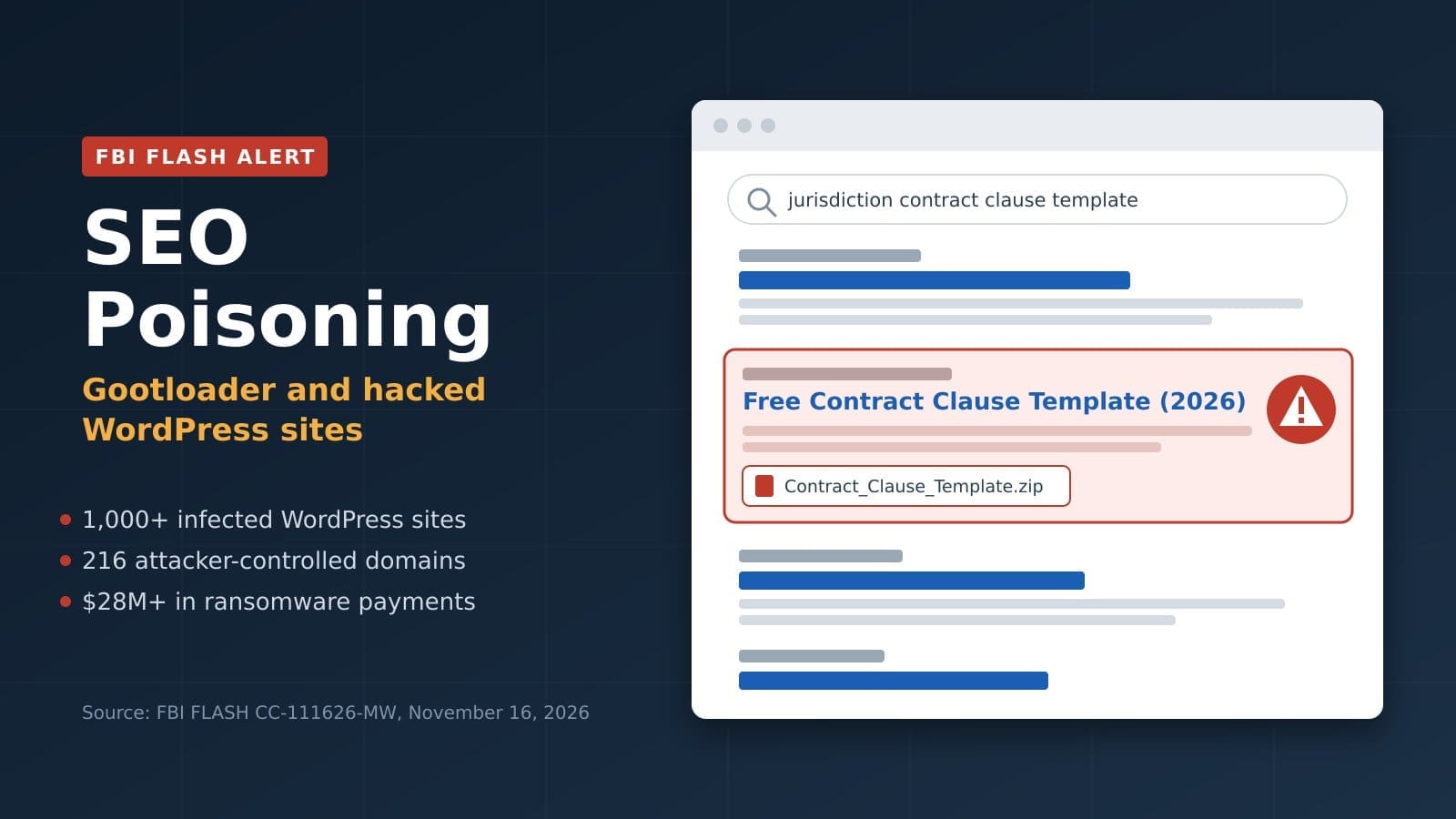
The FBI published a FLASH alert today that puts SEO (Search Engine Optimization) at the center of a ransomware operation. The alert says the Gootloader malware operation used SEO techniques and hacked WordPress sites to infect organizations, and that as of October 2026 the FBI had identified more than 1,000 infected WordPress sites, 216 domains run by the Gootloader administrator, and over $28 million in ransomware payments tied to it.
It is not often the FBI writes the letters SEO into a cyber alert. This one reads like a black-hat SEO playbook: low-competition keywords, hidden links, arranged backlinks and content served differently depending on who is asking. The alert, FLASH CC-111626-MW, was coordinated with DHS and CISA (the Cybersecurity and Infrastructure Security Agency) and is marked TLP: CLEAR, which means it can be shared freely.
If you run a WordPress site, the practical takeaway is simple. Your site can be a victim and the delivery truck at the same time. I clean up hacked WordPress sites for clients, and the owners are almost always the last to know, because the spam pages are built to stay invisible to them.
What the FBI Says Gootloader Did
Gootloader is what the FBI calls an initial access framework. It pairs a JavaScript malware loader with compromised websites and search rankings. Once a victim runs the file, attackers get a foothold that leads to ransomware.
Between 2020 and 2026, according to the alert, the operators picked search phrases with low competition, such as a contract clause specific to one jurisdiction. The FBI put the result plainly:
Using SEO, threat actor-controlled pages would appear next to legitimate resources.
The targets were lawyers. The FBI lists practicing attorneys, in-house counsel, law firm partners, litigation and privacy teams, legal operations staff, general counsel and legal technology buyers. The sample keyword list in the alert reads like a long-tail research spreadsheet: “When did Sports Betting Become Legal in Virginia,” “Which Parent Will Get the Child Tax Credit,” “Will Uk Abolish Inheritance Tax.”
Typos and all. That detail matters, because misspelled long-tail queries are exactly the ones nobody else is competing for.
I first wrote about this same operation in 2024, when Gootloader used SEO poisoning to target people searching whether Bengal cats are legal in Australia. The lure has changed. The method has not.
What SEO Poisoning Is
SEO poisoning, also called search engine poisoning, is the use of ranking tactics to push malicious pages into search results for queries real people type. The searcher sees what looks like a normal result on what is often a real, established website. They click, and they land on a page offering the document they wanted. The download is the malware.
The FBI’s description shows how the pieces fit together:
- Hacked sites supply the trust. The administrator scanned WordPress sites for xmlrpc.php, then used stolen credentials, vulnerable plugins and themes, injected posts and REST routes to get in.
- Hidden links supply the rankings. Hidden keyword links and arranged backlinks raised the visibility of the lure pages.
- A traffic filter supplies the cover. A TDS (traffic distribution system) filtered visitors by country, referrer, cookie or IP address.
That last point is cloaking, a tactic Google has penalized for two decades. The site owner logs in and sees nothing wrong. A researcher from the wrong country sees nothing wrong. A lawyer in the target market, arriving from a search result, gets the payload.
Attackers have used search engines this way for a long time. Back in 2011 I wrote that search engines were not doing enough to stop hackers who ran tens of thousands of automated queries to find vulnerable sites. Gootloader added the second half: once the site is hacked, rank it.
Why an FBI Alert About SEO Matters
Here is the line in the alert that SEO teams should print out. Among its WordPress protections, the FBI lists monitoring search abuse: review Search Console and other webmaster tools for unrelated legal or business queries, sudden indexed pages, manual actions and security warnings.
That is a federal law enforcement agency telling site owners that an SEO report is a security control.
I agree, and I have been saying a version of it for years. The person most likely to spot a Gootloader infection is not the IT department. It is whoever looks at the Performance report and asks why a plumbing company suddenly gets impressions for “Who Branch Implements Laws.” Most security teams never open Search Console. Most SEO teams never talk to security. Attackers live in that gap.
Gootloader is also not alone. The FBI’s own table of related WordPress campaigns lists SocGholish, where Operation Endgame cleaned 14,971 WordPress sites in June 2026, and DollyWay, which the alert ties to more than 20,000 sites since 2016.
How to Keep Your Site From Becoming the Lure
Start with the controls the FBI recommends for WordPress, in plain terms:
- Disable xmlrpc.php if nothing on your site uses it, or rate-limit it and restrict it to trusted integrations.
- Require strong MFA (multi-factor authentication) for every administrator and for hosting access.
- Remove unused plugins, themes, accounts and staging sites, and keep the rest updated.
- Block PHP execution in wp-content/uploads, where no PHP file belongs.
- Compare core files with official checksums and alert on changes to plugins, mu-plugins, JavaScript, .htaccess and index files.
- Store logs off the web server, so an attacker cannot erase the trail.
Then add the SEO checks. Search “site:yourdomain.com” along with terms that have nothing to do with your business. Watch Search Console for spikes in indexed pages and for queries you would never rank for. Run a backlink report and look for new links with off-topic anchor text. Crawl your site with a Googlebot user agent and with a normal browser, and compare what each one sees.
The access path matters as much as the cleanup. The FBI notes that related campaigns used domain shadowing through hijacked DNS accounts, so lock down your registrar and DNS logins too. My domain security coverage has more on that.
What Searchers Should Do
If you are the one searching, be suspicious of any result that hands you a ZIP file when you expected a document. The FBI’s guidance is specific. If you downloaded an archive but did not open it, do not extract it; record the URL, the search query and the file name, and send it to your security team. If you opened the JavaScript file inside, disconnect from the network, and change your passwords from a separate, known-clean device.
Organizations can go further by disabling Windows Script Host where business software does not need it, which cuts off the way Gootloader’s JavaScript runs.
The FBI asks anyone who suspects a Gootloader intrusion to report it to a local field office or to IC3.
For years, SEO poisoning was treated as a spam problem for Google to solve. The FBI has now attached a dollar figure to it, $28 million in ransom, and pointed site owners at Search Console as part of the defense. If you manage a WordPress site, check yours this week.