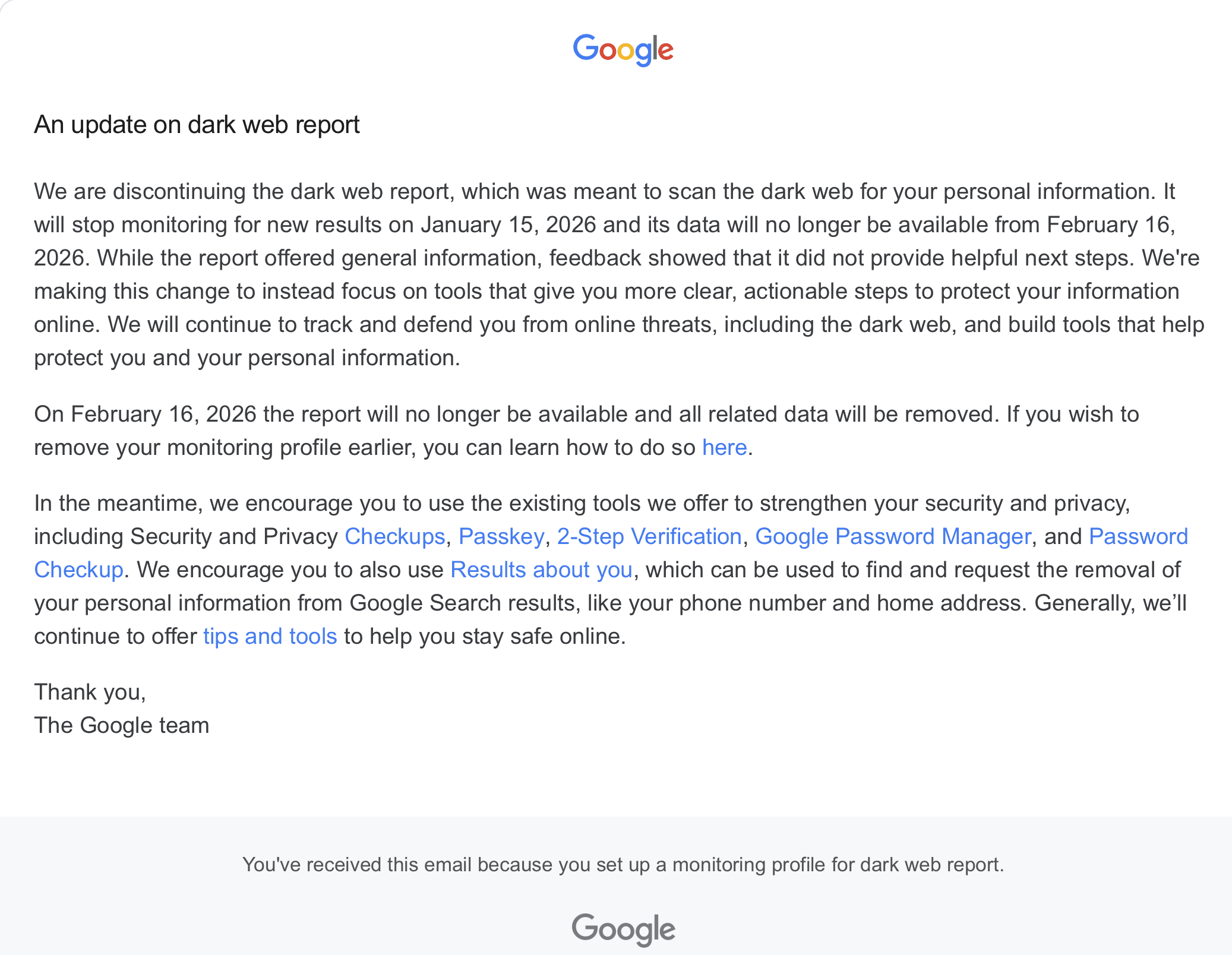
Google has notified users that it is discontinuing its Dark Web Report, a feature intended to scan portions of the dark web for exposed personal information. According to the email sent to users, the report will stop monitoring for new results on January 15, 2026, and all associated data will be permanently removed on February 16, 2026.
Google stated that while the report provided general awareness, user feedback showed it did not offer enough practical next steps. The company says it is shifting focus toward tools that provide clearer, more actionable guidance for protecting personal information online.
What Google’s Email Says About the Change
In its message, Google emphasized that it is not stepping away from online security. The company says it will continue tracking and defending users from online threats, including those connected to the dark web, while investing more heavily in security tools such as Security Checkup, Privacy Checkup, Passkeys, 2-Step Verification, Google Password Manager, and Password Checkup.
Google also highlighted its “Results about you” tool, which allows users to find and request removal of personal information, such as phone numbers and home addresses, from Google Search results.
After February 16, 2026, the Dark Web Report will no longer be accessible, and all monitoring data will be deleted. Users who want to remove their monitoring profile earlier can do so using the instructions provided by Google.
Why Google Is Really Shutting This Down
While Google’s explanation focuses on usability and next steps, the decision also reflects deeper limitations of dark web monitoring itself. The dark web is not a single searchable database. It is a fragmented collection of forums, marketplaces, private chats, invite-only communities, and temporary data dumps.
Most breached data circulates rapidly, is reposted repeatedly, and often disappears within days or weeks. Many high-value datasets are shared privately and never indexed or scanned. As a result, alerts frequently arrive long after credentials have already been exploited.
There are also legal and ethical constraints. Large technology companies cannot freely monitor criminal spaces at scale without running into jurisdictional, privacy, and compliance challenges. In practice, most “dark web monitoring” tools provide partial visibility and delayed awareness, not prevention.
Important Dates and What Users Should Do Before 2026
Until January 15, 2026, Google’s Dark Web Report will continue monitoring for new findings. After that date, monitoring stops entirely. On February 16, 2026, all historical data tied to the report will be removed.
Users who have previously received alerts may want to document or save any relevant information before access is removed. While Google does not position this as a data export event, retaining awareness of past exposure can help guide future security decisions.
What Dark Web Monitoring Can and Cannot Do
Dark web monitoring tools are often misunderstood. They do not remove leaked data from criminal marketplaces. They do not prevent breaches. They do not guarantee early detection.
At best, these tools provide confirmation that information has already been exposed. In many cases, identity theft, account takeovers, or fraud attempts occur months or even years after the original breach. Monitoring alone does not stop that chain of events.
Protection comes from what happens after exposure is discovered, not from the alert itself.
Alternatives to Google’s Dark Web Report
Google’s tool was never the only option. Several established services continue to provide breach detection and alerting, often with broader coverage and clearer remediation guidance.
Have I Been Pwned is one of the most widely trusted services for checking whether an email address or password appears in known data breaches. It is used by security professionals, integrated into password managers, and updated regularly as new breach data becomes available.
Credit bureaus and identity protection services also offer monitoring tied to financial and identity-related risks. Some paid services track underground forums and marketplaces more aggressively, though no service can see the entire dark web.
The key difference between tools is not detection, but how quickly and clearly they guide users toward meaningful action.
What to Do If Your Information Has Been Leaked
If you discover that your information has been exposed, the priority is damage control. Start by identifying which accounts may be affected and changing passwords immediately. Any password that has been reused elsewhere should be considered compromised.
Using a password manager is critical. It allows you to generate strong, unique passwords for every service without relying on memory. Password reuse remains one of the most common causes of large-scale account compromise.
Enable two-factor authentication wherever it is offered. App-based authenticators or hardware security keys provide significantly stronger protection than SMS-based codes.
If financial or identity data may be involved, credit monitoring and fraud alerts are advisable. These services can notify you of suspicious activity, new accounts, or unauthorized credit inquiries.
It is also wise to review account recovery settings, remove outdated accounts, and verify that backup email addresses and phone numbers are secure.
Why Business Owners and Domain Holders Should Pay Extra Attention
Business email addresses are frequent targets because they often unlock access to domains, hosting accounts, advertising platforms, and customer data. A single compromised inbox can lead to domain theft, DNS changes, or hijacked advertising accounts.
For businesses and domain owners, security should extend beyond passwords. Domain registrar locks, multi-factor authentication at the registrar level, and strict access controls are essential safeguards after any breach.
Exposure is not just a personal risk. It can quickly become a business continuity issue.
Frequently Asked Questions
Is Google still monitoring the dark web?
Google says it will continue defending users from online threats, but the Dark Web Report itself will no longer exist after February 2026.
Can Google remove leaked data from the dark web?
No. Once data is leaked, removal from criminal marketplaces is generally impossible.
Is Have I Been Pwned safe to use?
Yes. It is widely trusted within the security industry and does not expose your data when used properly.
Can dark web monitoring prevent identity theft?
No. Prevention comes from strong authentication, unique passwords, and ongoing account security.
A Shift Away From Awareness, Toward Responsibility
The shutdown of Google’s Dark Web Report underscores a broader reality. Awareness alone does not protect users. Action does.
Strong passwords, password managers, multi-factor authentication, account hygiene, and ongoing monitoring remain the most effective defenses. Tools may change, but the fundamentals do not.
Google’s report may be going away, but personal and business security remains an ongoing responsibility.