Creative Teams Are Breaking AI Rules at an Alarming Rate, New Survey Finds
Artificial intelligence has become part of the daily workflow for creative professionals. It writes copy. It generates images. It helps organize projects. It speeds up production.
There is just one problem.
Many employees are using AI tools their companies have not approved.
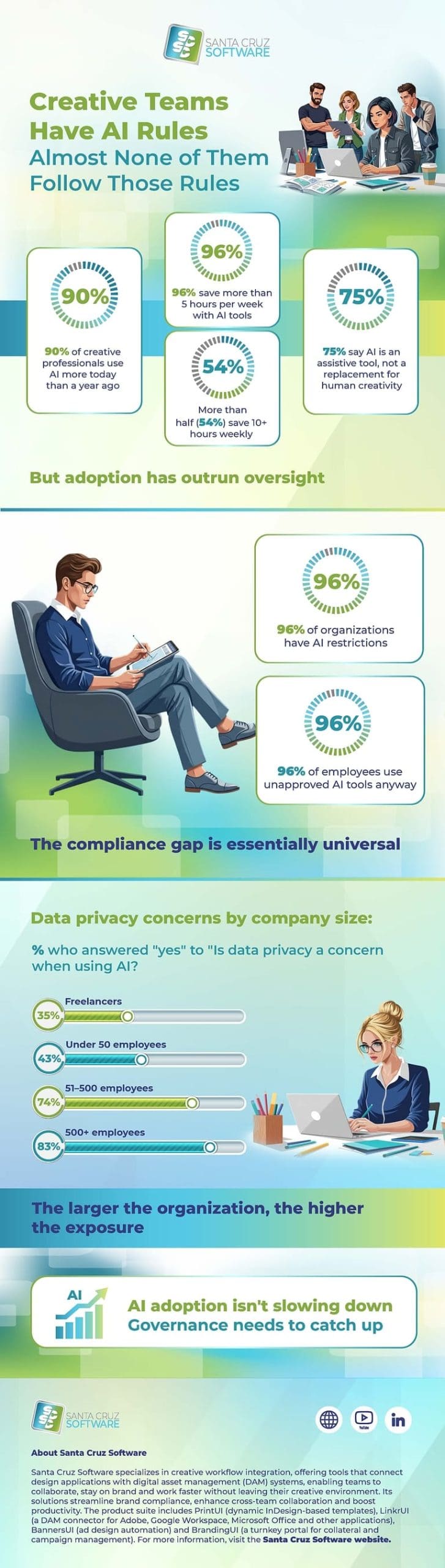
A new survey released by Santa Cruz Software highlights what may be one of the biggest workplace technology issues of 2026. According to the survey of more than 300 creative professionals, 96% of organizations have formal restrictions on AI usage. At the same time, 96% of employees admit they use unauthorized AI tools anyway.
That statistic jumps off the page.
It suggests that AI policies exist. Employees know the policies exist. Yet many workers continue using tools outside those guidelines.
The result is a widening gap between company governance and employee behavior.
The AI Policy Problem Is Growing Faster Than Many Companies Expected
For many organizations, the race to adopt AI has moved faster than internal policy development.
Leadership teams have spent the past two years creating AI usage rules. Legal departments have reviewed copyright concerns. Security teams have evaluated privacy risks. Compliance teams have drafted internal guidance.
Employees, meanwhile, have found tools that help them finish work faster.
That creates friction.
Many creative professionals view AI as another productivity tool. From their perspective, AI helps complete repetitive tasks, organize information, draft content, create visual concepts, and speed up production schedules.
Management often views the same tools through a different lens.
Questions arise about intellectual property rights. Questions arise about confidential information. Questions arise about what happens when company data enters a public AI platform.
The survey suggests those concerns are not slowing adoption.
In many offices, employees appear to be moving ahead regardless of company restrictions.
Large Companies Face Greater Exposure
The data shows concern levels rise significantly as organizations grow.
Among respondents working for companies with more than 500 employees, 83% cited data privacy as a concern. That figure drops to 74% at mid-sized organizations with 51 to 500 employees.
The number falls sharply among smaller businesses.
Only 43% of respondents at companies with fewer than 50 employees reported privacy concerns. Freelancers reported the lowest level at 35%.
The pattern makes sense.
A multinational corporation may have thousands of employees handling customer information, financial records, trade secrets, product plans, and proprietary content. A freelance designer has far fewer assets at risk.
More employees often means more systems. More systems often means more exposure. More exposure often means greater risk.
That reality helps explain why larger organizations appear more concerned about AI governance.
Copyright Concerns Continue to Follow AI Adoption
The survey found that 73% of respondents worry about copyright issues connected to AI-generated content.
That concern is difficult to ignore.
Copyright questions remain one of the most debated topics in artificial intelligence. Courts continue to examine cases involving training data, content ownership, and intellectual property rights.
Marketing agencies, advertising firms, publishers, media companies, and creative departments face difficult questions.
Who owns AI-generated content?
Can copyrighted works be used to train models?
Can businesses safely publish AI-generated assets without legal exposure?
Many of those questions remain unanswered.
That uncertainty creates hesitation inside large organizations. It also explains why legal teams continue paying close attention to AI deployment strategies.
Employees See AI as an Assistant, Not a Replacement
One finding stands out from the survey.
Most creative professionals are not looking at AI as a replacement for human creativity.
Seventy-five percent described AI as an assistive tool.
That distinction matters.
The public conversation around AI often focuses on job displacement. Creative teams appear to be viewing the technology differently.
Many professionals are using AI to handle repetitive production tasks. They are using it to generate concepts. They are using it to speed up routine processes.
The extra time is being redirected into strategy, storytelling, campaign development, creative direction, and client work.
That mirrors what many businesses experienced during earlier technology shifts.
Spreadsheets did not eliminate accountants. Search engines did not eliminate researchers. Content management systems did not eliminate publishers.
New tools often change how work gets done rather than eliminating the need for skilled professionals.
The Productivity Numbers Are Hard to Ignore
Few organizations can overlook the productivity gains reported in the survey.
According to Santa Cruz Software, 96% of respondents save more than five hours each week using AI tools.
More than half report saving over ten hours per week.
Those are significant numbers.
Across a team of twenty employees, ten hours saved per person translates into hundreds of additional productive hours each month.
The return on investment appears equally strong.
Ninety-eight percent of respondents reported measurable ROI from AI-enabled design tools. That figure increased from 91% reported in 2024.
Usage levels continue climbing as well.
Ninety percent of respondents say they use AI more today than they did one year ago.
The trend line points in one direction.
AI adoption is increasing. Employee reliance is increasing. Productivity gains are increasing.
Policy enforcement does not appear to be keeping pace.
Governance Has Become the New Battleground
Mark Hilton of Santa Cruz Software believes the conversation has shifted.
Adoption is no longer the primary issue.
Governance is.
That observation may be the most significant takeaway from the survey.
A few years ago, many organizations were asking whether employees would use AI.
Today, employees are already using it.
The real question is whether organizations can establish policies that employees will actually follow.
Rules that slow productivity often get ignored. Rules that create friction often get bypassed. Rules disconnected from daily workflows often become paperwork.
Business leaders face a balancing act.
They need speed. They need security. They need compliance. They need practical solutions that support all three goals at the same time.
That may be easier said than done.
The survey paints a clear picture. AI adoption inside creative teams is no longer an experiment. It is no longer a pilot project. It is part of everyday work. The challenge facing organizations now is far less about whether employees will use AI and far more about how companies can manage that usage responsibly. The organizations that close the gap between policy and behavior will likely be in a stronger position than those that continue watching employees work around the rules.