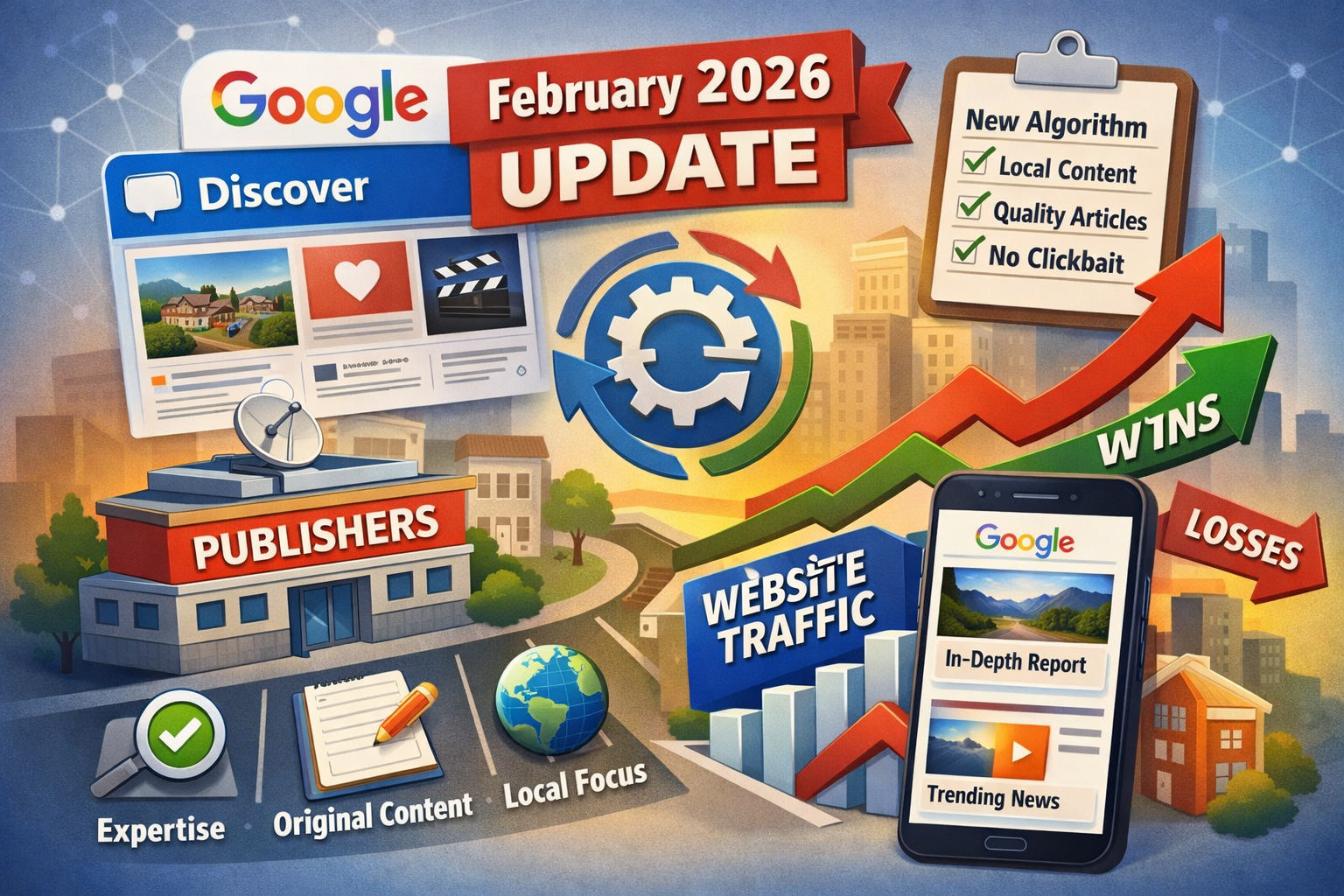
Google has confirmed the release of the February 2026 Discover Core Update, an algorithmic change aimed squarely at improving what users see inside the Discover feed. The update began rolling out on Thursday, February 5, 2026, and applies to English-language users in the United States, with broader global expansion planned in the months ahead.
According to Google, early testing showed that users found Discover more useful and more worth their time after the changes went live. That phrasing matters. Discover traffic is earned, not requested, and small system changes can shift visibility fast.
What Changed Inside Discover
This update adjusts how Google selects and ranks articles that appear in Discover. The focus stays consistent with Google’s long-running message: reward substance, context, and credibility, and filter out content built to provoke clicks instead of deliver value.
More Local Relevance by Country
One of the most noticeable changes is stronger emphasis on local relevance. Discover now surfaces more content from publishers based in a user’s country. For U.S. readers, that means U.S.-based publishers gain an edge when covering topics with regional or national importance.
This does not mean global publishers are excluded. It means proximity matters more when relevance is otherwise equal. A regional publisher writing with authority can now compete more effectively against larger international brands.
Less Sensational Content, Fewer Empty Promises
Google has drawn a clearer line against exaggerated headlines and preview tactics that inflate curiosity while withholding substance. Discover is reducing exposure for content that leans on shock, outrage, or bait-style phrasing to earn taps.
That shift aligns with what many publishers have already seen. Articles that promise drama but deliver thin analysis tend to spike briefly, then vanish. Discover is shortening that cycle.
Stronger Signals for Original, Timely Expertise
The update places more weight on in-depth and original reporting from publishers with demonstrated topical expertise. Importantly, that expertise is evaluated on a topic-by-topic basis, not across an entire domain.
A local news outlet with years of coverage in a niche area can surface prominently for that topic. A general-interest site publishing a one-off article in that same niche usually cannot. This rewards consistency, not breadth.
How Google Determines Eligibility for Discover
Content does not require special markup or structured data to appear in Discover. If a page is indexed and complies with Discover content policies, it is eligible. Eligibility does not guarantee visibility.
Discover also pulls from both fresh and older content. Articles published months or even years ago may resurface if they align with a user’s interests and remain useful.
Manual actions related to Discover appear inside Google Search Console under Security and Manual Actions. These actions are policy-based and distinct from algorithmic ranking changes.
What Google Recommends for Discover Visibility
Google’s guidance for Discover closely mirrors its broader advice for helpful, people-first content. Several practical recommendations stand out.
Headline Clarity Over Curiosity Traps
Page titles should reflect what the article actually covers. Headlines that obscure meaning or exaggerate outcomes reduce long-term visibility in Discover.
If a reader cannot understand the topic from the title alone, the article starts at a disadvantage.
Storytelling With Substance
Discover favors content that explains, contextualizes, and informs. Timeliness matters, but depth matters more. Articles that connect current events to broader implications tend to perform better than surface-level summaries.
Image Quality and Presentation
Visual presentation plays a direct role in Discover exposure. Google recommends large images at least 1200 pixels wide, enabled through the max-image-preview:large directive or AMP.
Low-resolution images, stock visuals unrelated to the topic, or image-free pages often struggle to gain traction.
Page Experience Still Counts
Discover uses many of the same signals as Google Search. Page speed, mobile usability, and overall layout influence performance. A clean reading experience remains table stakes.
Why Discover Traffic Changes Without Warning
Traffic from Discover behaves differently from keyword-driven search traffic. It is interest-based and subject to personal preference shifts.
User behavior changes. Topics cool off. Content formats rotate. Discover adjusts what it shows as interests evolve.
Search system updates can also influence Discover visibility. Since Discover operates as an extension of Search, core updates may affect both channels at once.
What This Update Signals for Publishers
The February 2026 Discover Core Update reinforces a familiar pattern. Publishers who invest in subject-matter depth, clear communication, and editorial discipline tend to hold ground. Those chasing clicks without delivering clarity face sharper volatility.
Discover remains supplemental traffic. It can amplify strong content. It cannot rescue weak content. Treat it as a bonus channel, not a foundation.
For publishers willing to commit to consistency and credibility, this update offers more opportunity than risk.