Restaurant Pushes Back on Google AI Specials
A family-owned restaurant in Wentzville, Missouri, has found itself caught in the crossfire of technology gone wrong. Stefanina’s Pizzeria, a well-known spot in town, says customers are showing up with expectations shaped by Google’s AI-generated search results—expectations the restaurant never set.
The Problem: AI Deals That Don’t Exist
Stefanina’s took to social media this week with a blunt message: “Please do not use Google AI to find out our specials.” The post explained that the search tool is spreading false information about menu items and discounts, which has led to tense moments between staff and diners.
One glaring example is an AI Overview that claimed the restaurant was offering a large pizza for the price of a small. That deal was never real. The AI tool also produced incorrect menu items, confusing both staff and customers. “It’s coming back on us,” said Eva Gannon, a member of the family that runs Stefanina’s. “As a small business, we can’t honor a Google AI special.”
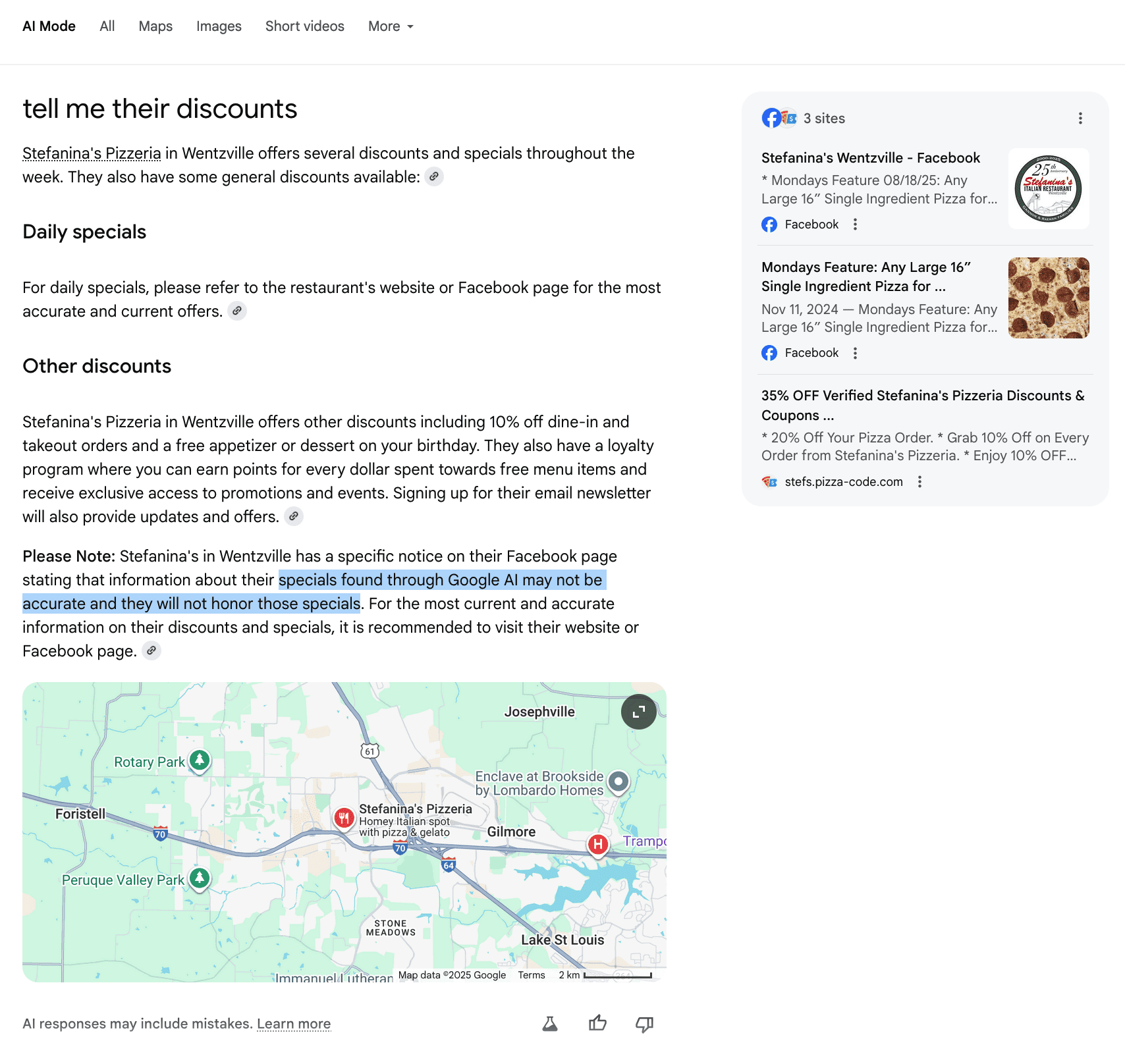
Google includes note that its made up specials may not be honored by the restaurant.
Google’s AI in Context
Google’s AI tool, referred to as AI Overview, is part of the company’s shift to automatically summarize search results instead of showing only links. The idea is that users get answers faster, without needing to click through to multiple sources. But the summaries are generated by machine-learning models that can misinterpret data, combine unrelated details, or fabricate offers that were never posted by the business.
At the same time, Google is preparing to roll out a new feature called “Have AI Call.” This service would allow users to request that Google’s AI call a business directly to book reservations, ask questions, or confirm details. For restaurants, salons, and service companies, that means conversations could be handled by an automated voice assistant before a human ever picks up the phone. While that could improve efficiency, it also raises questions about accuracy, accountability, and whether small businesses can keep up with corrections if the AI spreads wrong information.
Google’s Silence
Local station KMOV reported that Google had not yet responded to requests for comment. The company’s online materials do caution users that AI results may contain errors, pointing out that the system can misinterpret the information it draws from. For Stefanina’s, those warnings are little comfort when customers demand deals that were never advertised.
Expert Perspective
Jonathan Hanahan, a Washington University professor who studies and teaches artificial intelligence, says this is a clear reminder that users must approach AI-generated information with care. He draws a distinction between using AI and actually working with it. The first assumes accuracy at face value, while the second involves verifying the details.
Hanahan offered his own golf scoring app as an example. AI helps him quickly pull in course data that would otherwise take hours to collect. But the app still requires him to confirm the numbers before presenting them to users. “It will sometimes take liberties to get you what you’re looking for,” he explained, noting that the way a question is worded can skew the output.
The Role of Prompts
Hanahan warns that the phrasing of a prompt can shape the result in unexpected ways, creating a risk of confirmation bias. He urges people to think carefully about how they ask questions. “Think about the bigger conversation, not just the single answer you expect,” he said.
Why This Matters for Businesses
This isn’t just a pizza shop problem. Any business that depends on search visibility is now at risk of having its reputation shaped by machine-generated guesswork. A restaurant may lose a customer over a fake discount. A contractor could lose credibility if Google AI lists services they don’t provide. And in professional services, even a small error in pricing or description could cost thousands of dollars in lost trust.
The bigger picture is that AI search is already influencing buyer decisions before they reach a company’s website. That means misinformation—even if accidental—directly impacts sales, customer service, and long-term brand value. Businesses can’t afford to ignore this. The smartest move right now is to make sure official channels—websites, social media, verified profiles—are accurate and updated. If a mistake from AI shows up, at least customers can see the truth directly from the source.
What Businesses Can Do
Businesses don’t have direct control over what AI-generated summaries display. But they do have control over their own data sources. Keeping Google Business Profiles updated, posting specials consistently to official websites and social media pages, and monitoring search results regularly can help reduce confusion. Some companies are also beginning to train staff on how to respond when a customer cites information from AI that isn’t true—treating it less as an argument and more as an opportunity to guide the customer back to official channels.
It may also be worth documenting instances where AI misrepresents a business. These records could support complaints to Google or be used in the future if broader industry standards or regulations are introduced to hold platforms accountable for misinformation.
This dispute highlights a larger concern about how AI-driven search tools are shaping customer expectations. For now, Stefanina’s is urging patrons to rely on its own website and Facebook page for accurate information. But this is unlikely to be the last case. As AI continues to play a larger role in how customers discover, compare, and engage with businesses, the risk of misinformation spreading faster than it can be corrected will only grow. Small businesses, in particular, may find themselves forced to adapt faster than they ever expected just to keep up.