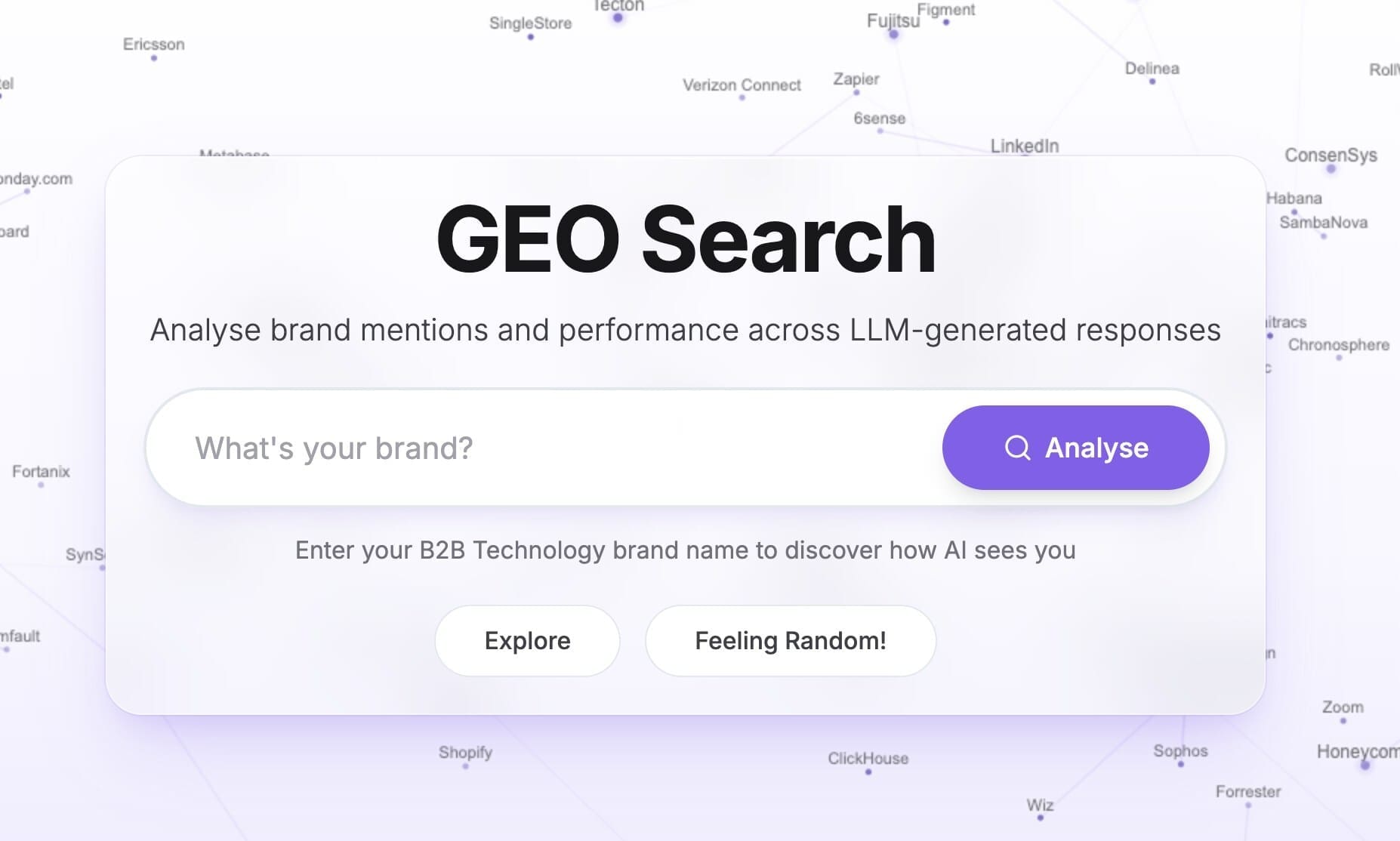
In a marketplace where artificial intelligence is quietly rewriting how buyers choose vendors, Resonance has stepped forward with a new tool that promises to make the invisible visible. The company announced the launch of GEO Search, a free platform that shows B2B brands exactly how large language models (LLMs) describe them during the buying process — and why that matters.
A New Front in the Visibility Race
Resonance’s GEO Search is built on one of the largest research efforts ever conducted in B2B technology marketing. Over 100,000 buyer-intent prompts were processed through the latest generation of LLMs, producing nearly a million URL citations and close to one million brand mentions from 34,000 companies across 113 technology sectors. The result: a detailed map of how AI systems interpret and recommend vendors.
According to Resonance, the data confirms what many marketers have only suspected — that the real competition isn’t for clicks anymore, it’s for citations inside AI-generated responses. As CEO Claire Williamson put it, “If you are not visible in AI answers, you are invisible to the buyer.”
AI Is Now the Shortlist
Recent findings from Forrester show that 89 percent of B2B buyers now use tools like ChatGPT, Claude, and Gemini at some point during vendor research. Traditional search results no longer dictate the buyer journey. Instead of browsing links, buyers rely on AI summaries that produce a single, trusted answer — a digital shortlist that heavily shapes final purchase decisions.
Tom Fry, Resonance’s CTO and co-founder, added that AI recommendations aren’t random. “LLMs follow patterns, and those patterns can be influenced,” he explained. “Once you understand which sources the model trusts for your category, you can shape visibility. Citations and brand mentions are the new clicks.”
What the Research Found
The GEO dataset revealed several consistent findings across its 100,000 test prompts:
- Earned media drives visibility. Publications remain the most-cited sources by LLMs during vendor shortlisting.
- Analyst and peer-review sites dominate evaluation phases. Platforms such as Gartner, G2, TrustRadius, and IDC heavily influence perceived authority.
- Category differences matter. Cybersecurity buyers consume very different information than DevOps or Cloud Infrastructure buyers. One uniform content strategy doesn’t work.
Inside GEO Search
Rather than providing search results, GEO Search reveals what AI already knows — and says — about a brand. Users can enter their company name or category and instantly see how LLMs are framing their visibility. The tool identifies competitor mentions, key buyer questions, and the narrative positioning that AI uses to rank one brand over another.
“This isn’t SEO as we’ve known it,” Williamson said. “This is about understanding how AI perceives your brand in real time.”
Why It Matters
Many marketing teams still assume that appearing high in Google search rankings guarantees similar placement in AI-generated responses. GEO Search testing proves otherwise. In many sectors, the brands topping Google results are missing entirely from AI-driven recommendations. Others are being misrepresented or grouped with the wrong competitors.
Resonance’s data shows that earned visibility — public relations, media citations, and authoritative mentions — now has greater influence on LLM recommendations than traditional SEO metrics. The firm is using those insights to help B2B technology clients refine their positioning, messaging, and content strategies to align with what AI systems actually trust.
Behind the Numbers
The GEO Search project analyzed 113 distinct B2B tech segments, from cybersecurity to orchestration platforms. Each segment included 500 buyer-intent queries spanning awareness, evaluation, and purchase decisions. Every LLM output was studied for brand mentions, cited URLs, and the types of sources referenced, from peer-review communities to analyst reports.
Buyer intent categories included informational, benchmarking, comparison, purchase decision, technical evaluation, risk and compliance, and community validation. This structure allowed the Resonance team to see how brands performed at each stage of the funnel, not just whether they appeared at all.
The Bigger Picture
Resonance is making GEO Search publicly available at no cost, giving every B2B brand a chance to understand how they appear inside AI-driven research environments. The company sees it as an opportunity for transparency — a way for marketers to measure, adjust, and improve their influence over automated decision-making systems that are quietly shaping billions in enterprise spend.
For B2B leaders, the takeaway is clear: AI visibility has become the new front line of brand strategy. GEO Search doesn’t just expose the leaderboard — it explains why some brands make the cut and others don’t. And in a buying landscape now dominated by algorithms that summarize rather than list, that insight could be the deciding factor between growth and obscurity.