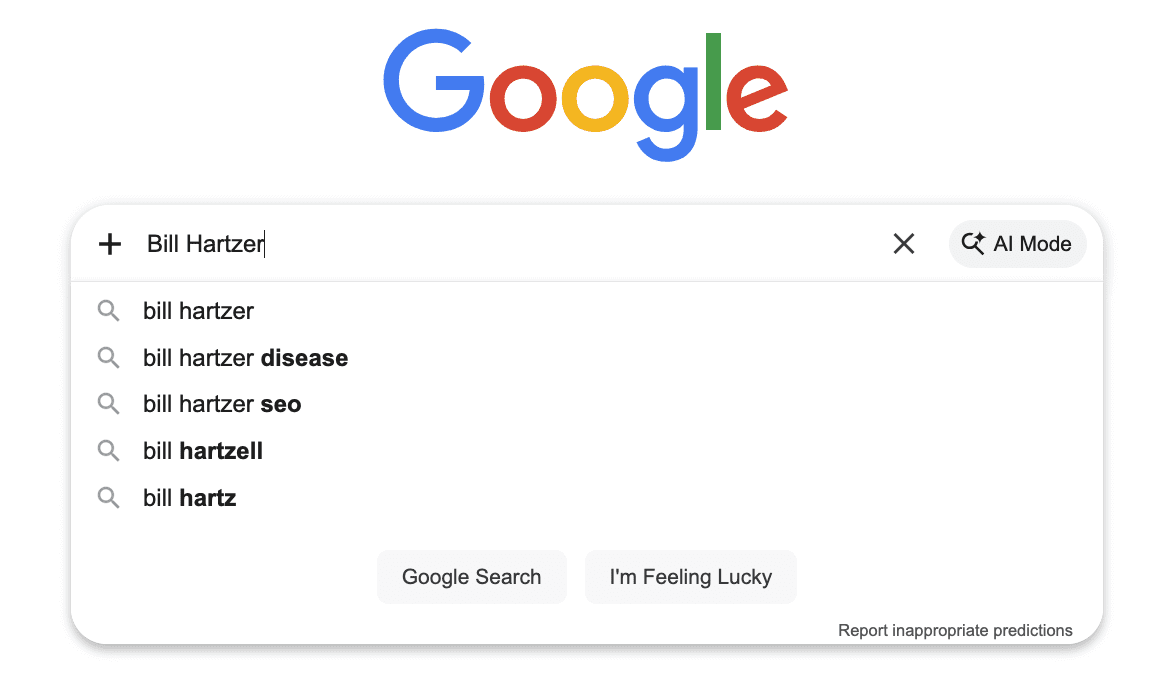
For more than a decade, Google Autosuggest has displayed a phrase that appears structured, plausible, and yet completely unfounded: “Bill Hartzer disease.” There is no such disease. There is no medical reference, no clinical documentation, and no legitimate explanation rooted in healthcare or science. And yet, the phrase persists.
This is not a glitch. It is not a typo that Google failed to correct. It is something far more interesting and far more revealing about how modern search systems operate. The existence of this phrase is the result of user behavior, query patterns, and a self-reinforcing feedback loop that has allowed it to survive for over ten years.
To understand how this happens, we need to move beyond surface-level explanations and look deeper at how queries are formed, how autosuggest works, and how users themselves effectively “invent” phrases through repeated interaction.
Autosuggest Reflects Behavior, Not Truth
Google Autosuggest does not validate facts. It does not confirm whether a phrase corresponds to a real-world concept. Instead, it reflects what users have typed into the search box over time. It is, at its core, a behavioral system.
If users repeatedly search for a phrase, that phrase can become eligible for suggestion. Once it appears, it can attract more searches simply because it is visible. This creates a dynamic where visibility leads to more visibility, regardless of whether the phrase is accurate or meaningful.
This distinction is critical. Autosuggest is not telling you that something exists. It is telling you that people have searched for it.
The Key Insight: A Composite Query
The phrase “Bill Hartzer disease” is best understood as a composite query. It is not a single idea that originated intact. It is the result of two separate behaviors merging into one query string.
First, “Bill Hartzer” is a recognizable entity. It is a name that exists on the web, indexed, referenced, and searched. Branded search behavior means that users regularly type that name into Google for a variety of reasons.
Second, users frequently append modifiers such as “disease,” “illness,” or “health” to names. This is a common pattern across search behavior. People search phrases like “does [person] have a disease” or “what illness does [person] have,” even when there is no known issue.
These two behaviors, independent of each other, combine into a single query: “Bill Hartzer disease.”
How Users Construct Queries in Real Time
Search behavior is iterative. Users rarely type a perfect query on the first attempt. Instead, they start with a base query and modify it as they go. This process happens in seconds, often without conscious thought.
A user might begin with “Bill Hartzer.” They review results. They refine the query. They add a modifier. Sometimes that modifier is logical, such as “SEO” or “bio.” Other times, it is exploratory or even random.
At this stage, the query becomes something else entirely. It becomes “Bill Hartzer disease.”
This does not require intent or factual basis. It simply requires that a user typed the phrase. Once typed, it exists in the system.
How Those Behaviors Combine
There are several realistic scenarios that explain how this composite query forms and becomes persistent. In one scenario, a user searches for “Bill Hartzer” and then modifies the query out of curiosity. They may wonder whether there is something unusual or noteworthy, or they may simply follow a common behavioral pattern of appending health-related terms to a name. This leads them to search “Bill Hartzer disease,” even though there is no underlying information driving that query.
In another scenario, Autosuggest itself plays a role in shaping the behavior. A user begins typing “bill hart…” and Google suggests “Bill Hartzer.” The user continues typing and adds “disease.” The system logs the full query. At that point, the phrase exists as a searchable string, regardless of its meaning or lack thereof.
These scenarios are not mutually exclusive. They likely occurred multiple times, across different users, creating enough query volume for the phrase to become visible.
The Feedback Loop That Sustains It
The persistence of “Bill Hartzer disease” is driven by a feedback loop that is both simple and powerful. Once the phrase appears in Autosuggest, even briefly, it becomes visible to users who were not actively looking for it.
A user sees the phrase and pauses. It looks structured, similar to legitimate disease names. It raises a question. The user clicks or searches it, not because they believe it is real, but because they want to understand what it is.
That action reinforces the query. The system interprets it as continued interest. The phrase remains in Autosuggest. More users see it. More users search it.
This cycle repeats over time. The original cause becomes irrelevant. The phrase is no longer sustained by its origin. It is sustained by the behavior it generates. This is how a query with no factual basis can persist for more than a decade.
Why This Is Not Just a Misspelling of a Real Disease
There has been speculation that the phrase may originate from a misremembered condition such as Hartnup disease. While this is plausible at a superficial level, it does not fully explain the behavior we observe.
If the origin were purely a misspelling, we would expect to see independent queries like “Hartzer disease” without any person’s name attached. We would also expect Google to correct the query or associate it with a known medical condition.
Instead, what we see is a consistent pattern centered around a person’s name combined with a keyword. This behaves like a reputation or curiosity query, not a medical one. The presence of “Bill” is the defining signal. It indicates that this is a name-based query artifact rather than a corrupted medical term.
Query Forensics: Which Came First?
To understand the origin more precisely, we can evaluate two possible paths. The first path assumes that the query began with the name itself. Users searched for “Bill Hartzer” and then modified the query by appending “disease.” This modified query was logged, surfaced in Autosuggest, and reinforced through repeated searches.
The second path assumes that a generic query such as “Hartzer disease” existed first, possibly as a misspelling of a real condition. In this scenario, Google would associate “Hartzer” with a known entity and expand it to “Bill Hartzer disease.”
When we compare these two paths against observed search behavior, the first path is far more consistent. Users frequently append random or exploratory terms to names, while Google rarely expands generic terms into full person-name queries in Autosuggest unless users are already typing those queries.
This makes the branded query origin the most plausible explanation.
The Role of Query Co-Occurrence
From a technical standpoint, this phenomenon can be described as a query-level co-occurrence artifact. The system has learned that “Bill Hartzer” and “disease” appear together in user queries. It does not assign meaning to that pairing. It simply records the association.
There is no underlying entity called “Bill Hartzer disease.” There is no concept being modeled. There is only a string that has been reinforced through repeated behavior. This is a fundamental characteristic of modern search systems. They model patterns, frequency, and relationships, but they do not inherently validate truth.
Real-World Patterns: This Is Not Unique
This type of anomaly is not isolated. There are numerous documented and observed cases where names become attached to unusual, negative, or nonsensical terms in Autosuggest.
One common pattern is the “why is [person]…” anomaly. Queries such as “why is [person] evil” or “why is [person] a criminal” have appeared without any factual basis. These often originate from a small number of initial searches, followed by curiosity-driven reinforcement.
Another pattern involves health-related modifiers. Users frequently search “[person] illness” or “[person] disease,” even when there is no supporting information. These queries often surface in Autosuggest and persist due to continued curiosity.
There are also cases where completely nonsensical phrases become attached to names. These include combinations of a person’s name with unrelated or fabricated terms. These phrases persist because they are unusual enough to attract attention and trigger additional searches.
In all of these cases, the mechanism is the same. A small number of initial queries create a seed. Autosuggest exposes the phrase. Users react to it. Their reactions reinforce it. Over time, the phrase becomes stable.
Why These Queries Become “Sticky”
Not every unusual query persists. The ones that do share specific characteristics. They involve a recognizable name. They include a trigger word that invites curiosity. They are ambiguous and unresolved. Most importantly, they lack a definitive answer.
“Bill Hartzer disease” fits this pattern perfectly. It looks plausible because of its structure. It raises a question that is not easily answered. It encourages users to search, even if only to confirm that it is not real.
That ongoing behavior is what keeps it alive.
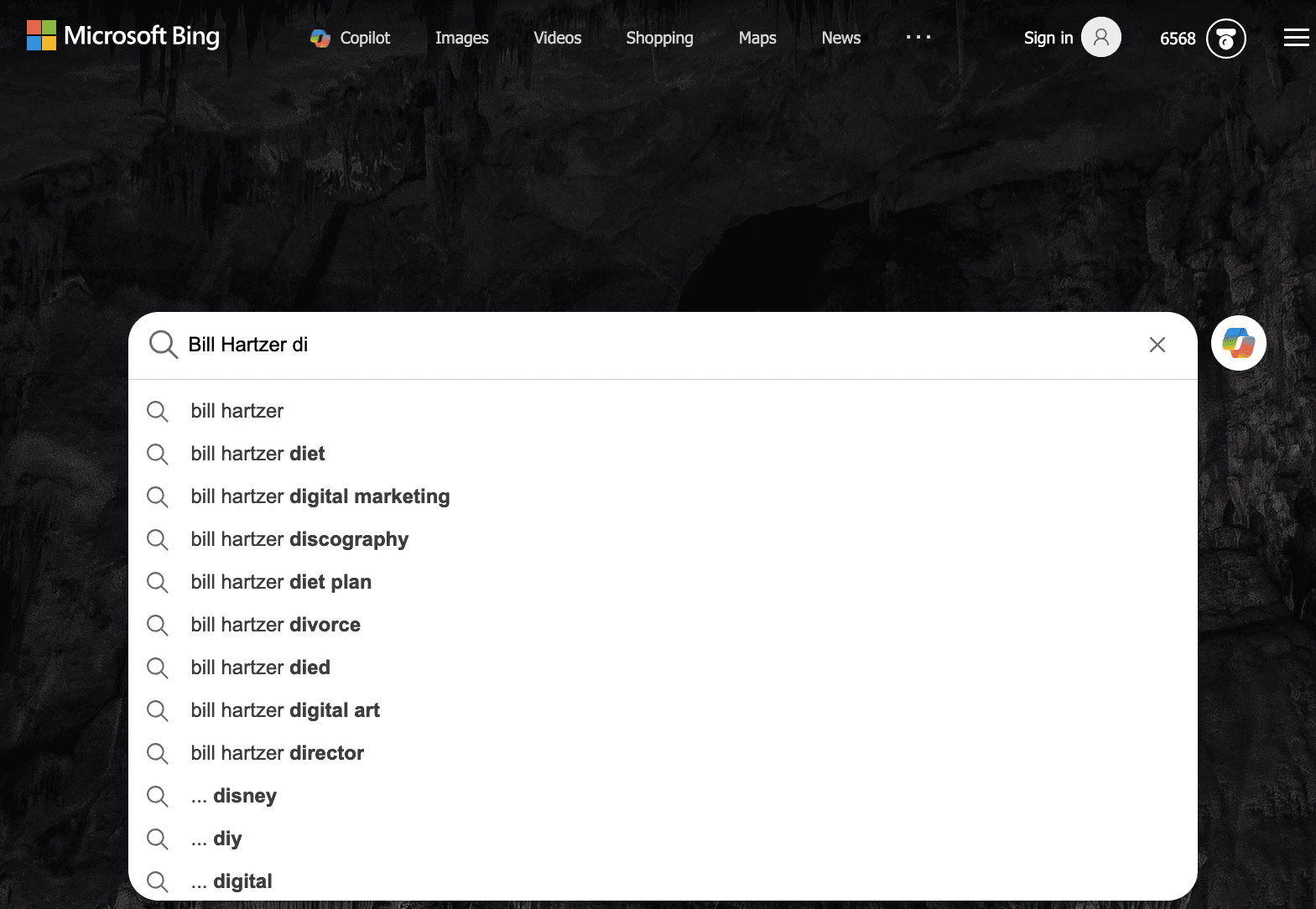
Microsoft Bing Autosuggest: A Useful Comparison
When comparing Google Autosuggest to Microsoft Bing Autosuggest, the differences become immediately apparent. Bing’s suggestions for the same name often include a wider range of loosely related or even unrelated modifiers. For example, suggestions such as “bill hartzer diet,” “bill hartzer divorce,” or “bill hartzer died” may appear alongside more relevant queries like “bill hartzer digital marketing.”
This highlights a key distinction between the two systems. Google tends to be more conservative in what it surfaces, filtering suggestions more aggressively based on quality signals, historical behavior, and policy constraints. Microsoft Bing, on the other hand, often reflects a broader set of query variations, including those with weaker relevance or lower confidence.
The underlying reason for this difference comes down to how each system weighs query volume, user interaction, and filtering thresholds. Autosuggest is highly sensitive to search volume, even at relatively low levels. If a small number of users repeatedly search a phrase, it can become eligible for suggestion.
However, each engine applies different thresholds and filtering logic. Google may suppress certain queries that Bing allows to surface. Bing may expose a wider range of exploratory or edge-case queries. As a result, the same name can produce very different suggestion sets across platforms.
This also reinforces an important point. Autosuggest is not static. It changes over time as user behavior changes. If more users begin searching for different variations of a name, those variations can replace or displace existing suggestions.
What Now?
After analyzing the structure, behavior, and technical mechanisms behind this phrase, the explanation becomes clear. “Bill Hartzer disease” is not a medical term, and it is not the result of a persistent typo. It is a name-based query artifact that emerged from the combination of branded search behavior and curiosity-driven modifiers.
It has been sustained for more than a decade by a feedback loop in which visibility drives further searches. At this point, the origin is less important than the behavior that continues to reinforce it.
I do not have an issue with it appearing in Autosuggest. While there are certainly other phrases that would be more relevant or representative, Autosuggest reflects what people search, not what should be there.
As search behavior evolves and as new content, projects, and initiatives gain traction, the set of suggested queries will change. Over time, different phrases may replace it, just as others have appeared and disappeared in the past.
Until then, it remains an interesting and very visible example of how search behavior can create and sustain something that never actually existed.