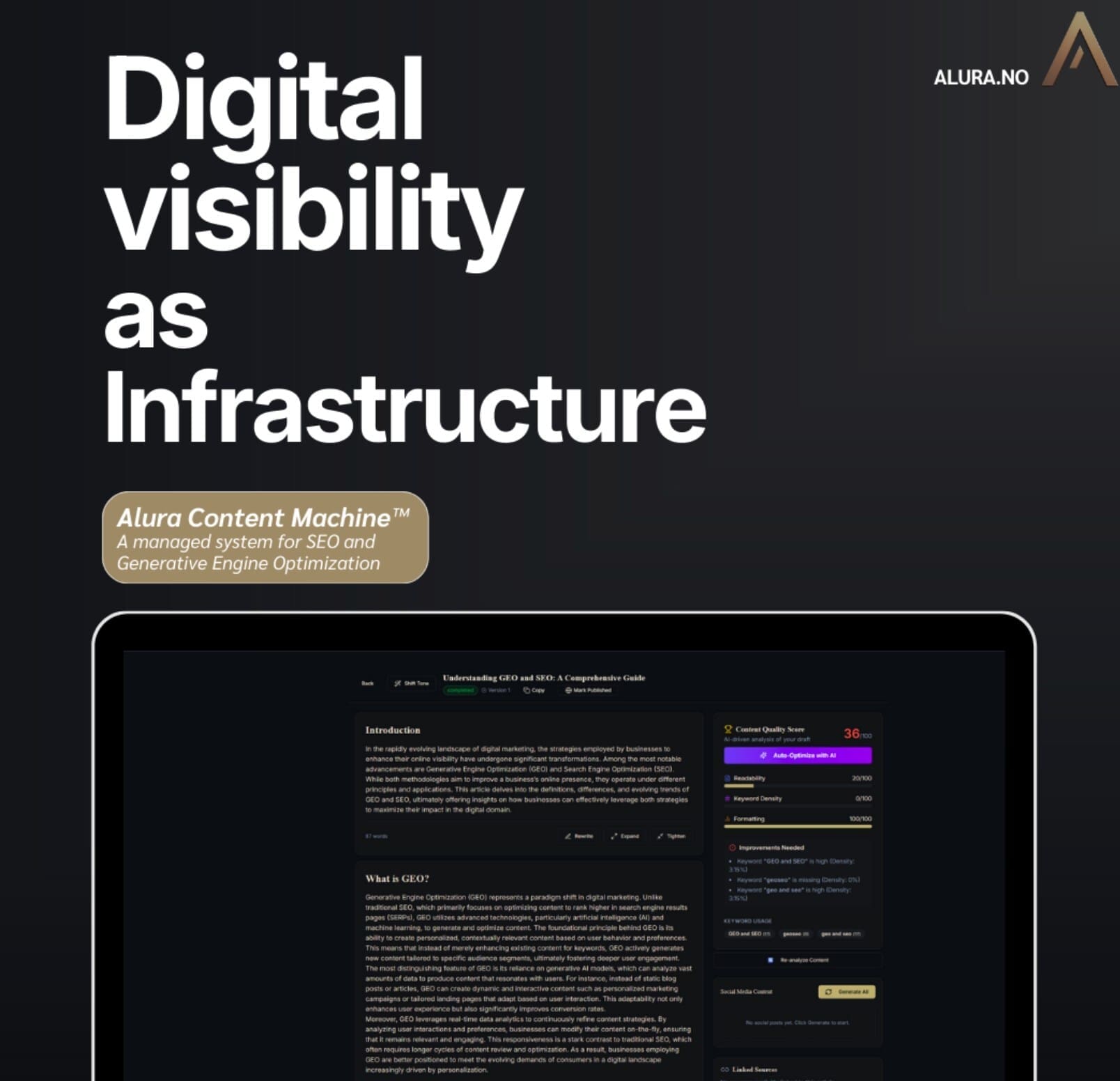
ALURA, a Norway-based AI and automation consultancy, has announced the launch of Alura Content Machine™, a managed content system intended to help organizations remain visible across both traditional search engines and AI-generated answer platforms. The company positions the product as an operational solution rather than a marketing campaign, arguing that discoverability has shifted from occasional activity to continuous discipline.
The release reflects a broader change in how decision-makers gather information. Buyers increasingly rely on automated summaries, chat-style responses, and curated knowledge panels rather than scanning pages of search results. In this environment, organizations are selected as sources only if their information is structured, consistent, and easy for machines to interpret.
Content Treated as Infrastructure, Not Advertising
ALURA’s leadership frames the product around a simple premise: publishing more material does not guarantee visibility. Information must be organized, updated, and measurable. Jonas Bakke, CEO of ALURA, stated that companies must be “consistently understood and selected,” a phrase that captures the new rules of digital discovery.
The company describes its system as comparable to maintaining software or financial controls. Content is planned, produced, evaluated, and refined on a weekly cycle. This approach replaces sporadic blog posts or campaign-driven publishing with a predictable workflow tied directly to measurable outcomes.
Combining SEO and GEO Into One Operating Model
The platform merges two related disciplines. SEO (Search Engine Optimization) focuses on ranking in traditional search engines. GEO (Generative Engine Optimization) focuses on appearing in AI-generated answers, summaries, and knowledge panels.
Search Optimization Functions
On the SEO side, the system produces and publishes content at scale according to a prioritized search plan. Each asset is delivered fully optimized, including titles, meta descriptions, URL structures, internal links, and structured data markup. Performance data then informs the next cycle of production.
ALURA emphasizes iteration. Rankings, indexing behavior, and inbound leads are reviewed weekly. Content that performs well is expanded. Content that stalls is revised or repositioned.
AI Visibility Functions
The GEO component focuses on how machines interpret company information. This includes defining core facts about the organization, clarifying what it offers, and ensuring consistency across public sources. Material is formatted to be easily extracted and cited, using definitions, lists, comparisons, and direct answers.
Authority signals are also addressed. Clear authorship, current data, and evidence-based formatting help systems determine whether the content is reliable enough to reference.
Measurement Framework Built Around Real Outcomes
ALURA reports that the system relies on continuous measurement rather than periodic reporting. For search performance, common indicators include rankings for high-intent queries, growth in non-branded organic traffic, indexing rates, inbound leads, and increases in referring domains.
For AI visibility, the metrics are less straightforward but still observable. These include how often a company is referenced in automated answers, which sources are cited in industry summaries, traffic patterns associated with AI discovery, and increases in branded searches over time.
Early Results Suggest Gradual but Compounding Impact
The company notes that most organizations begin seeing movement within one to three months. Early indicators include more indexed pages, improved long-tail rankings, modest traffic gains, and reduced dependence on paid search for targeted topics.
In one documented engagement, ALURA reported organic traffic growth from 1,836 visits to 17,400 over several months, with a later peak of 23,000. The firm attributes part of this improvement to stronger consistency across external sources, which increased the likelihood of being referenced in automated summaries.
Pilot-First Implementation Strategy
Deployment typically starts with a limited pilot. This phase validates content quality, establishes baseline metrics, and confirms operational fit. After that, production scales gradually while maintaining control over accuracy and brand voice.
This cautious rollout reflects a broader truth: large-scale content operations can cause harm if poorly managed. Incorrect information propagates quickly online, and once cited by automated systems, it becomes difficult to retract.
Why This Launch Matters
The announcement signals a shift in how organizations think about digital presence. Visibility is no longer just about ranking for keywords. It is about being recognized as a reliable source across an ecosystem of search engines, AI tools, aggregators, and databases.
In practical terms, companies that fail to maintain structured information risk becoming invisible, even if they publish frequently. Meanwhile, organizations that treat knowledge management as an operational function are more likely to appear wherever buyers seek answers.
ALURA’s approach reflects that reality. By turning content into a governed process with measurable outputs, the firm is betting that discoverability will increasingly resemble infrastructure—something maintained continuously, not rebuilt from scratch every quarter.
The broader takeaway is straightforward. In an environment where machines increasingly decide which sources matter, clarity beats volume, consistency beats novelty, and maintenance beats one-time effort. Organizations that internalize those principles will likely remain visible. Those that do not may find themselves speaking into the void.