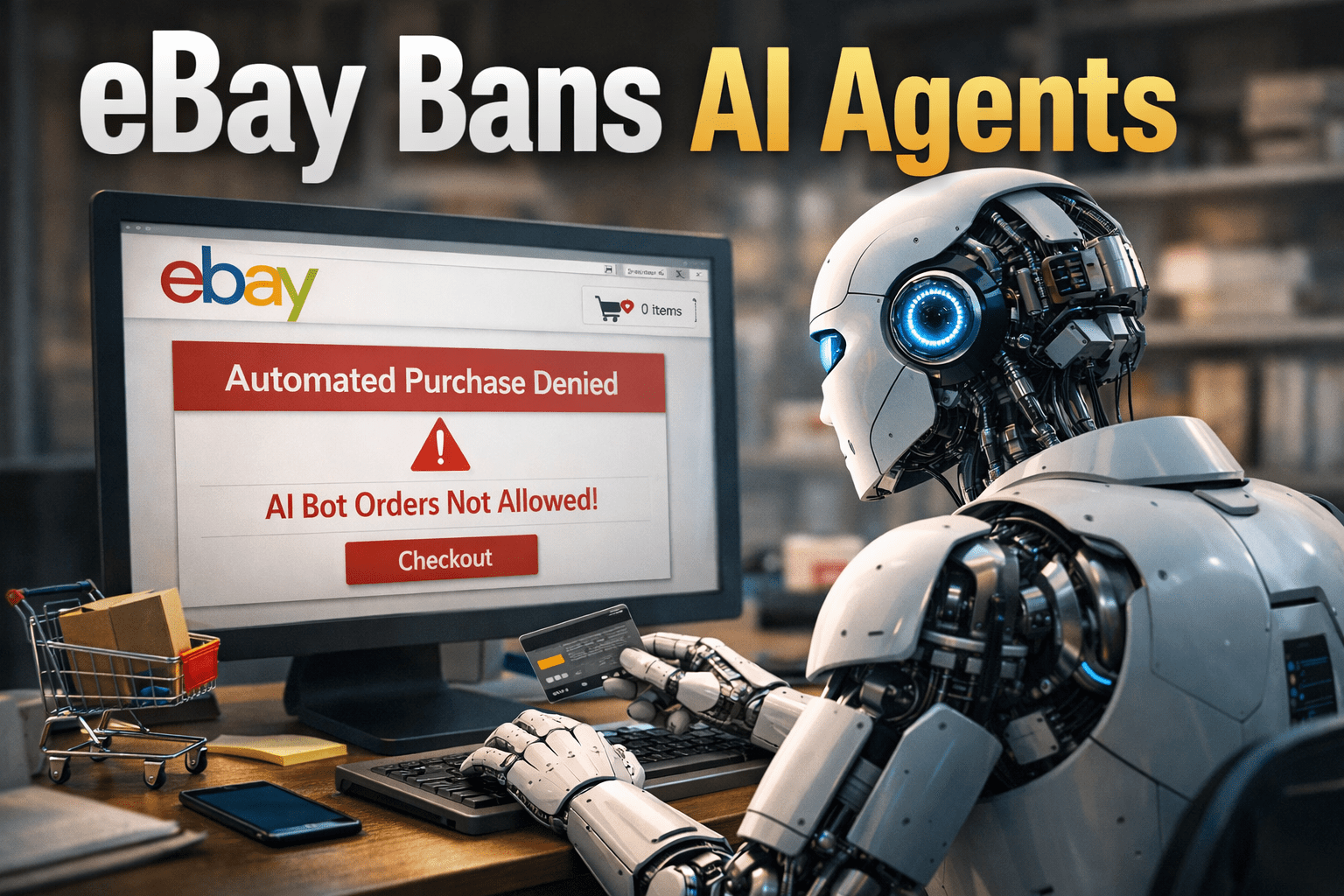
eBay has made its position unmistakably clear, and it did it in contract language that leaves very little wiggle room. Automated buying agents are no longer welcome on the platform, at least not without prior permission. That choice has ripple effects that go beyond policy compliance, because it reaches straight into commerce workflows, attribution models, and the way marketers measure demand.
In a User Agreement update posted January 20, 2026, and effective February 20, 2026, eBay explicitly bans AI “buy for me” agents and LLM (large language model) driven bots from interacting with its platform without approval. The same update tightens arbitration language, expands limits on group legal actions, and corrects legal contact information that no longer matched reality. This was not a soft edit meant to be overlooked. The language is direct, and the intent reads like a warning label.
AI Agents Are Now Explicitly Off-Limits
eBay has prohibited automated access for years, so the concept is not new. What changed is specificity and the fact that eBay is now naming the behavior it wants to stop, rather than relying on broad “bot” language. The old agreement banned robots, spiders, and scrapers unless eBay granted permission. The new version goes further and calls out buy-for-me agents, LLM-driven bots, and end-to-end flows that attempt to place orders without human review.
That final clause is the key phrase because it draws a bright line between automation that supports a person and automation that replaces a person. Retail platforms can tolerate tools that help users research, compare, and decide. They get far less tolerant when the tool becomes the buyer, because the platform then inherits disputes that no longer map cleanly to a human customer’s intent.
This update follows a December change to eBay’s robots.txt file that placed tighter guardrails around automated access and AI behavior. Put together, these two moves send the same message in two different places: one aimed at technical controls, the other aimed at legal controls. Automation can observe and automation can analyze, but automation cannot transact without permission.
Why eBay Acted Now
The timing is hard to ignore because the broader market has been flirting with agentic commerce. Amazon’s Buy For Me test has drawn attention by showing how an app can surface items from merchant websites and facilitate purchase flows inside the app, even when those merchants never set out to sell through that marketplace. That pattern raises a familiar set of questions for sellers and platforms: who controls product presentation, who owns customer communications, who handles refunds, and who is responsible when something goes sideways.
eBay appears to have watched those headlines and decided to shut the door before the foot traffic turns into a stampede. Platforms are built on accountability. Transactions require a clean chain of responsibility. A buy-for-me agent complicates that chain, and eBay is signaling that it wants human intent to remain a requirement, not an optional feature.
This May Be the First Domino
eBay may be the first major marketplace to say this so explicitly, but it is unlikely to be the last. Buy-for-me agents create legal exposure because they blur agency and they create confusion over who approved what. They also complicate refunds, fraud claims, chargebacks, and seller protections because the “buyer” becomes a software workflow rather than a person making a decision in real time.
Expect other platforms to follow with similar bans, permission-based programs, or tightly controlled APIs. Some will do it quietly through technical enforcement. Others will do it loudly through updated terms, because contract language is how platforms scale rules without arguing every case on its own. From a practical standpoint, this looks like an early signal that large online sites may start prohibiting autonomous purchase flows as a category, especially when those flows bypass human review.
Arbitration Rules Tighten Further
The second half of the update focuses on dispute resolution, and it is consistent with the direction eBay has been moving for some time. In May 2025, eBay rewrote its arbitration rules in ways that sharply limited lawsuits and forced most disputes into arbitration. This update builds on that foundation by clarifying what group actions are prohibited, updating procedures, and fixing contact details used for legal notices.
Updated Legal Address
eBay corrected its mailing address for legal notices and opt-out correspondence. The company sold its former Draper, Utah office in 2024, yet the old agreement still pointed to that location. Under the updated terms, notices can still be sent by email to [email protected], and physical notices now go to 339 W. 13490 S., Ste. 500, Draper, UT 84020. This reads like housekeeping, but it matters because bad addresses create missed deadlines, missed rights, and procedural chaos.
Expanded Limits on Group Actions
The arbitration clause now blocks more than class actions. The updated language prohibits claims brought as a class member, representative action, collective action, or private attorney general action, and it also blocks attempts to recover damages incurred by third parties. In plain language, users may pursue only individual claims for their own harm and for their own remedies. That framework reduces platform exposure to large-scale group litigation, and it also changes the leverage profile for users who previously relied on group actions as the pressure point.
What Did Not Change
Regulators are unaffected, and that point is worth repeating because many users confuse private arbitration clauses with government authority. State Attorneys General, the FTC, and other agencies can still bring actions on behalf of the public. Users can still file complaints with those bodies. Arbitration language does not block regulatory scrutiny, and it does not prevent agencies from acting if they believe a pattern of behavior violates consumer protection laws.
Opt-Out Is Closed for Existing Users
The agreement clarifies that only new users may opt out of arbitration. Existing users who did not opt out by May 16, 2025 no longer have that option. This is one of those lines that will catch people by surprise, because many users assume they can opt out whenever a new update appears. Under this structure, that assumption is wrong. The window was earlier, and the update makes the limitation explicit.
What Sellers and Developers Should Take Away
For sellers, the message is straightforward: read updates closely because platform terms now change fast, and small edits can carry meaningful consequences. For developers, the warning is sharper: agents that place orders without human review are prohibited unless eBay grants permission, and workarounds create enforcement risk. For the industry, the bigger point is that platforms are drawing boundaries around AI behavior before courts and regulators are forced to do it for them, and that boundary-setting tends to spread once one major player normalizes it.
eBay chose clarity over ambiguity, and that choice will shape how agentic commerce evolves across the internet. The future of AI shopping will be negotiated in contracts long before it becomes normal in consumer behavior, and marketers should plan for that reality instead of assuming autonomy will be allowed by default.
What This Means for Digital Marketing Teams
The ban on buy-for-me agents changes more than checkout mechanics because it changes how demand is captured, attributed, and defended. Digital marketers should treat this as a market signal about control, consent, and responsibility in commerce flows. If a retailer blocks agent-driven purchasing, then a portion of “frictionless conversion” fantasies disappear, and the focus returns to persuading a person to complete a transaction.
This matters for campaign design because many teams have been building toward automation-heavy purchase experiences. If platforms require human review at checkout, then marketing must optimize for human decision points again, including the final click. That pushes more weight onto messaging, landing page clarity, trust cues, and post-click experience, because an agent will not be there to “finish the job” on behalf of the customer.
Human Intent Becomes the Required Input
If buy-for-me agents cannot place orders, then every transaction must originate from a person making a decision. That shifts value back to traditional demand channels such as search ads, product pages, email, marketplace listings, and influencer referrals, because those channels are built to persuade humans in moments of choice. Marketing teams can no longer assume an agent will bridge the gap between discovery and purchase, so conversion paths need to be built for people, tested with people, and measured in ways that reflect human behavior.
Attribution Gets Cleaner and More Enforceable
Buy-for-me agents blur attribution because they introduce an intermediary that can break the session, rewrite the path, or even “choose” a seller based on criteria that marketing teams cannot see. By prohibiting automated purchasing flows, platforms restore a cleaner chain of custody for conversions, which helps marketers defend performance claims and explain outcomes. It also strengthens first-party data because the path from click to conversion becomes easier to measure, and disputes over “who drove the sale” lose a major source of ambiguity.
What Digital Marketers Should Stop Doing
Marketers should stop experimenting with unofficial agent-based purchase flows that attempt to complete transactions without visible human review. That includes scripts, browser automations, and agent-assisted checkout tools marketed as “hands-free commerce,” because retailer enforcement can break these flows overnight. The risk is not theoretical. When a platform bans a category of automation, the compliance consequences land on the marketer and the seller at the same time, often without a warning period that fits a campaign calendar.
What Digital Marketers Should Double Down On
Marketers should focus on influence rather than execution. AI still has a role in research, comparison, content summarization, and product discovery, because those functions help buyers make decisions. The safer operating model is simple: let AI guide decisions upstream, then let the person complete checkout downstream. This approach aligns with platform rules, reduces enforcement risk, and keeps campaigns stable when policy shifts occur.
If Buy-For-Me Agents Are Blocked Industry-Wide
If other retailers follow eBay, digital marketing will shift in predictable ways. Marketplaces will regain leverage because they control the approved transaction environment. Brand sites will regain importance because they provide direct persuasion and direct data. Affiliate programs will regain relevance because they rely on trackable, human-driven referral paths. SEM (search engine marketing) and SEO (Search Engine Optimization) benefit because they capture visible human intent, and intent is what retailers are trying to protect when they block autonomous buying.
The Strategic Takeaway for Marketers
This is not an anti-AI move. It is an anti-autonomy move. Retailers want AI to inform buyers, not impersonate them, and that distinction will show up in more contracts. Digital marketers who respect that line will avoid rework, enforcement pain, and broken funnels. Teams that ignore it will spend more time rewriting playbooks than scaling campaigns, because the ground under their conversion models will keep shifting.
Direct Impact on SEO, Paid Search, Affiliate Tracking, and Marketplace Attribution
Banning buy-for-me agents forces a reset across search, ads, and tracking, and it changes where marketing teams should expect “credit” to land. Agent-driven checkout flows can fragment sessions, mask referrers, and reroute purchase decisions through systems that do not preserve attribution. When platforms require human checkout, attribution becomes cleaner, and attribution becomes easier to defend inside organizations.
SEO Reclaims Its Original Role
SEO (Search Engine Optimization) works best when humans control intent and make the final decision. Buy-for-me agents short-circuit that process by scraping, summarizing, and acting, sometimes without preserving the signals that marketers rely on to measure influence. When agents are blocked from checkout, organic search regains leverage because rankings must persuade people again. That pushes more value into product comparisons, review content, trust indicators, and brand mentions across credible sources, because those are the inputs that shape human choice in the last mile.
From a practical standpoint, SEO teams should treat this as a reason to strengthen content that answers “should I buy” questions and “which seller can I trust” questions. Those pages convert humans. They also create durable intent signals that are not dependent on an automated buyer completing checkout.
Paid Search Regains Attribution Clarity
Paid search relies on a clean path: a person clicks, evaluates, and buys. Agents break that chain by inserting an intermediary decision engine that can shift the purchase to a different seller, a different channel, or even a different site. If a bot clicks, summarizes elsewhere, and completes a purchase autonomously, attribution collapses and spend becomes harder to justify. By requiring human checkout, platforms restore the paid search contract, and marketing teams can once again tie spend to outcomes without explaining invisible intermediary systems.
That does not mean paid search becomes “easy” again. It means it becomes legible again. Legibility is what finance teams and legal teams often demand, and this policy direction supports that demand.
Affiliate Tracking Stops Leaking Credit
Affiliate programs live and die on attribution, and agent-driven buying introduces disputes that affiliates cannot resolve. Did the affiliate influence the buyer, or did the agent override the path by selecting a different offer after the click? Blocking agent-driven purchases protects affiliate integrity because referral links retain meaning, commission rules remain enforceable, and disputes decline. This favors clean referral paths, clear disclosure practices, and affiliate platforms that preserve referrer data end-to-end.
Affiliate managers should respond by tightening program terms, auditing traffic sources, and monitoring for automation patterns that might trigger retailer enforcement. The goal is to keep commissions tied to human intent, because that is where retailers are drawing the line.
Marketplace Attribution Tightens
Marketplaces track performance across listings, ads, promotions, and seller history, and those systems assume the buyer is a human making a choice. Agentic buying breaks those signals because the “buyer” becomes a workflow that may not behave like a person, may not preserve session context, and may not respect marketplace ranking logic. Human checkout restores those signals, which means listing quality, pricing, seller reputation, and ad placement regain weight in the decision process.
For sellers, that is a return to fundamentals. For marketers, it means marketplace optimization and marketplace advertising regain measurable impact, because the marketplace can once again attribute outcomes to the levers it controls.
What Marketers Should Adjust Immediately
Marketing teams should audit funnels for hidden automation, including browser-based scripts and third-party tools that promise “hands-free purchasing.” They should review affiliate and partner agreements for automation exposure, and they should make sure tracking infrastructure is built around human decision points. They should also assume attribution rules will tighten rather than loosen, because once platforms start naming prohibited agent behavior, they tend to expand enforcement rather than walk it back.
The Broader Signal
This is a line in the sand for commerce. AI can inform, suggest, and summarize, and those uses will continue to grow. AI cannot replace the buyer without retailer consent. Digital marketers who align with that reality will see steadier performance across SEO, paid search, affiliates, and marketplaces. Teams that bet on agent autonomy will face platform friction, broken attribution, and conversion paths that fail at the point that matters most: checkout.