A new survey of 1,151 U.S. adults sheds light on how artificial intelligence—especially large language models like ChatGPT—are reshaping how people search, shop, and learn online. The findings expose a clear pattern: Americans are growing more comfortable with AI, using it frequently, and in some cases, preferring it over Google. And that’s a signal businesses can’t afford to ignore.
How Many People Are Really Using AI?
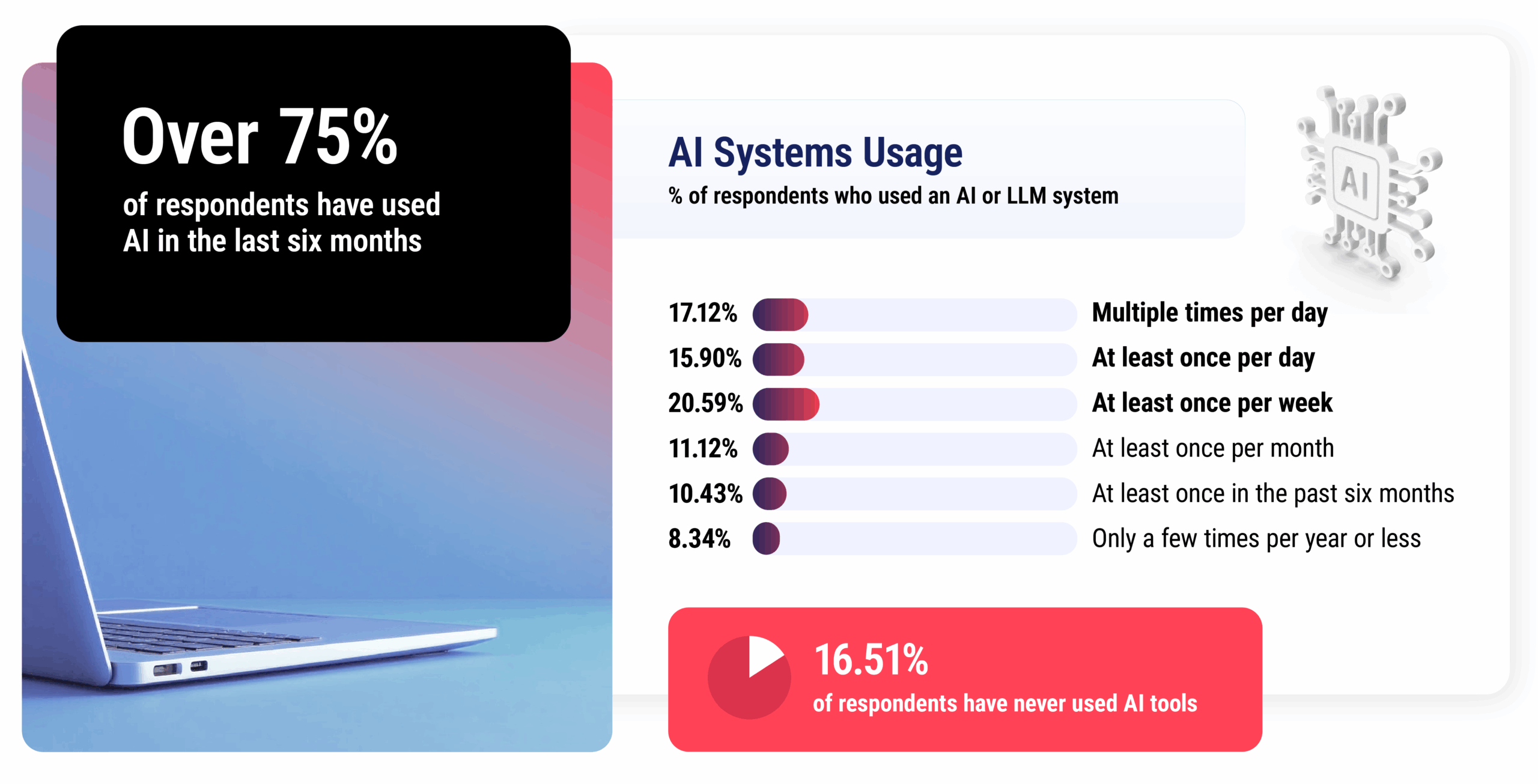
It’s not just hype. Over 75% of Americans said they’ve used an AI system in the last six months. One-third of them—dubbed “Heavy AI Users”—engage with AI tools daily. Another 42% use AI at least once a month, while a smaller but vocal 25% barely touch the stuff or avoid it altogether.
This usage curve maps almost perfectly to what marketers know as the Rogers Adoption Curve. Except this time, it’s not about buying a new gadget—it’s about replacing the way we interact with the internet.
What AI Systems Are People Using?
ChatGPT leads by a mile. Nearly half of respondents (46.13%) reported using it. Google’s Gemini system came in second at 22.76%, while Meta’s AI on Facebook held third at 19.29%. Google holds three of the top six spots, but the real surprise? Lesser-known tools like DeepSeek and WriteAI outranked well-funded platforms like Jasper and Apple’s AI tools.
That’s not great news for Apple. Their platform barely registered at all. In fact, GoDaddy’s Airo and Snapchat’s AI had the same usage rates—0.08%.
Top 5 Most Used AI Systems
- ChatGPT – 46.13%
- Google Gemini – 22.76%
- Meta AI (Facebook) – 19.29%
- Google AI Overviews – 18.94%
- Microsoft Copilot – 15.81%
What Are People Actually Doing With AI?
Search is king. Nearly 30% of respondents said they use AI just to search the web—ironically, something we used to trust Google for.
Other common uses include:
Learning new information (24.76%)
Fixing grammar or spelling (19.80%)
Idea generation (19.64%)
Casual entertainment (16.59%)
Cooking help (13.81%)
Some are even using AI for relationship advice, therapy, and catfishing. Yes, really.
AI vs. Traditional Search: Who’s Winning?
When it comes to shopping, ChatGPT leads Google. For product discovery, 26.32% of Americans said they start with ChatGPT, compared to 23.11% who start with Google. Among daily AI users, ChatGPT’s lead jumps even higher.
In terms of general information, ChatGPT and Google are neck and neck—27.54% versus 26.24%. Google’s lead only holds when including all its AI products (Gemini and Overviews). Bing barely registers.
And for local business discovery?
Google Maps still dominates, but ChatGPT isn’t far behind. 31.54% of people rely on Google’s search engine (including Maps) to find local businesses. ChatGPT clocks in at 21.89%, which is higher than expected considering its spotty location data.
Is AI Making Search Better or Worse?
According to users, better.
40.83% of Americans said AI made web search better. Only 24.5% said it made things worse. Among heavy users, 57.36% say search has improved since adopting AI tools. That might raise some eyebrows considering how often AI responses still rely on shaky sourcing, hallucinations, and vague citations.
But the perception is clear. Even people who barely use AI think it improves the web experience. That’s a major shift.
Which Brand Do People Trust Most?
Still Google—for now. Nearly half (48.39%) of respondents called Google the most trustworthy source of information.
ChatGPT placed second at 26.15%.
But trust erodes with experience. Among heavy AI users, Google’s trust score drops to 40.62%, while ChatGPT climbs to 35.26%. Put another way: The more you use AI, the less you believe Google has all the answers.
So, What Does This All Mean?
We’re watching a power shift in real time. Google’s two-decade grip on search is starting to loosen. ChatGPT is gaining traction not just as a curiosity but as a functional replacement for how people find information and make buying decisions.
Local businesses should pay close attention. If you’re not already planning for AI visibility—beyond SEO and Maps listings—you’re behind. And for everyone else, the message is simple: user behavior is changing fast. Either adapt or disappear from view.
This survey offers more than just numbers. It paints a clear picture of what happens when consumers are given alternatives. AI isn’t a fad. It’s already baked into the way millions of Americans live, learn, and buy. Google’s still dominant, but its lead is shrinking. The next move belongs to the businesses that see this shift for what it is—a warning shot, not a footnote.