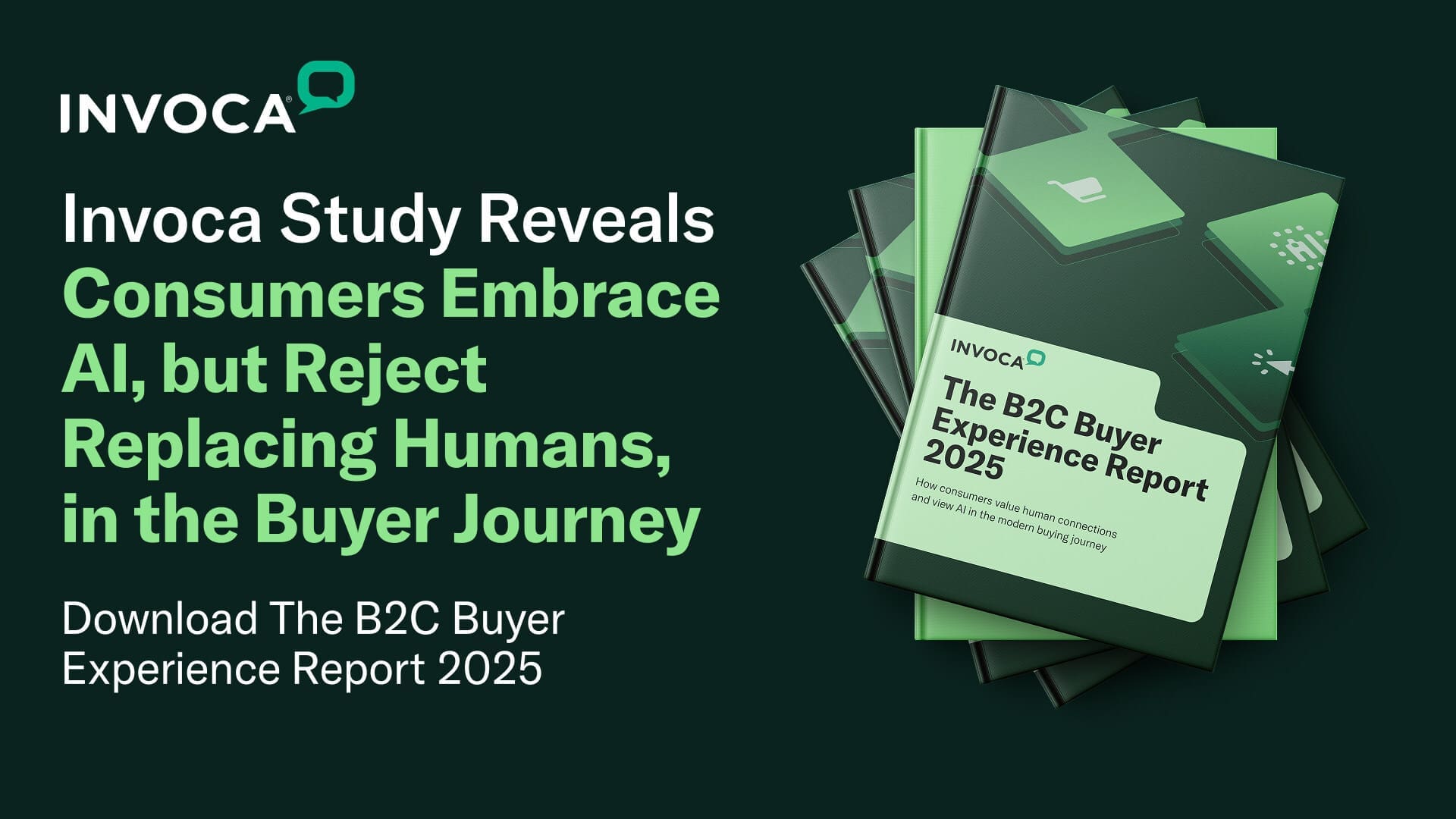
AI may be everywhere, but if Invoca’s latest research is right, it hasn’t earned the right to fly solo—especially when money’s on the line. Invoca’s B2C Buyer Experience Report 2025 was released this week, and it delivers one clear message: consumers are using AI to research and interact with brands, but they’re not ready to give up on real people. Not even close.
Seventy-seven percent of consumers say they’re happy to use a brand’s AI assistant—if they can still easily reach a human. In fact, 67% outright prefer to speak to a person when making high-stakes purchases like cars, healthcare, or financial services. That preference has real consequences: 84% say human connection still matters during major buying decisions, and 70% will pay more for great service.
Peter Isaacson, CMO at Invoca, puts it plainly: “It’s not about AI versus humans. It’s about using AI to empower people to connect, convert, and close when it matters most.”
AI is assisting, not replacing—and consumers want it that way
Consumers are warming up to generative AI platforms like ChatGPT, Claude, and Gemini. Forty-one percent say they’re using those tools at the start of their buying journey—to compare options, generate questions for salespeople, or clarify complex topics.
Still, only 2% rely mostly on generative AI for decision-making, and 10% lean on it more than traditional search engines. For now, search remains the anchor. In fact, 46% still use search engines alone when researching high-stakes purchases, while 44% mix AI with search—but tend to lean more on the latter.
This shift is most visible among younger consumers. Gen Z leads the way with 61% using generative AI to help make purchase decisions, while only 11% of Boomers do the same. Yet even Gen Z isn’t letting AI fully take the wheel.
Brand AI is everywhere—but it doesn’t always impress
According to the survey, only 16% of respondents said they hadn’t interacted with a brand’s AI at some point during a major purchase. For those who had, the feedback was split. About 35% said AI made the experience better, another 35% said it made no difference, and 29% said it actually made things worse.
The emotional reaction to AI is also mixed. While 37% said they felt positively once they realized they were talking to AI, 30% felt indifferent—and another 30% felt negative. As many as 60% said they felt forced to use AI at least some of the time.
Worse yet, 46% of consumers said interacting with AI made them feel less valued by the brand. Only 28% felt more valued. So while AI may speed things up, it’s not doing brands any favors if it comes across as a barrier to real help.
Phone support is not dead—it’s gaining ground
One of the most surprising findings in Invoca’s report? The old-fashioned phone call is making a comeback.
In 2022, 32% of consumers said they preferred calling a business when they needed help. Today, it’s 44%. And 67% of consumers say they actually called a business at some point during their most recent high-stakes purchase.
When asked what they did when they needed help, consumers consistently chose calling over email, chat, AI bots, or even in-person visits. It’s not nostalgia—it’s necessity. People want fast, clear answers, and a phone call still delivers that best, especially when context and empathy are critical.
Despite AI’s progress, many consumers still hit the phone when the stakes are high. That includes 70% who prefer to call when completing a complex sale, and 28% who said they called simply because the information they needed wasn’t available online.
Where AI shines—and where it flops
Consumers do see value in AI when it works quickly and clearly. Seventy-four percent prefer using AI when it resolves issues faster than a human. They’re also fine with AI handling simple tasks (39%) or helping them avoid long hold times (34%). But only 25% said they prefer AI specifically because they don’t want to talk to a human.
Asked what AI gets wrong, the answers were clear:
- 53% say AI struggles with solving complex problems.
- 44% say it fails at empathy.
- 43% say it misses context or nuance.
- 39% say it lacks personalization.
- 30% say it can’t follow through.
In short, AI can handle the basics, but it breaks down when the situation calls for human judgment.
Gen Z is open to AI. Boomers? Not so much.
Age is a major factor in AI perception. Among Gen Z, 58% said a brand’s AI improved their opinion of that company. That number drops to just 5% among Boomers. Similar splits appear across other measures of satisfaction and trust. For example, 56% of Gen Z said they trust answers from AI most of the time, compared to only 20% of Boomers.
Yet both groups—roughly 40% each—agree on one thing: AI is likely to provide inaccurate or misleading information. So even the tech-savvy crowd isn’t blind to its flaws.
The hold music is still killing deals
Fifty percent of consumers say they’ve hung up after being put on hold. Most people expect a 3–5 minute wait before frustration sets in, and 11% won’t even hold for two minutes. That familiar “we’re experiencing higher than normal call volumes” message? Sixty-six percent of consumers say it makes them hang up.
There’s some good news: the automated callback option is gaining traction, with 42% of consumers preferring it over waiting. And only 9% say they’d rather call another business than wait for a callback.
Where things are headed next
Despite all the hesitation, 57% of consumers believe AI will become more helpful in the next three years. Forty-two percent even think it will eventually replace human agents entirely—though 27% of them admit they won’t be happy about it.
What do consumers want AI to do better?
- 39% say: get them to a real person faster.
- 22% want smarter responses.
- 19% want more personalization.
- 11% want AI to sound more natural.
- Just 8% say they don’t want to use AI at all.
The bottom line
Invoca’s 2025 Buyer Experience Report confirms what many brands are already sensing: AI is part of the sales and support process now—but it doesn’t replace trust. Consumers want fast answers, but they still need the human touch when it matters. Companies that strike the right balance will see results. Those that lean too hard on automation risk losing customers, fast.
Human-first isn’t just a slogan—it’s a revenue strategy.