Bluehost announced on November 5 a global run of AI events for small businesses: a free virtual small business summit on November 10 with Gary Vaynerchuk and Codie Sanchez, plus an AI Builder Tour through 10 cities on four continents that runs into January 2027. The number in the release that matters most is Bluehost’s own. Only 16 percent of the small business owners it surveyed have deployed an AI agent.
The events are a marketing push, and a sensible one. Bluehost’s parent, Newfold Digital, also owns Network Solutions, Crazy Domains, HostGator and Yoast. The company that sells you the domain name wants to sell you the AI that builds the website on it. GoDaddy is making the same bet with its Airo tools. That trend is good for anyone who registers a domain and never gets around to building the site.
Here is my caution, from years of cleaning up small business websites. An AI that builds your site still needs a babysitter. Someone has to read what it wrote, check how it describes your company, and confirm that search engines can actually find and index the result. Easy to build does not mean safe to ignore.
What Bluehost Announced
The Small Business Growth Summit runs online on November 10 from noon to 6 p.m. Eastern, with watch parties in New York, San Francisco and Austin. Speakers include Vaynerchuk, Sanchez, TikTok’s Brendan Jacobsen, Google’s Farhaz Karmali and Newfold CEO Sachin Puri. The agenda also lists an SEO panel with Loren Baker of Search Engine Journal, Aleyda Solis and Alex Moss of Yoast.
The AI Builder Tour is aimed at developers and founders. It started in Florianópolis, Brazil, on October 30, stops in Austin, San Francisco, London and New York among others, and ends in Chicago on January 12, 2027. Bluehost runs it with community groups AI Tinkerers and AI Camp.
“But access to AI alone isn’t enough,” said Sachin Puri, Chief Executive Officer of Newfold Digital.
I agree with him. I would take the thought one step further.
What Bluehost’s Own Survey Shows
The 16 percent figure comes from Bluehost’s State of Small Business AI Confidence study, fielded in May with research firm ListenLabs. It surveyed 350 U.S. owners of businesses with one to 50 employees, with a margin of error of plus or minus 5.2 points. Bluehost sells to exactly these owners, so read the numbers with that in mind. I covered the study in June and flagged that its headline finding is a correlation, not a cause.
Two other numbers in the report tell the more interesting story:
- Only 6 percent of owners highly trust AI to write in their brand voice.
- The top tasks owners want an AI agent to handle include website and SEO updates.
Put those side by side. Owners do not trust AI to sound like them, yet they want it maintaining the website and the SEO. Both instincts are reasonable. Acting on the second one without the first is how a small business ends up with a site that ranks for the wrong things and says things the owner never would.
Why an AI-Built Site Needs a Babysitter
An AI site builder works from a short prompt and a lot of guessing. It fills gaps with plausible copy. Plausible is not the same as accurate.
How It Represents Your Brand
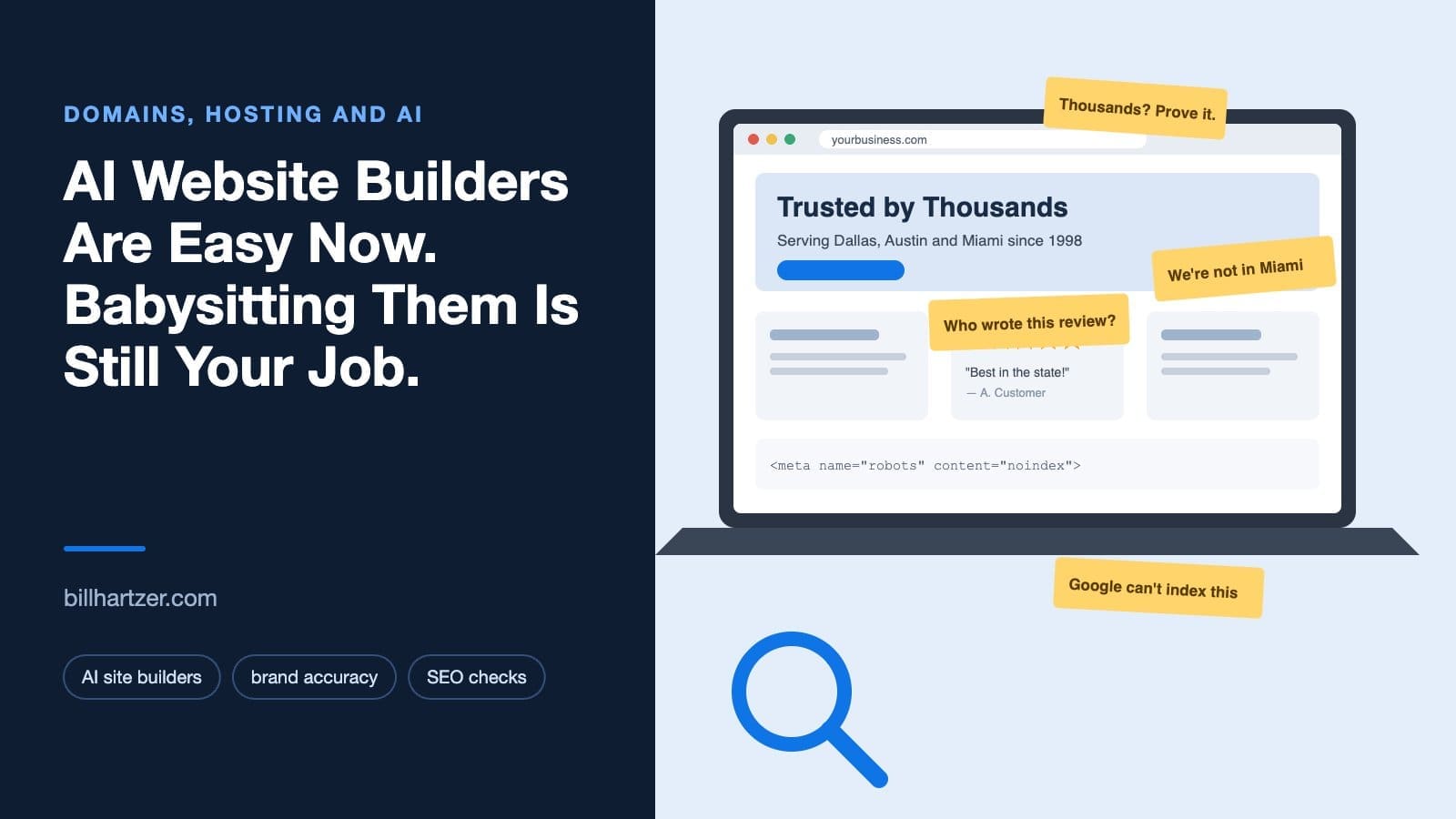
Read every page before it goes live, and again after any AI update. Look for services you do not offer, cities you do not serve, credentials you do not hold, and testimonials nobody gave you. Stock language like “trusted by thousands” is harmless until a customer asks which thousands. A false claim on your own site is your claim, whoever typed it.
The words you publish also feed the AI answers people read about you later. ChatGPT, Gemini and Google’s AI Overviews all draw on what a business says about itself. An invented detail on your About page can turn up in an AI answer months from now.
How It Handles Search
The technical side needs the same attention. Check the title tags and meta descriptions on every page, not just the home page. Make sure the business name, address and phone number match your Google Business Profile exactly. Confirm that the site is not blocking search engines.
That last check matters more than it sounds. Last year I found a new site that Google would not index for weeks. The cause was a robots.txt file that Cloudflare had created automatically, a setting nobody on the project had chosen. Platforms make decisions on your behalf. AI builders make many more of them, and most owners never look.
What It Leaves Behind
AI-generated pages can carry leftover code and formatting that readers never see but browsers and crawlers do. I wrote about how hidden HTML can expose AI-generated content. It is worth a look at the page source before launch.
What To Check Before and After Launch
- Read every page for claims, services and locations that are not true.
- Remove any testimonial, review or statistic you cannot back up.
- Match your business name, address and phone number to your Google Business Profile.
- Confirm robots.txt and page settings allow indexing, then verify the site in Google Search Console.
- Review titles, meta descriptions and headings for each page.
- Recheck the site after every AI update, the same way you would review an employee’s work.
Registrars and hosts putting AI builders next to the domain checkout is a good thing. More small businesses will get a website, and some of them will get a better one than they would have built alone. The AI does the first draft. The owner still signs off on it, because the owner is the one whose name is on the domain.