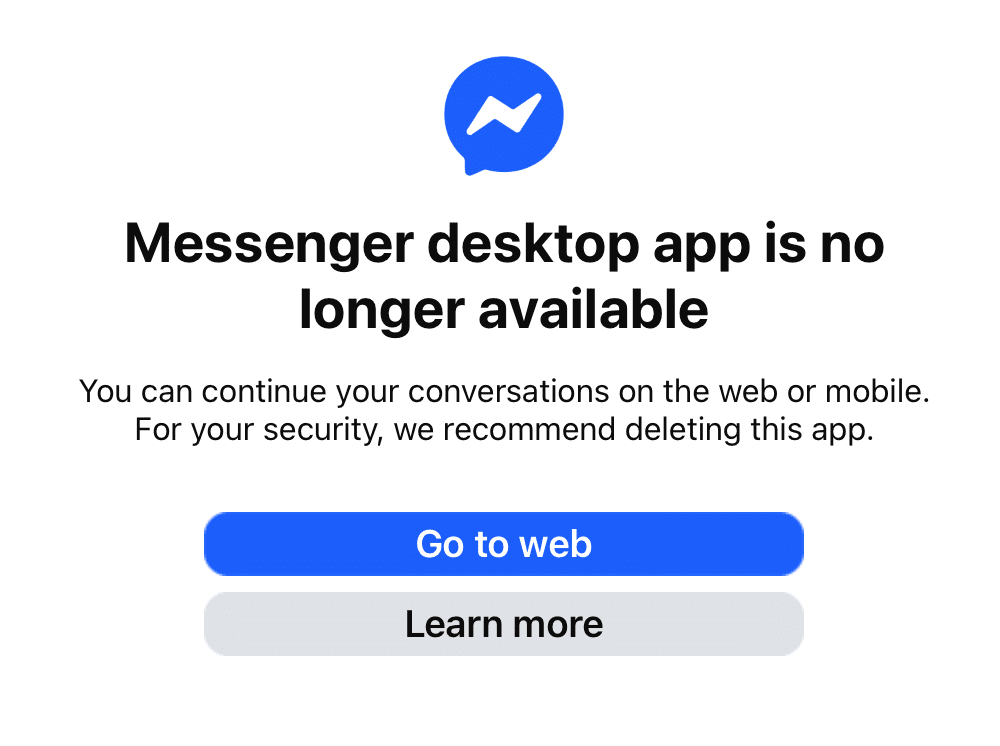
As of December 15, 2025, Meta has officially turned off the Facebook Messenger desktop app for both macOS and Windows. Users opening the app are now being redirected to the Facebook website or Messenger.com to continue their conversations.
The shutdown marks the end of a relatively short chapter in Messenger’s long history. While Facebook Chat dates back to 2008, the native desktop app only arrived in 2020, at the height of the COVID-19 pandemic. Just over five years later, it is gone.
Why the Desktop App Never Fully Took Off
From the start, Messenger’s desktop app struggled to justify its existence. It lagged behind business-focused competitors like Zoom and Webex, supporting fewer video call participants and lacking core features such as screen sharing or easy URL-based meeting access.
As video and voice calling gradually became available directly through web browsers and the main Facebook mobile app, one of the desktop app’s few advantages disappeared. What remained was a familiar chat interface that offered little beyond what users already had elsewhere.
A Trail of Technical Transitions
Behind the scenes, Messenger’s desktop app went through several technical transformations. On macOS, it moved from Electron to React Native Desktop, and later to Apple’s Catalyst framework, which allows iPad apps to run on the Mac.
Catalyst has long faced criticism from both developers and users. Developers cited the additional effort required to maintain apps, while users often complained that Catalyst apps felt awkward and insufficiently native. On Windows, the app was downgraded to a progressive web app, further reducing the incentive to maintain a standalone client.
Messenger’s Gradual Reabsorption into Facebook
The shutdown did not come out of nowhere. In 2023, Facebook began folding Messenger back into the main Facebook app, reversing the earlier strategy that forced users to install Messenger separately.
By October 2025, Meta made its intentions clear. The company announced that the desktop apps would be deprecated by year’s end and advised users to set up a PIN to preserve their chat history before migrating to the web. New downloads were quietly removed from the Mac App Store, while existing installations were allowed to limp along until the cutoff date.
What Users Will See Now
Users who missed the announcement were eventually notified inside the app itself. A pop-up warned that the Messenger desktop app was going away and encouraged users to continue chatting through their web browser.
Mac and Windows users are now directed to Facebook.com for Messenger access. Those who use Messenger without a Facebook account are being redirected to Messenger.com, where they can continue logging in without creating a Facebook profile.
The mobile apps for iOS and iPadOS remain unaffected and continue to function as normal.
A Short Life Compared to Messenger’s Long History
The removal of the desktop app is unusual because the Messenger service itself is not shutting down. Instead, Meta has chosen to eliminate support for specific platforms while keeping the broader ecosystem intact.
Messenger has evolved through multiple eras, from Facebook Chat in 2008, to the iOS app following Facebook’s acquisition of Beluga in 2011, to the forced separation of Messenger from Facebook’s core app in 2014. The macOS version, launched in March 2020, turned out to be one of the shortest-lived iterations.
Useful, Then Redundant
When it launched, the desktop app filled a real need. Lockdowns and remote work pushed people toward larger screens for communication, education, and group video calls. Messenger Rooms briefly positioned the app as a competitor to enterprise conferencing tools.
Over time, those features were duplicated in browsers and mobile apps. What remained was a desktop client that consumed system resources while offering no meaningful advantage over Safari, Chrome, or a phone already sitting in most users’ pockets.
Why Meta Likely Pulled the Plug
Meta has not offered a detailed explanation for killing the desktop app, but the reasoning is not hard to infer. Maintaining native apps costs time and money. If usage numbers do not justify that investment, the incentive to shut them down is strong.
With Messenger readily accessible through browsers and mobile devices, the standalone desktop app became increasingly difficult to defend. From Meta’s perspective, it was a redundant product in a world already saturated with access points.
Gone, but Hardly Missed
Facebook Messenger remains available on nearly every platform imaginable, including browsers, smartphones, tablets, and even Meta’s own headsets. The desktop app’s disappearance is unlikely to disrupt most users, many of whom had already migrated elsewhere.
The Messenger desktop app may have been useful at the right moment in history, but in the end, it became a casualty of consolidation, cost-cutting, and a browser-first strategy. Its exit will be quiet, and for most users, barely noticeable.