
Liftoff’s 2025 Mobile Ad Creative Index isn’t based on theories. It’s based on 4.7 trillion impressions, 263 billion clicks, and over 1.1 billion installs from January 2023 through May 2025. That’s not a guess—it’s a field test with global reach. And when that much real user data speaks, it’s worth listening.
The report breaks down what high-performing mobile apps are doing right—and where others are falling behind.
Consumer Apps Get Interactive—But Not in the Way You Think
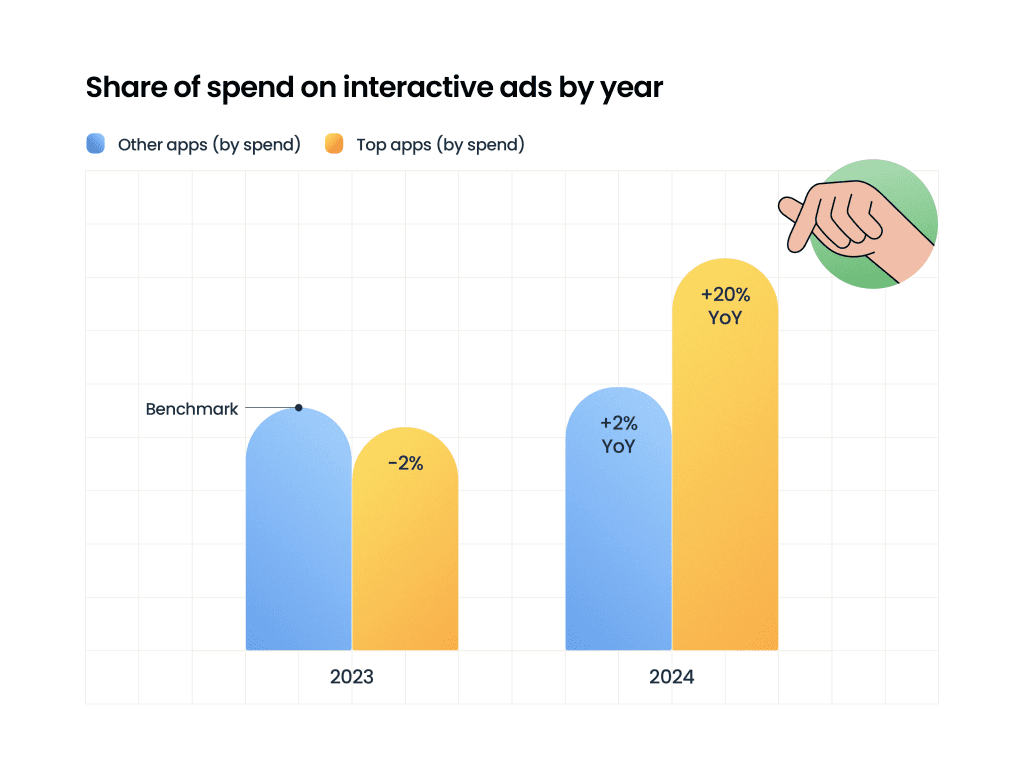
Top Apps Spent 10x More on Interactive Formats in 2024
Interactive ad formats aren’t new, but top advertisers are rethinking how they use them. In 2023, top-spending consumer apps barely outpaced the rest of the field in interactive ad spend. By 2024, that changed. Their share of interactive ad spend jumped 20 percentage points. For everyone else? Just 2 points.
And it’s not just about doing something flashy. Advertisers are breathing new life into known formats—carousels, social scrollers, scratch-offs—by layering in subtle upgrades. A basic carousel becomes a 3D animation. A static scroll feed gains movement or video.
For example, Bigo Live turned a standard social scroller into a dynamic video feed. The format remained familiar, but the engagement spike was measurable.
AI Is Speeding Up Creative Iteration
Advertisers are no longer rebuilding from the ground up. They’re upgrading their best-performing assets—2D visuals are upgraded with 3D motion, static content becomes animated, and variations can be spun up in minutes. This lets teams A/B test and scale what’s already working instead of starting cold.
It’s not guesswork anymore. It’s tuning proven winners.
Sports Betting and Crypto Apps Use FOMO to Their Advantage
This category is built around urgency, and Liftoff’s data confirms it: ads that emphasize limited-time offers or volatile market events perform better than generic brand spots.
Banner Ads + Urgency = 93% IPM Uplift
Banner ads that show live odds and include urgent CTAs like “Bet Now” drove 93% more installs per thousand impressions. Add in a reward, and the effect grows. One example: Binance saw success by using simulated coin rises in its creative, then followed up with carousels featuring Ethereum and Dogecoin. The design wasn’t complicated—but it was timely.
Product Ads Are Built for This Moment
Liftoff’s Product Ads take dynamic content one step further. Sports betting apps used them to surface real-time odds, geo-targeted offers, and direct deep links to specific matchups. For bettors, this meant relevance. For advertisers, it meant conversions.
UGC Is More Than a Trend—It’s the Default Now
UGC (user-generated content) is no longer optional. It’s now one of the most reliable drivers of performance in mobile ads, especially for consumer apps.
152% Higher Conversion Rates From UGC Creatives
App advertisers that leaned into UGC-style video ads saw conversion rates from impression to install rise by 152% on average. And in terms of budget, top apps increased their UGC share by 11 percentage points in 2024, compared to only 2 points for the rest.
Social and utility apps saw the sharpest increases—nearly 30 percentage points—making UGC the format with the highest rate of growth in these verticals.
What Works in UGC: Real People, Real Actions
Liftoff’s team outlined proven formats for UGC that consistently outperform:
- Walkthroughs that show clean app UI and ease of use
- Two-person skits for crypto and sports betting to humanize features
- First-person POVs in e-commerce to show real-life product interaction
- Lifestyle content for social apps, especially when stitched from multiple creators
Combining top creative concepts with top-performing assets led to a 350% increase in ad spend efficiency. That’s not marginal.
AI Is Scaling UGC Globally
With AI localization, teams are now dubbing, lip-syncing, and translating content without re-shooting. You can keep a creator’s voice while swapping the language and geo. It’s a way to take a single top-performing asset and turn it into a dozen geo-specific campaigns.
Playable Ads Drive Real Performance—but Many Still Aren’t Using Them
16x Better ITIs for Non-Top-Spending Apps
Playables aren’t just a trend in gaming—they’re producing results. For non-top-spending advertisers, playable ads delivered 16 times the impression-to-install rate (ITI) of non-playables. For top spenders, the lift was 8x. Still, many advertisers aren’t allocating enough budget here, even with numbers like these.
Why Customized Playables Work Better
The key isn’t just playable format—it’s what happens inside the playable. Liftoff is experimenting with “interactive first” formats, where the ad starts with engagement, not video. In early results, Liftoff Exclusive Ads (custom-built interactive ad experiences) produced 2.5x the average ITI of standard playables.
These ads also adapt on the fly—if users don’t interact, the ad changes content to re-engage. It’s a better use of ad real estate and attention.
Longer Can Be Better—If You Earn It
Gaming ads are shifting toward 45-60 second lengths when paired with interactive elements. For non-gaming? Shorter formats still work best—but as more interaction is added, that could change.
Metaplay Ads: The Right Motivations, the Right Audience
Top games are turning to “metaplay” formats—ads that use alternative gameplay to draw in new players. But the winning edge comes from matching these ads to the mindset of the publisher’s audience.
Matching Motives Matters
According to Liftoff’s data, most casual and midcore game installs come from puzzle and hypercasual placements. That means advertisers should match the motivations of those players. If users are coming from games like Candy Crush, they’re probably drawn to challenges or solving puzzles—not combat or building simulations.
Games like Toon Blast and Project Makeover leaned into “thinking and solving” mechanics in their metaplay creatives, and saw measurable IPM increases.
Targeted Metaplay = 93% More Installs-Per-Mille
Ad spend on well-matched metaplay creative jumped by 93% year over year. Meanwhile, “core gameplay only” creatives dropped by 23%. This isn’t a call to mislead users—but to find alignment between your app and where your ads are shown.
Live Events Drive Spikes—Especially for Re-Engagement
LiveOps (live operations) strategies are now baked into top-performing campaigns. Apps are using event-driven creatives to reactivate lapsed users or boost short-term revenue.
Live Events Tied Directly to Revenue Peaks
In Monopoly Go!, install and revenue spikes tied directly to in-game events. In Angry Birds Dream Blast, showcasing new challenges brought back users motivated by progress. Lily’s Garden did the same by tapping into treasure-collecting behavior.
Live event creative is especially effective in retargeting campaigns—since many events are gated to mid- or high-level players.
Where Gen AI Is Headed Next
Right now, gen AI is helping with creative production—translation, asset variation, and testing. But there’s much more on the horizon.
Only 24.6% of Ad Teams Are Using AI for Dynamic Content
That means most are missing out. Liftoff’s Exclusive Ads point toward what’s possible: building ad experiences that shift in real time, based on behavior or performance. Long term, the winning campaigns will be the ones that combine user data, AI tools, and creative iteration in near real-time.
What the Data Says Loud and Clear
If you’re still relying on static video, celebrity branding, or generic banners, you’re competing with one hand tied behind your back. The top mobile apps are using interactive formats, UGC, customized playables, and AI-driven tools to run campaigns that speak directly to users.
The 2025 Mobile Ad Creative Index doesn’t just confirm what works—it shows how fast things are changing, and which tactics are already outperforming the rest. Liftoff’s data isn’t a prediction. It’s a report card.
And if your campaigns aren’t aligned with these findings, it might be time to make some hard decisions.