User Centric Releases Results of Eye Tracking Study: Google Versus Bing
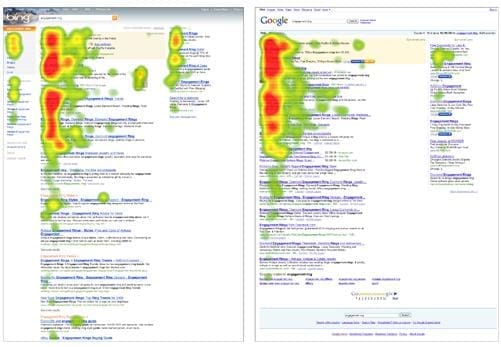
User Centric has released the results of an eye tracking study that compares data between Google and the new Microsoft search engine Bing. What is interesting to note is that sponsored links are attracting more attention than they are on Google. Google users appear to be more aware of the sponsored links.
User Centric used eye tracking technology to capture 21 participants’ eye movements as they completed two informational and two transactional search tasks, each in Google.com and Bing.com.
The two search phrases that were used during this eye tracking study:
Learn about eating healthy
Book a last minute vacation
![]()
User Centric used eye tracking technology to capture 21 participants’ eye movements as they completed two informational (e.g., “Learn about eating healthy”) and two transactional (e.g., “Book a last minute vacation”) search tasks in each engine.
According to User Centric, “Preliminary findings revealed comparable amount of visual attention on organic search results and top sponsored links across both search engines. Sponsored links on the right, however, attracted more attention on Bing than they did on Google. On average, across all four tasks, 42% of participants looked at Bing’s sponsored links on the right; by contrast, only 25% of participants looked at Google’s right rail links.”
When it came to the amount of attention paid to the organic search results, Bing and Google did not differ: users spent an average of seven seconds looking at the organic search results. They were both about the same amount of time spent.
During a search, 90 percent of users tested looked at the “sponsored links”. User Centric also reports that during “transactional searches” (searches that involved someone buying something or searches related to completing a transaction), “participants would spend more time looking at the sponsored results on top (~2.5 seconds) than they did on informational searches (~1.5 seconds).” But, on the Bing.com search engine, participants of the study spent more time looking at the paid links (sponsored links). About 42 percent paid more attention to the sponsored results on Bing. About 25 percent on Google.
More details of the study are here on the User Centric site.
Related posts:
- comScore Releases May 2009 Search Engine Rankings comScore, Inc. (NASDAQ: SCOR), has released its monthly comScore qSearch analysis of the United States search marketplace. In May 2009, Americans conducted 14.3 billion...
- Bing Search Engine Losing Users Fast Bing, one of the newest search engines on the block powered by Microsoft, had a great opening with a strong marketing campaign, but lately...
- Study Proves Facebook and Digg Visitors More Loyal; Twitter in Last Place Are you a loyal visitor? When you browse the web every day, when you log on, are there websites that you go to every day?...
- comScore Releases August 2009 Search Engine Rankings comScore, Inc. (NASDAQ: SCOR) has released their monthly comScore qSearch analysis of the United States search marketplace. In August 2009, Americans conducted more than...
- comScore Search Engine Rankings for June 2009 comScore, Inc. (NASDAQ: SCOR) , a leader in measuring the digital world, has recently released its monthly comScore qSearch analysis of the United States...

Jun 8th 2009
Lot’s of Russians in the mix, didn’t see any Americans…all of our geeks are probably playing wow instead of coding.
Jun 9th 2009
looks like the Adwords guys better optimize their Bing ads
Jun 9th 2009
It seems common sense and logical. Most people use Google…because of this, our eyes automatically will skip the “sponsored” links. With a new search engine, the eyes will naturally scan more, as we don’t know what to expect. I’d be baffled if money was put into this…
Jun 10th 2009
This is an interesting study but I don’t know if Google will change their paid links format. The two images (google and bing) are really helpful and proves that the top 5 search result and the last entry of page 1 is more likely to be seen by the searcher.
Jun 10th 2009
I agree with Dara, we skip sponsored ads and search results. Bing is new, we scan more. I think Bing will work for a while because it is the new, hot thing. Once everyone uses it, it will fade away like Excite and Lycos. Regards!
Jun 11th 2009
Maybe if the new Google optins were shown by default, the pattern would be different.
Jun 13th 2009
That’s definitely a good news for Bing and M$. But this might be temporary. Everytime I have changed layout on my websites, I see an increase in CTRs. It’s only a couple of months before people go ‘blind’ to ads on Bing.
Jun 15th 2009
I don’t know if Google will change their paid links format. The two images (google and bing) are really helpful and proves that the top 5 search result and the last entry of page 1 is more likely to be seen by the searcher.
Jun 15th 2009
It would be very earlier to compare Bing with Google however no doubt Bing seems revolutionary.
Jun 16th 2009
Shows if you are going to use sponsored search, you’ll likely get a higher CTR on Bing than Google. Will behaviour change over time though?
Jun 16th 2009
I have to admit I am continually amazed at the testing that can be done on consumer behavior. What is next?
Jun 16th 2009
The two images (google and bing) are really helpful and proves that the top 5 search result and the last entry of page 1 is more likely to be seen by the searcher.
Jun 17th 2009
i still love google
Jun 17th 2009
Shows if you are going to use sponsored search, you’ll likely get a higher CTR on Bing than Google. Will behaviour change over time though?
Jun 17th 2009
This test doesn’t seem reliable because of the fact that Bing.com is new. It is too early to tell which search engine is attractive when it comes to sponsored links. The way I interpret it, more eyes are looking at Bing merely because of curiosity. Bing.com still needs to build its name as a search engine.
Marcy
Jun 19th 2009
I don’t see any ads in Bing, I live in India lol! So, no worries for Google Adwords as far as India is concerned
Jun 21st 2009
This is a interesting study, I’m still a big fan of google, maybe I’ll warm up to bing
Jul 3rd 2009
As noted in a number of the previous comments, the novelty effect is a likely explanation for the increase in attention to ads in the right column. The participants had not used Bing prior to the study but all were very familiar with Google. If you go to a site that you have never been to, you will scan more areas than you normally would if you were familiar with the site because you are trying to orient yourself.
However, we speculate that the three column layout of Bing is a factor that led to the increased gaze attention to the right hand column ads. The lessening of the separation between Bing’s organic results in the center and the sponsored ads on the right may be producing the increase in ad views.
User Centric is planning to conduct a follow-up study with Bing users as our participants, so we can determine if the increased amount of attention on the right rail in our first study was due to Bing’s newness or the layout.
Randy Pickard
User Centric, Inc.
Jul 7th 2009
I think that with most of the browsing population using google, there is an inate familiarity with the layout and design. Users know already how to find what they are looking for. With a new search engine like Bing, it’s only natural to have a quick look around first.
Jul 12th 2009
Google is very famous, I don’t know much about Bing, actually I just heard about it just now, in this particular page.
Jul 14th 2009
Bing is relatively new. A more conclusive eye tracing profile should be made in several months from now, where users will be used to its GUI. Right now I would say this is a Microsoft study to attract customers for PPC.
Jul 20th 2009
It is too early to tell which search engine is attractive when it comes to sponsored links. The way I interpret it, more eyes are looking at Bing merely because of curiosity.
Sep 26th 2009
i think bing is rapidly becoming more popular, i have started using it myself and got good appropriate results from searches.. we have also noticed from our site visitor stats a large increase in visitors originating from bing searches
Nov 4th 2009
Nice post! Very helpful for a newbie like me. I am just starting to promote my site and these infos give me ideas on how should I do it. It will really help me as an affiliate marketer. Please continue posting informative blogs.