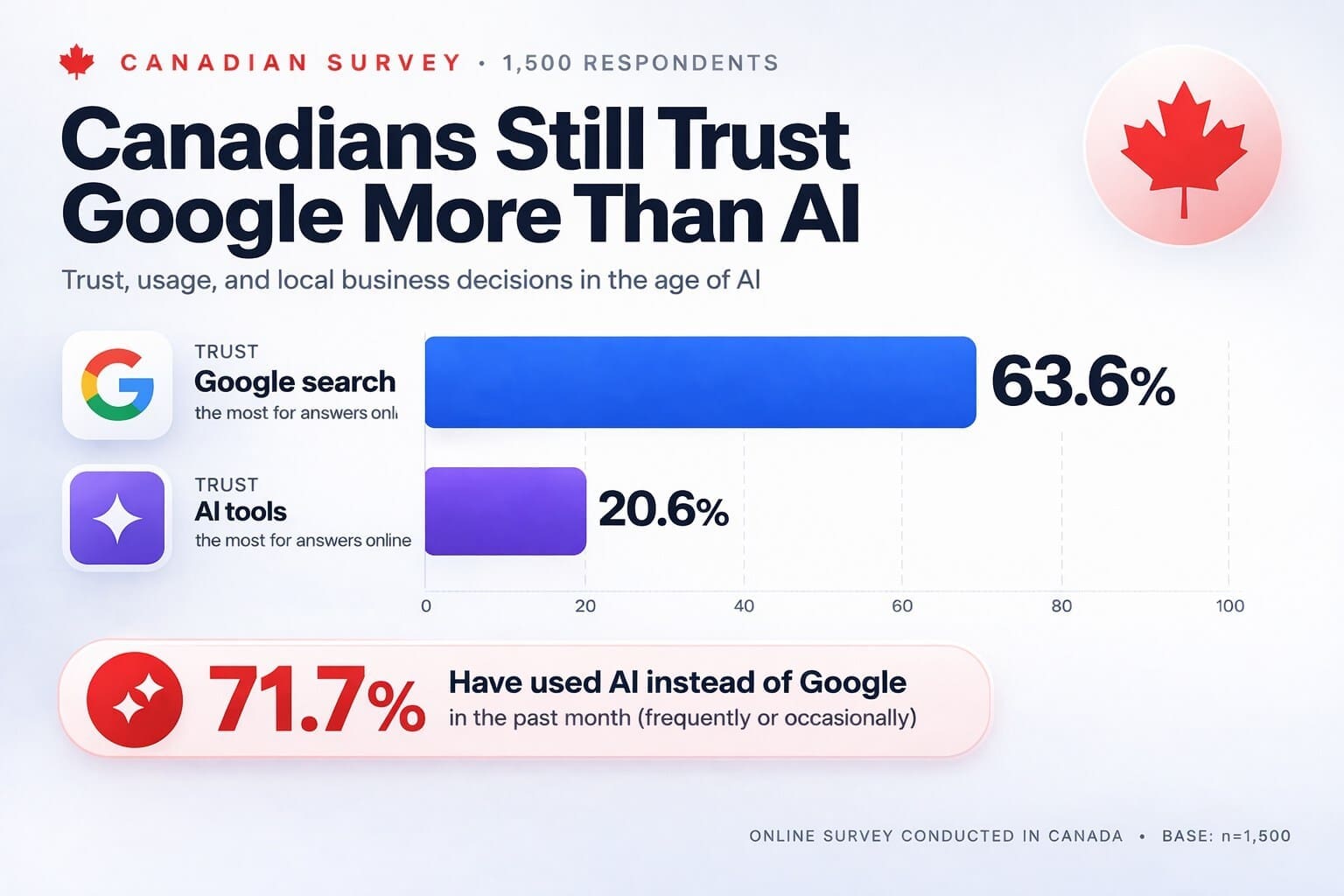
A new survey from Little Dragon Media reveals a split behavior that many marketers have suspected but lacked data to confirm. Canadians are experimenting with AI tools at a high rate. At the same time, they still rely on Google Search for answers they trust.
The numbers are direct. No spin needed.
Out of 1,500 respondents, 71.7% said they used AI instead of Google in the past month. That includes 33.9% who use AI often and 37.8% who use it occasionally. Yet 63.6% still trust Google the most. Only 20.6% said they trust AI tools above all else.
That gap tells a story. People are curious. They test AI. Then they double-check on Google.
Behavior Is Changing Faster Than Trust
This is the key takeaway. Behavior moved quickly. Trust did not.
Christina Voll, an AI-focused growth marketer at Little Dragon Media, explained it in plain terms. People use AI to explore options. They use Google to confirm decisions.
That pattern shows up across industries. A user might ask ChatGPT or another AI system for recommendations. Then they search Google, read reviews, and verify details before taking action.
It is the digital version of asking a friend for advice and then checking the facts yourself.
Search Still Anchors Online Credibility
Google continues to act as a primary trust signal. That is especially clear in local business decisions.
Nearly half of respondents, 49.7%, said Google reviews influence their choice the most. Only 10.0% pointed to AI recommendations as the top factor.
This reinforces a long-standing principle in SEO (Search Engine Optimization). Visibility matters. Reputation matters more.
A business can appear in search results. That gets attention. Strong reviews close the deal.
Younger Users Lead AI Adoption
Age plays a major role in how people use AI.
Respondents aged 18 to 24 reported the highest adoption rate at 80.7%. This group is comfortable testing new tools. They move fast. They adapt quickly.
Older groups show a different pattern. Respondents aged 55 to 64 showed the highest trust in Google at 71.9%.
This divide is not surprising. Younger users experiment. Older users rely on established systems.
Still, both groups meet in the same place at the end of the process. They want reliable information. Google remains that checkpoint.
What This Means for Businesses and Marketers
This data carries a clear message. AI visibility matters. Search visibility still drives trust.
Businesses cannot ignore either channel.
Search Fundamentals Still Carry Weight
Core elements remain unchanged. A strong website. Accurate business listings. Verified Google Business Profile data. Consistent NAP (Name, Address, Phone Number) information. High-quality reviews.
These are not optional. They form the base layer of credibility.
From an SEM (Search Engine Marketing) perspective, paid campaigns also benefit from this trust bias. Users are more likely to engage with ads tied to known platforms.
AI Visibility Adds a New Layer
AI tools are becoming a discovery channel. They summarize content. They recommend businesses. They influence early-stage research.
This creates a second front for marketers.
Content must be clear. Data must be structured. Information must be consistent across platforms. AI systems rely on these signals to generate responses.
If the data is weak, the output will be weak.
Parallel Strategy Is Now Required
Businesses must manage two tracks at once:
Maintain strong search presence. Maintain consistent brand data. Maintain high review ratings.
At the same time, ensure content is accessible to AI systems. Publish clear answers. Use structured data. Provide authoritative information.
This is not optional. It is now standard practice.
Trust Is Hard to Move
Trust builds slowly. It does not shift overnight.
Google has spent decades earning user confidence. That history matters. Users recognize the interface. They trust the results. They rely on reviews.
AI tools are newer. They are improving fast. Still, trust takes time.
Users notice errors. They question sources. They verify answers.
That behavior will continue for the foreseeable future.
A Market in Transition
The survey highlights a market in transition. AI is gaining ground as a research tool. Google remains the final checkpoint for validation.
This dual behavior will shape digital marketing strategies moving forward.
Businesses that ignore AI will lose early-stage visibility. Businesses that ignore Google will lose conversions.
There is no shortcut here. Both must be addressed with equal attention.
In plain terms, AI may start the conversation. Google still closes it.