Cyrus and Dawn Shepard published the 2026 Google Ranking Factors Expert Survey this morning. One hundred thirty-one SEO professionals scored more than 100 possible ranking factors on a seven-point scale, from strongly positive to strongly negative, producing 13,665 data points and about 43 hours of collective work.
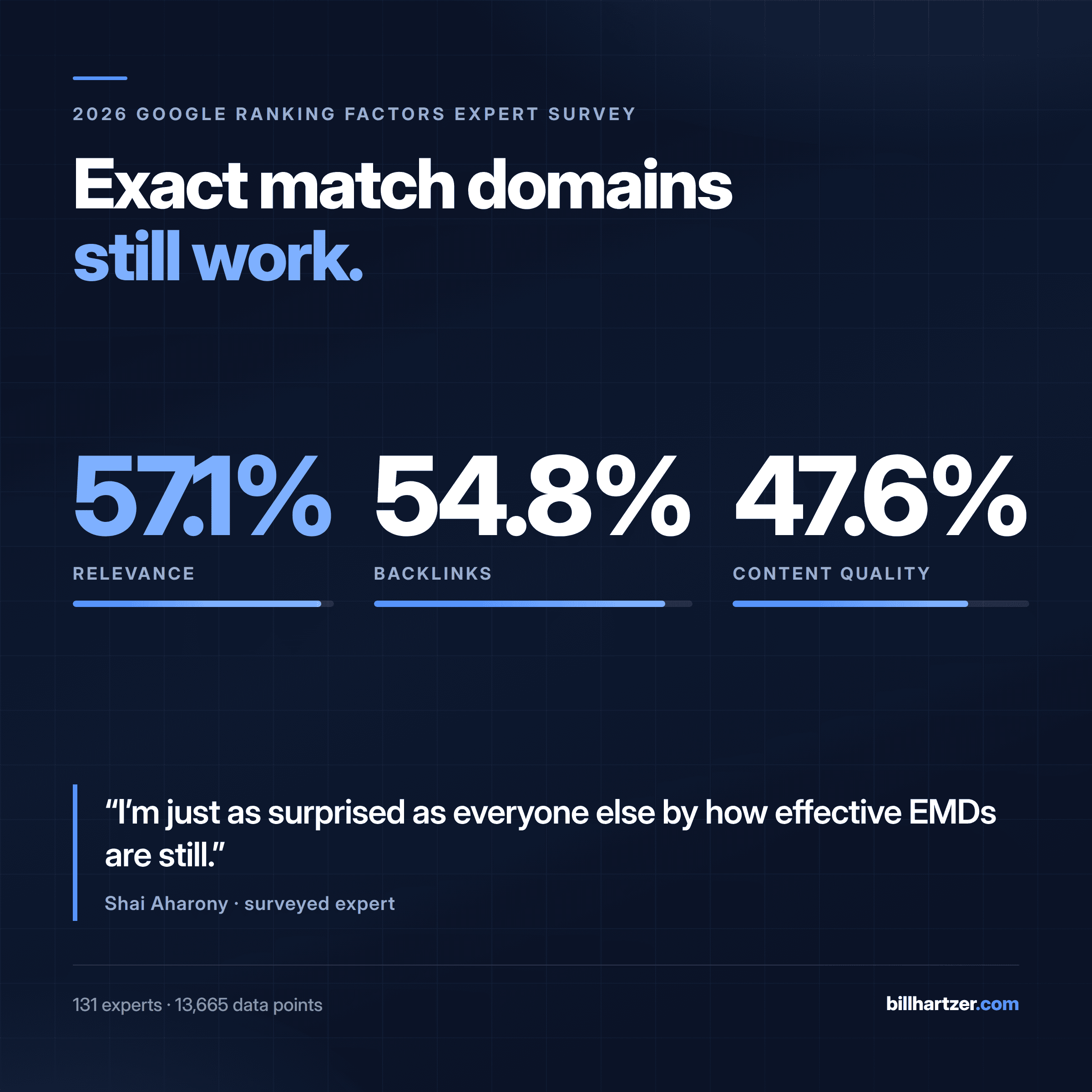
The top of the list will disappoint anyone hoping for a revolution. Relevance came first, named in the top three by 57.1 percent of respondents. Backlinks came second at 54.8 percent. Content quality was third at 47.6 percent.
Same three as a decade ago. Which is the story, though not the one most coverage will run with.
What 131 Practitioners Put At The Top
The full top ten, by the share of experts naming each factor among their three most important:
- Relevance, 57.1 percent
- Backlinks, 54.8 percent
- Content quality, 47.6 percent
- Authority and trust, 36.5 percent
- Behavior and click signals, 29.4 percent
- Brand signals, 27.0 percent
- User satisfaction, 19.8 percent
- Technical SEO health, 17.5 percent
- Topical authority, 14.3 percent
- Internal links, 11.1 percent
Melissa Popp put the relevance finding in the plainest terms available: “You can have technically perfect content with pristine headings and a gorgeous URL structure, but if the person searching wanted one thing and you answered another, none of that saves you.” Every SEO has watched a beautifully built page lose to an ugly one that answered the question. That is the whole finding.
Meta description scored lowest among the relevance factors. Twenty years of clients asking me to rewrite them, and the people who do this for a living rate them near zero for rankings. They still earn clicks, which is a separate argument worth having.
The Two Findings That Actually Moved
Behavior signals came out into the open
Click and behavior signals landed fifth, and user satisfaction seventh. Ten years ago saying that out loud got you an argument. AJ Kohn’s contribution was four words long: “Navboost is still a monster.”
What changed is not Google. What changed is the documentation. The antitrust testimony and the leaked Content Warehouse API material gave the industry names and mechanisms for behavior it had suspected for years, and the survey reflects a profession that has stopped hedging. Kohn’s practical advice follows from it: build your own satisfaction metric, page type by page type, and treat it as a ranking input rather than a reporting nicety.
Gerry White drew the useful line. Bounce rate is a bad metric, he said, but users who pogo-stick back to the results page and pick a competitor are sending a signal Google takes seriously. Return to SERP was in fact the lowest-rated user signal in the survey, scored as an active negative.
Diego Ivo asked the question the whole industry is going to be arguing about by next year: when most browsing is done by agents rather than people, how does anyone measure user satisfaction at all?
Links now do double duty
Backlinks held second place, which by itself is just continuity. The interesting part is what one is now worth.
“With AI, links can have an even greater effect. A client recently got mentioned and linked from a Reuters article a few weeks ago. Their visibility in ChatGPT went up 4x over the next week,” said Andrew Shotland.
That is a single practitioner reporting a single case, so hold it loosely. It also matches what everyone working on AI visibility has been seeing. A link from a trusted publication now feeds two systems at once: Google’s ranking of your page and the corpus that language models pull from when someone asks for a recommendation. The same placement, twice the return.
On what makes a link count, Nitin Manchanda was blunt: “A hundred links from real audiences beat a thousand links nobody ever clicks.” Links from trusted domains and topically relevant pages scored highest. Spam links scored as strong negatives. Geoff Kenyon added the anchor text nuance that trips people up, which is that exact match anchors help to a point and suppress performance past it, and the variable that matters is what share of your profile they represent rather than the raw count.
The Domain Name Finding Nobody Will Lead With
Buried in the relevance section is a line from Shai Aharony: “I’m just as surprised as everyone else by how effective EMDs are still.”
EMD stands for exact match domain, a domain name that is the keyword itself. Google released an algorithm update targeting low-quality EMDs in 2012, and the industry has been declaring them dead ever since. Fourteen years later, working SEOs are still surprised to find them working.
I am not surprised, and I have documented exact match domains ranking on new gTLDs, where designertrunks.shop sits at the top for its keyword. What the 2012 update actually targeted was thin sites hiding behind a keyword domain. It never removed the benefit of a name that plainly says what the business is. A relevant, memorable domain earns better anchor text, better branded search, better click-through from the results page, and more trust from anyone deciding whether to link. Those are four of the factors on the list above.
Domain choice is not a ranking factor in the way a title tag is. It is an input to half a dozen of them, which is more useful and much harder to undo later.
Where The Experts Disagreed
The disagreements are the most valuable part of a survey like this, because consensus findings tend to be the ones you already knew.
Site speed and Core Web Vitals produced the sharpest split. Ryan Jones called them “the most over-rated things in SEO,” arguing the page either loads or it does not. Greg Gifford answered with context: speed matters enormously for a large ecommerce site, and a local car dealership with heavy vehicle photography operates under different expectations. Both are right, which is exactly why blanket ranking factor advice fails.
AI-generated content split the room in a more interesting way. The survey found it viewed negatively only where it was scaled with little added value. Abby Gleason reported good results from high-quality AI content at scale on a site with substantial unique material and heavy human editing. Ross Simmonds framed the reason it cuts both ways: “AI has made content cheap. Anyone can spin up a thousand articles overnight. And Google knows it. That’s why quality is becoming the filter.” Gianluca Fiorelli named the trap on the other side, that too much consensus makes you invisible and too much contrarianism gets you buried.
Technical SEO landed eighth, which the report characterizes as table stakes. Marshall Simmonds said it best: “Tech SEO is a commodity at this point. It won’t necessarily win the race, but it can absolutely lose it.” Dana DiTomaso supplied the proof, describing a client whose canonical tags pointed at unrelated pages and who saw roughly a 60 percent lift in impressions and clicks once it was fixed. That is not a ranking factor doing work. That is a self-inflicted wound being closed, and I find one on most sites I audit.
What This Survey Can And Cannot Tell You
Here is the part to keep in mind before anyone builds a strategy deck out of it.
This is a survey of expert opinion. It is not a correlation study, and it is not controlled testing. It measures what 131 experienced practitioners believe, and belief moves for reasons that have nothing to do with the algorithm changing. Behavior signals did not necessarily get more important this year. What happened is that a court case and a document leak made it professionally safe to say they were important all along.
That distinction matters when you are deciding where to spend. The survey is excellent evidence of where informed practitioners are placing their bets, and Cyrus has never claimed more than that. Treat it as the profession’s collective read rather than a specification, and it earns its place.
The consistency is what I take from it. Relevance, links, quality and trust have topped every credible version of this exercise going back to the Moz surveys, through Panda, Penguin, mobile-first, Core Web Vitals, helpful content and now AI answers. Jan-Willem Bobbink went furthest on brand, arguing a site can survive being technically broken and poorly optimized as long as people search for and talk about it. Roger Montti compressed the same idea into a sentence: branded search is the new link.
Neither man was describing a tactic. They were describing what happens when a business is worth talking about, which is the one ranking factor that has never appeared on any list and has decided the outcome every time.
Read the survey. Then go fix your canonicals.