Semrush has published a study that puts real numbers behind an argument the search industry has been having since ChatGPT started answering buying questions. Does any brand actually own a topic inside an AI (artificial intelligence) assistant, or do the answers reshuffle every time someone asks?
The research, run with Kevin Indig of Growth Memo and published July 20, tracked 1,094 US categories from January through June 2026. It pulled from more than 220,000 domains, over 50,000 brands and roughly 600,000 citations captured in the Semrush AI Visibility Toolkit. You can read the full Semrush ChatGPT topic authority study for the raw charts.
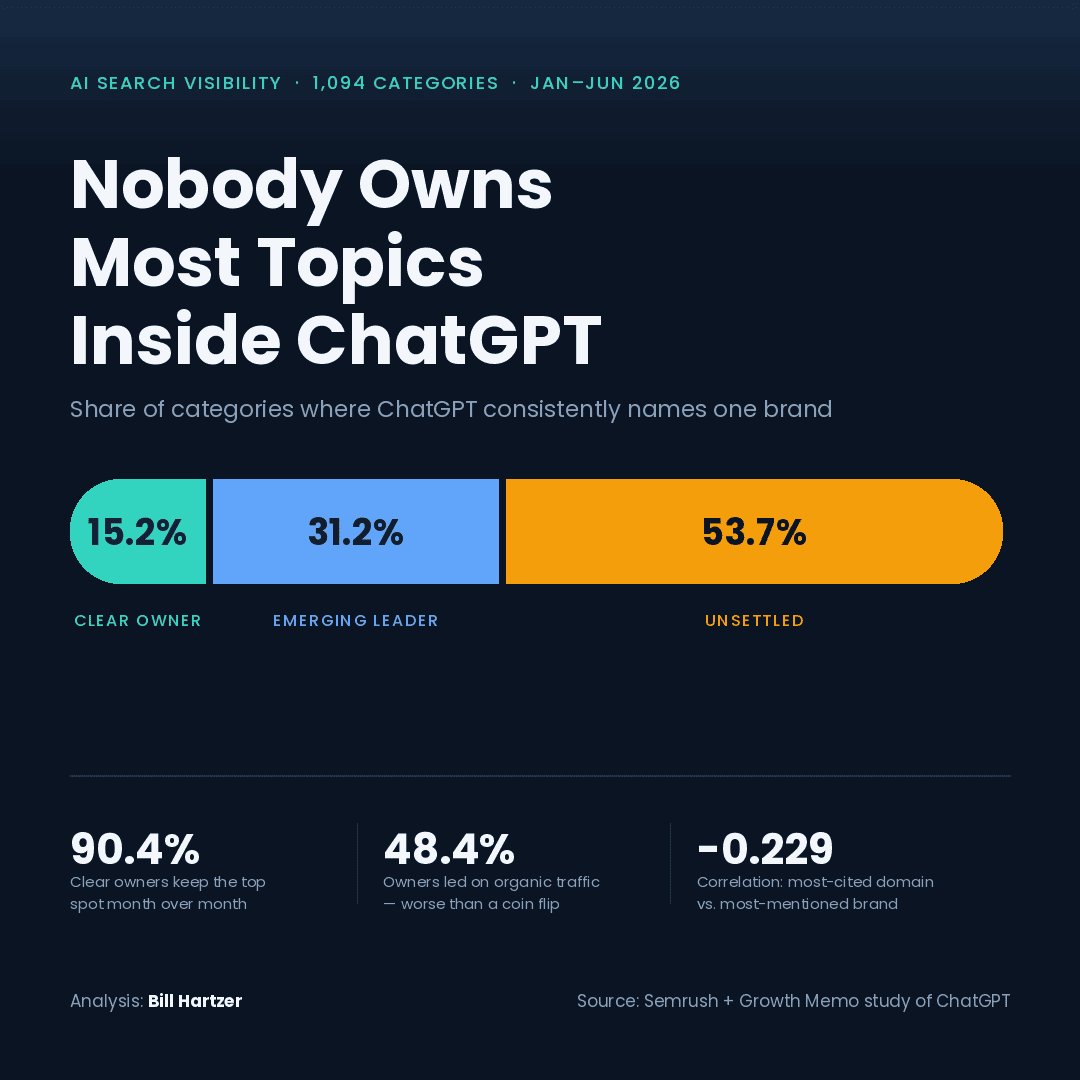
The number that will get quoted everywhere: 53.7% of categories have no brand that shows up consistently. Better than half the map is blank.
The number that should get quoted: the brand that owned a topic had more organic traffic than its runner-up only 48.4% of the time. That is worse than a coin flip.
What Semrush Actually Measured
Each category was built as a cluster of five prompts covering the questions a buyer asks in sequence. What is this. How do the options compare. What are the alternatives. Does it fit my situation. Should I buy it. Categories included payroll software, small business banking and best pillows for neck pain.
For every prompt they logged which brands ChatGPT named and which sources it linked. Three buckets came out of that:
- Clear owner — highest mention share, named in at least four of five prompts, leading the runner-up by at least five percentage points.
- Emerging leader — the most-mentioned brand hits three prompts but misses the owner threshold.
- Unsettled — no brand reaches three prompts.
One methodological choice deserves attention up front. Semrush scored brands on mentions in the answer text, not on which domains got cited. The justification is earlier research finding that 74% of users picked the top-mentioned brand as their final choice. That borrowed statistic carries a lot of weight.
Half The Map Is Blank, And The Valuable Half Is Blanker
The split across all 1,094 categories: 15.2% have a clear owner, 31.2% have an emerging leader, 53.7% are unsettled.
Then the part that should change how you pick your battles. Semrush split the categories in half by AI search volume. Among the top-half topics, which carry 98% of all AI search volume, only 11.3% had a clear owner. In the bottom half, 19% did. The commercially valuable topics are less settled than the obscure ones.
I would not read that as pure opportunity. High-volume categories attract more competitors, so mention share splits further and nobody clears a five-point lead. Part of that 11.3% is a crowded field, not a vacuum. The practical conclusion survives either reading: nobody has locked down the topics that matter.
Domain Metrics Are The Wrong Unit Of Analysis
Semrush compared topic owners against runners-up on three site-level measurements. Owners had higher branded search volume in 55.7% of pairs. Higher organic traffic in 48.4%. Higher Authority Score in 52.5%. Every one of those hovers around chance, and Kevin Indig was careful about what that means:
Treat that as a hypothesis, not a finding. What the data actually shows is: traditional SEO metrics aren’t enough to explain who owns a topic.
He is right to hedge, and I would push the point further. Those three metrics are measured at the domain level. Topic ownership is measured at the topic level. Comparing a whole-site number against a single-cluster outcome is a unit mismatch, and it produces exactly the near-50% noise the study found.
Anyone who has run a technical SEO (Search Engine Optimization) audit on a large site has seen this firsthand. I have audited sites doing two million organic sessions a month with four thin pages covering a category their own sales team called core. Sitewide Authority Score said one thing. Coverage of that cluster said something else. The study did not disprove that SEO fundamentals matter in AI search. It showed that sitewide averages cannot tell you which topics you cover well.
Getting Cited And Getting Recommended Are Separate Jobs
Buried in the methodology is the most actionable finding in the whole study. Only 21% of the most-cited domains in a category were also the most-mentioned brand. The correlation between the two runs slightly negative, at -0.229.
The pages ChatGPT links are mostly not the brand’s own pages. They are review sites, Reddit threads, trade publications and comparison roundups. The brand gets recommended in the sentence. Somebody else gets the link under it.
That splits generative search work into two workstreams most reporting still mashes together. Citation share is a publisher metric. Mention share is a brand metric. Measure your AI visibility by counting how often your own domain shows up in the source list and you are tracking the scoreboard for a game you are not playing.
Where I Think The Study Overstates Its Case
Five prompts per category is a thin sample to run against a system that answers the same question differently on different days. ChatGPT is non-deterministic. Session history, model version and personalization all move the output, and under a four-of-five threshold one flaky run knocks a brand out of the owner bucket. So I read 53.7% unsettled as a ceiling, not a floor.
Three more limits worth stating out loud. The data is US-only and ChatGPT-only, so it says nothing about Gemini, Perplexity, Copilot or Google AI Overviews. Share of mentions ignores position and sentiment, and being named as the also-ran in a comparison is not the same as being the pick. Six months is a short window for a category that moves this fast.
None of that makes the research weak. It makes it a first map rather than a finished one. I have watched enough good studies get flattened into a ranking factor checklist by the third conference talk. Indig said plainly that the data shows correlation. Somebody will quote it next month as causation.
The Finding I Would Build A Plan Around
Once a brand becomes a clear owner, it stays one. Clear owners held first place in 90.4% of month-over-month comparisons. Among emerging leaders and unsettled categories, leadership changed hands in 1,950 of 5,470 comparisons. The margin data explains why: topics where the leader flipped had a median lead of 1.3 percentage points, and topics where the leader held had a median lead of 2.9.
That gives you a usable threshold. Lead by a point or two and you do not have a position. You have noise. North of three points the lead starts holding, and at five points it holds nine times out of ten.
Which makes this a land grab with a deadline nobody has announced. Pick two or three categories where you already have content depth and a real product angle. Cover all five buyer questions, not just the definition page that ranks today. Clean up your entity signals so the model can tell who you are: consistent brand naming across every property, organization schema with accurate sameAs references, third-party citations that agree with each other. Then get into the corpus the model pulls from, because your own site is not it.
None of that work is new. It is topical authority, which technical SEO practitioners have been building since long before anyone typed a prompt into a chatbot. Broad subject coverage, clean entity signals, credible third-party mentions. Same discipline, new scoreboard. What changed is that you can finally measure it at the topic level instead of guessing. Just do not mistake a six-month snapshot of one assistant for the rules of the game.