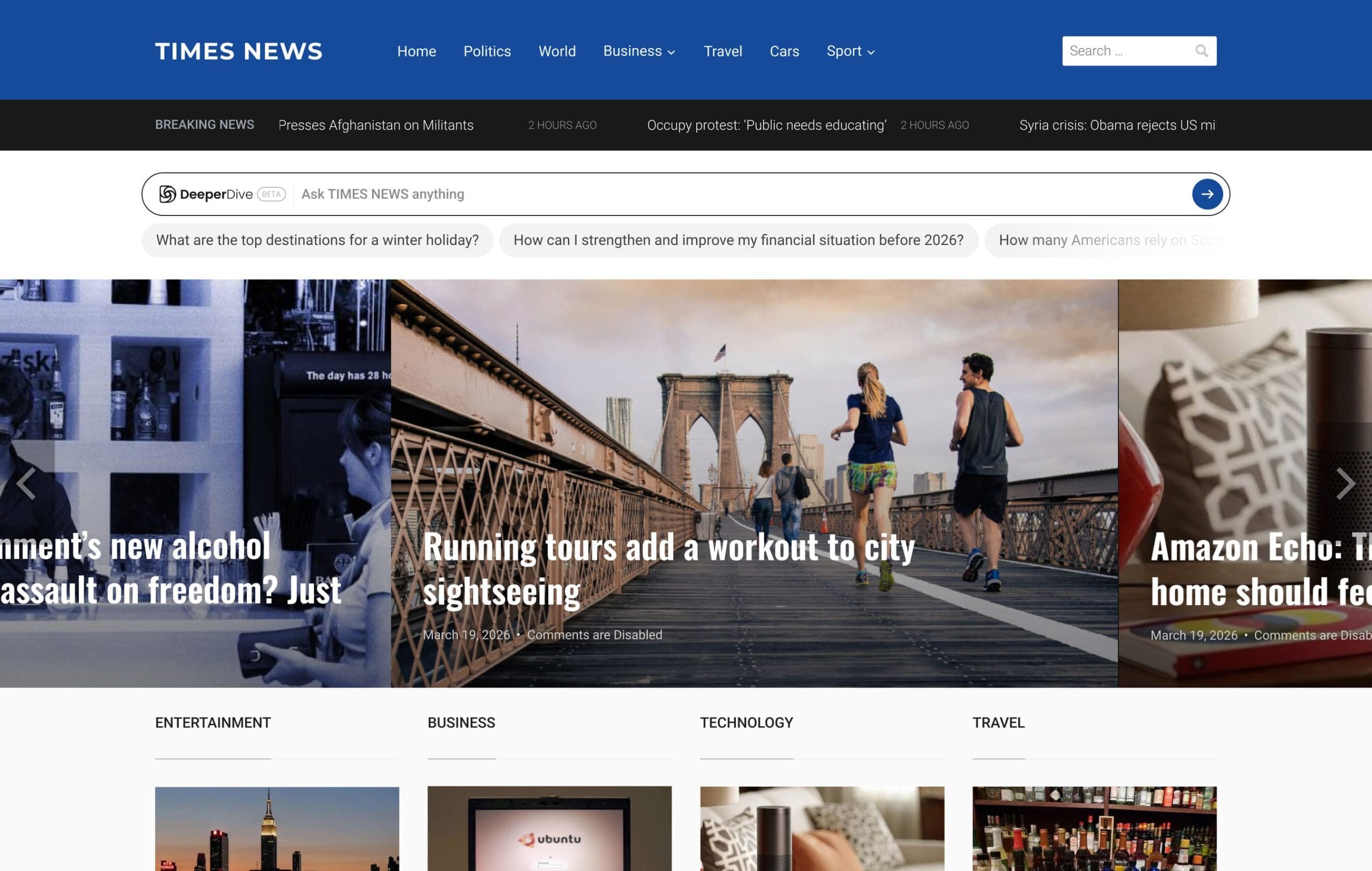
Taboola is pushing deeper into AI-driven content discovery, and early numbers suggest the strategy is working. The company announced that DeeperDive, its Generative AI answer engine, has reached nearly 7 million monthly active users just eight months after launch.
That pace is hard to ignore. In a space crowded with AI tools, most struggle to gain traction. DeeperDive appears to be doing the opposite. It is gaining users. It is increasing engagement. It is changing how readers interact with publisher content.
From Passive Reading to Active Engagement
DeeperDive operates directly within publisher websites. It allows users to ask questions, explore related topics, and discover additional articles without leaving the site.
This shift matters. Traditional content consumption is passive. A reader lands on an article, reads it, and leaves. Recirculation rates—meaning the percentage of users who click to another article—have stayed low for decades.
DeeperDive changes that behavior. Once users begin interacting with the AI interface, engagement increases. The likelihood of reading additional content rises to around 20%.
That is a meaningful jump. For publishers, higher engagement translates into more page views. For advertisers, it translates into higher conversion rates.
In simple terms, users stick around longer. And that changes everything.
Adoption Rates Signal Strong User Interest
1 in 6 Readers Are Engaging
Some publishers report that as many as 17% of their visitors actively use DeeperDive. That equates to roughly one in six readers.
For comparison, most content recirculation tools operate in the low single digits. That gap is not small. It is significant.
It suggests that users want interaction. They want context. They want to ask follow-up questions instead of searching elsewhere.
Half of all questions asked through DeeperDive relate to events from the past 24 hours. That includes news, sports, and entertainment.
This reinforces a key point. Users are not just researching long-term topics. They are using AI to stay current.
Publishers Gain Direct Insight Into Audience Intent
Editorial Strategy Gets a Data Upgrade
DeeperDive provides publishers with access to millions of user questions each month. In many cases, that number exceeds 10 million questions.
This data has real value. Editorial teams can see what readers are asking in real time. They can adjust coverage. They can prioritize topics. They can refine headlines.
This mirrors keyword research in SEO (Search Engine Optimization). Instead of guessing what users want, publishers receive direct input.
That feedback loop can influence content planning, homepage layout, and editorial direction.
In practice, it turns audience curiosity into actionable data.
A New Model for AI on the Open Web
Ad-Supported AI vs Subscription AI
Taboola’s CEO, Adam Singolda, outlined a broader vision. He sees the AI landscape forming around two models: subscription-based systems and ad-supported systems.
DeeperDive falls into the second category. It is free for users. It is free for publishers. Revenue comes from advertising.
This approach aligns with how much of the open web operates today. Content is free. Advertising funds the ecosystem.
DeeperDive extends that model into AI-driven experiences.
Keeping Users on Publisher Sites
One of the biggest concerns for publishers has been traffic loss to external AI tools. Users search elsewhere. Publishers lose engagement.
DeeperDive addresses that issue by keeping the interaction on-site. Users ask questions within the publisher’s environment. Answers connect back to publisher content.
This keeps traffic where it belongs. It also reinforces trust, since responses are tied to known sources.
There is a subtle but important distinction here. The experience feels like a search engine. The content remains within the publisher ecosystem.
Global Expansion Signals Broader Ambition
Support for Multiple Languages
Taboola is expanding DeeperDive into new markets with support for six additional languages. These include French, German, Hebrew, Japanese, Korean, and Spanish.
New publisher partnerships include Ouest France, El Nacional, and Ynet. These are established media brands with strong regional audiences.
Language support is not a minor update. It opens the door to wider adoption. It allows DeeperDive to operate across different markets and cultural contexts.
For global publishers, this increases relevance. For users, it improves accessibility.
What This Means for Digital Marketing and SEO
DeeperDive introduces a shift in how users discover content. It blends elements of search, recommendation engines, and conversational AI.
From an SEO standpoint, this raises new questions. Visibility may depend less on traditional rankings and more on how content is referenced within AI-driven responses.
Publishers may need to adapt. Content structure, authority signals, and real-time relevance could carry more weight.
Advertisers also benefit. Higher engagement leads to stronger conversion rates. Users who ask questions show intent. Intent drives performance.
This creates a more efficient advertising environment. Fewer wasted impressions. More qualified interactions.
Still, there is a practical consideration. Increased engagement does not guarantee better content. Quality still matters. Trust still matters.
AI can guide users. It cannot replace credible reporting.
Taboola’s approach leans into that idea. It connects AI responses to publisher content rather than replacing it.
That distinction may determine how sustainable this model becomes.
Where This Is Headed
DeeperDive’s early growth suggests strong demand for interactive content experiences. Users want more than static articles. They want context. They want answers. They want follow-up.
Publishers want to retain traffic. Advertisers want better performance. Platforms that align those interests will gain traction.
DeeperDive appears to be doing that—for now.
The open web has faced pressure from large AI platforms that pull users away. Taboola is betting that integrating AI directly into publisher sites will reverse that trend.
It is a calculated move. It also reflects a broader shift in how content is consumed.
The next phase will depend on scale, accuracy, and trust. If those elements hold, DeeperDive could become a standard feature across publisher sites.
And if that happens, the line between search, content, and conversation will continue to blur.