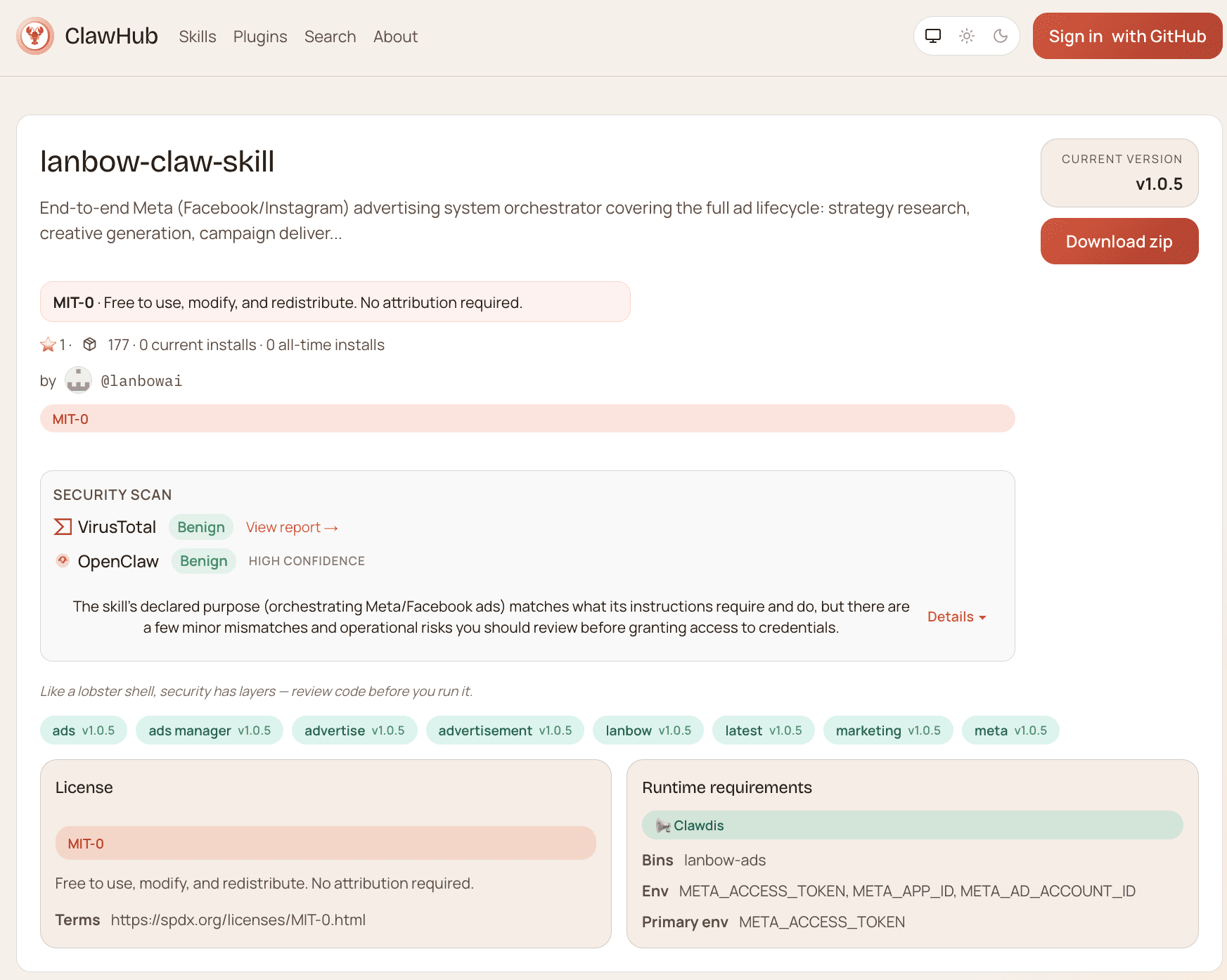
Lanbow, developed by Sandwich Lab, has released a key part of its advertising system as open-source. The release includes Lanbow Claw Skill, a component built to manage Meta ad execution from start to finish.
The company states this system was shaped through hundreds of campaigns and millions in ad spend. That experience is now packaged into a callable unit inside the OpenClaw agent framework.
This is not a sample project. It is production logic made public.
What Lanbow Actually Open-Sourced
The release focuses on execution. It does not include the higher-level decision system that controls budget allocation and strategy across campaigns.
Lanbow Claw Skill connects four stages into a single loop. Each stage feeds the next.
The Four-Stage Execution Loop
- Insight Report: Converts campaign data into structured reports that support decisions
- Creative Direction: Produces ad concepts based on defined strategy inputs
- Meta Ad Launch: Builds and deploys campaigns using Meta’s advertising platform
- Performance Loop: Feeds results back into the system for the next cycle
This loop follows a clear pattern: observe, decide, execute, repeat.
That pattern is not new. What stands out is how it is packaged. One callable unit controls the entire process.
Execution Is Public—Decision-Making Stays Private
Lanbow made a deliberate choice. It released the execution layer. It retained the decision layer.
The decision layer includes cross-campaign capital allocation, multi-market coordination, and reinforcement-based learning models. These systems determine where money is spent and how strategy evolves.
That is where long-term advantage sits.
Execution gets you into the game. Decision-making determines whether you win.
Lanbow is making that distinction clear.
Technical Architecture Built for AI Agent Systems
The Claw Skill is built in TypeScript. It spans 5,291 lines of code with only three runtime dependencies.
The architecture follows strict constraints:
- No global state
- Isolated dependency graphs
- No side effects between calls
These constraints matter. AI agents require predictable execution. Shared state and hidden dependencies introduce risk.
This system avoids those issues by design.
Validation Happens Before Spend
One of the more practical elements is the built-in validation layer.
The system checks for common Meta API errors before campaigns are launched. These include:
- Budget conflicts between campaign elements
- Incorrect bid strategy configurations
- Video upload authentication issues
In traditional workflows, these errors appear after submission. By then, time is lost. In some cases, budget is wasted.
Lanbow moves those checks earlier in the process.
This is a simple idea. It is also one that many teams overlook.
Performance Gains From Skill-Based Orchestration
Lanbow reports a campaign completion rate above 92% using this system. Earlier versions based on MCP-only orchestration achieved around 60%.
This is a meaningful improvement.
Completion rate, in this context, refers to campaigns that move from setup to execution without failure.
Higher completion rates reduce friction. They also reduce manual intervention.
Less manual intervention means faster iteration cycles.
Faster cycles lead to better optimization over time.
The math is straightforward.
Why Open-Source This Now
The timing is not random.
Tools like OpenClaw and command-line interfaces now allow complex systems to be packaged into callable units. That makes distribution easier. It also makes adoption faster.
Lanbow is using that shift to share its execution framework.
At the same time, it is moving its internal focus up the stack.
The company is directing resources toward enterprise-level decision systems. These systems handle budget distribution across campaigns, coordination across markets, and continuous learning from performance data.
This is where scale happens.
Industry Context and External Signals
Sandwich Lab has received attention from major technology programs. It was selected for Microsoft and BLOCK71’s AI Accelerate initiative. It also participated in events tied to Alibaba Entrepreneurs Fund and AWS global expansion efforts.
These signals indicate external validation. They also place Lanbow within a broader ecosystem of AI-driven enterprise tools.
That context matters for adoption.
An Analytical View From a Digital Marketing Perspective
From a digital marketing standpoint, this release highlights a pattern that continues to repeat.
Execution becomes standardized. Strategy remains differentiated.
We saw this with SEO tools. We saw it with paid search platforms. We are now seeing it with AI-driven ad systems.
Anyone can access execution frameworks. Few can build decision systems that allocate capital effectively across channels and markets.
That gap is where competitive advantage lives.
Lanbow is effectively saying: here is how campaigns run; the real value sits above that layer.
That position makes sense.
There is also a practical takeaway. Open-sourcing execution logic allows others to audit, test, and improve it. That can accelerate development across the industry.
At the same time, it raises the bar. If execution becomes easier, expectations increase.
Teams will need to focus more on strategy, data interpretation, and decision-making.
That is where the hard problems remain.
Lanbow’s release makes one point clear. Running ads is no longer the difficult part.
Deciding what to run, where to spend, and how to adapt over time—that is where the work is.
And that is the part they chose to keep.