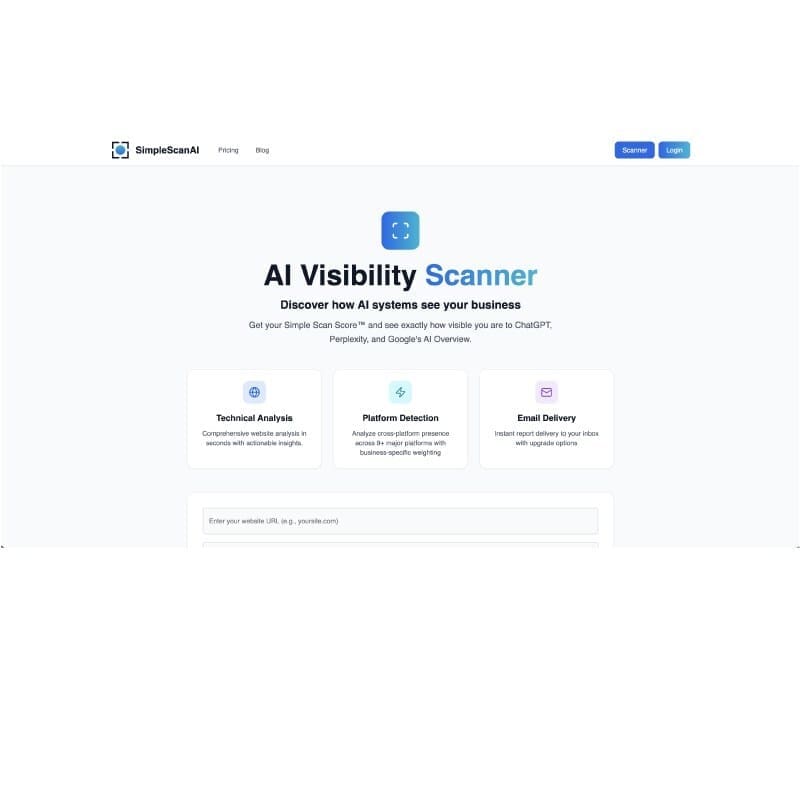
SimpleScanAI Introduces the Simple Score, a New Metric Defining AI Visibility
SimpleScanAI has launched what it calls the first AI visibility measurement system. The company introduced the Simple Score, a 0–100 metric that functions much like a traditional credit score.
Instead of judging financial risk, this score evaluates a business’s presence across AI-driven search platforms. The idea is simple: AI assistants now act as recommendation engines, and businesses that fail to appear in those recommendations fall behind competitors who do.
Why Visibility in AI Assistants Now Matters
The press release points to a significant shift: roughly 40 percent of consumers are using AI services such as ChatGPT, Google Gemini, and Perplexity to find local companies, professional services, and product suggestions. That shift mirrors what we have already seen in SEO (Search Engine Optimization). When search behavior moves, discovery patterns move with it. And once those patterns change, older visibility signals lose strength.
SimpleScanAI argues that most businesses are becoming invisible inside these models. When a customer types or voices a request like “best lawyer near me,” the AI response draws from signals related to digital authority, schema markup, local citations, and structured sources the models can reliably interpret. If those signals are missing, the AI returns competitors by default. Anyone who has worked in SEO has seen this pattern in other areas: missing data leads to missed opportunities.
The Structure of the Simple Score
The company designed the Simple Score to combine a variety of measurable digital factors into a single value. It evaluates website configuration, schema markup accuracy, platform consistency, and broader indicators of authority. SimpleScanAI has kept the exact formula private to protect the scoring system. That mirrors how credit scoring models operate. What matters is the output and its consistency.
What Beta Testing Revealed
During early testing, SimpleScanAI found that most companies fell between 40 and 60 points. The company labels this range as “Barely Visible.” Businesses scoring above 85 sit in the “Industry Leader” tier. Anyone who works with digital metrics knows the pattern: the spread between weak and strong performers always reflects differences in structure and execution. The Simple Score attempts to show this in a single value.
The practical impact is direct. A lower score means reduced odds of appearing in AI-generated suggestions. A higher score leads to more visibility when users ask these assistants for recommendations. It’s a simple relationship, and it mirrors long-standing SEO logic. Better signals lead to better placement.
What Comes After the Score
The company offers more than a number. Each scan produces recommendations tied to competitive analysis, projected revenue impact, and step-by-step actions. These steps include schema markup updates, technical adjustments, and cross-platform corrections. The plans are straightforward and priced between $199 and $399 for schema work. The company reports that many businesses see improvements of 20 to 30 points after adjusting technical issues.
This pattern reflects something I’ve seen for years in audit work. Businesses rarely fail to show up in search because their service is weak. They fail because their structure is incomplete. Missing markup, old citations, broken references, or inconsistent details push them downward. A single metric gives them a quick way to diagnose the issue.
The Market Behind the Product
SimpleScanAI is addressing a large market. There are more than 33 million small businesses in the United States alone, and most of them still spend money on SEO tools that do not measure AI visibility. The release positions the company inside the emerging GEO (Generative Engine Optimization) market. GEO focuses on visibility inside AI assistants rather than traditional search engines. SimpleScanAI wants the Simple Score to become the standard metric for that space.
From a technical perspective, GEO requires different reference points than SEO. AI assistants draw from structured data, quality-controlled sources, and patterns learned from user interactions. Businesses that fail to supply the necessary signals get buried. Tools like SimpleScanAI aim to bring that issue to the surface.
Pricing, Availability, and Adoption
SimpleScanAI is offering several products: a free scan that provides the Simple Score, a $49 detailed analysis, monthly subscriptions arriving soon, and paid schema solutions. The company is also pursuing trademark protection for the Simple Score, adding an extra layer of branding around the metric.
Moses Gora, the Founder and CEO, predicts the phrase “What’s your Simple Score?” will become as common as asking for a credit score. It’s an ambitious claim, but the market trend supports the idea. As AI assistants continue to take over recommendation duties, businesses will need a standard way to measure their visibility inside those systems.
From my perspective, this metric will succeed if it helps business owners understand the concrete steps needed to influence AI visibility. As long as the output ties back to actions that produce measurable improvement, it will hold value. And based on the early structure, that appears to be the company’s goal.
SimpleScanAI’s launch signals a broader shift in how digital visibility is measured. As AI platforms become the primary recommendation channel for millions of users, businesses will need tools that reflect that shift. The Simple Score gives them a quick, digestible number, but the larger story sits beneath that score: AI-driven discovery is no longer optional. It’s a new part of the customer acquisition system, and businesses ignoring it will feel the impact.