Broadcasters Are Late to the Party—Quickplay’s AI Studio Aims to Catch Them Up
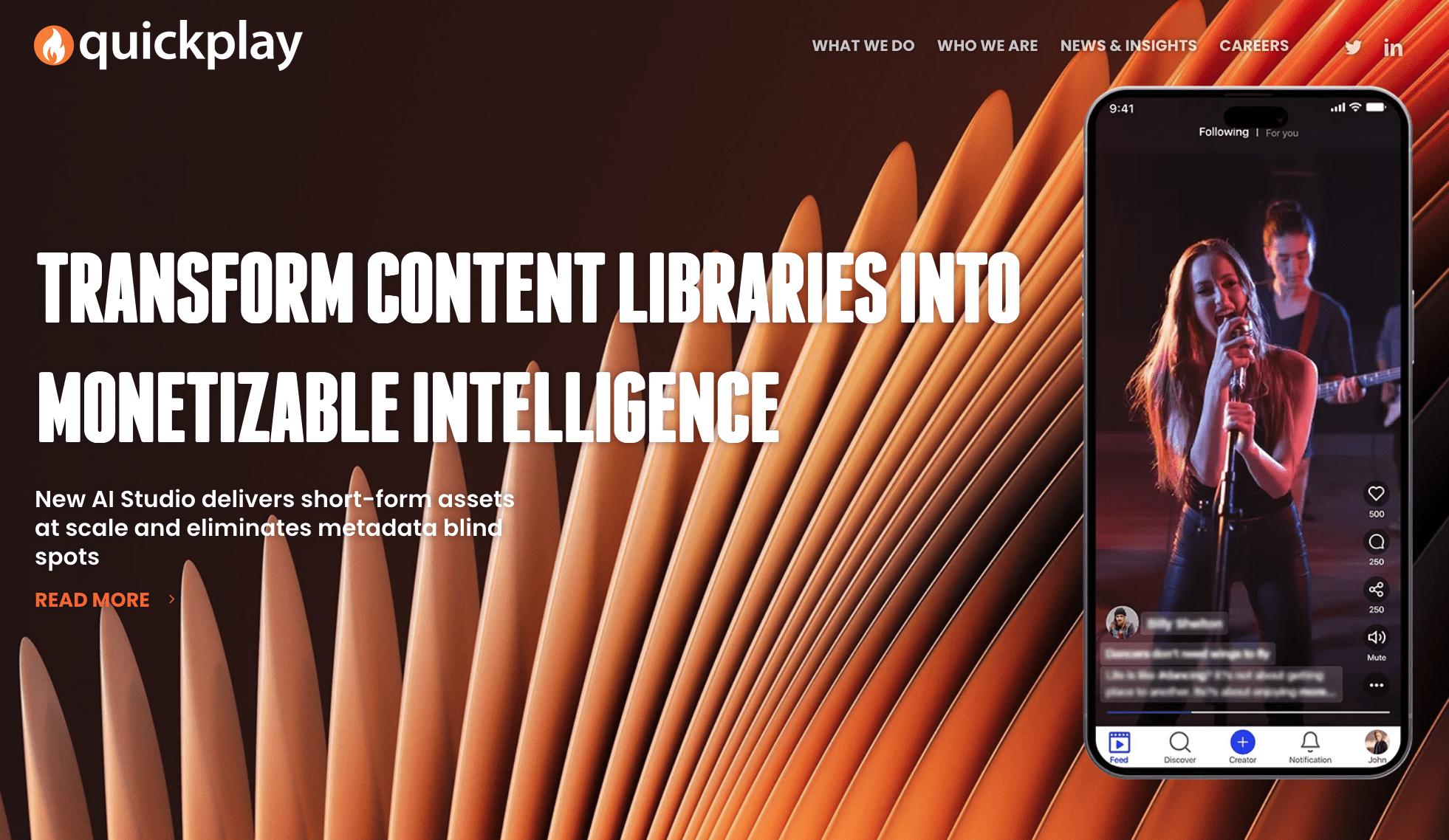
At IBC 2025 in Amsterdam, Quickplay announced AI Studio, a platform built to help broadcasters and streamers stop playing catch-up. The message behind the launch was clear: TikTok creators have been years ahead, and professional media companies are now scrambling to recover lost ground. AI Studio promises to turn long-form archives into fresh, monetizable clips that can compete with the flood of short-form content already dominating screens. For broadcasters, this isn’t about staying relevant; it’s about survival with a generation that consumes differently.
Turning Archives into Assets
Broadcasters sit on massive libraries of content, often decades deep, but the value of those archives has been trapped. Metadata gaps, manual clipping, and outdated workflows have made it nearly impossible to deploy that content in formats today’s audience actually watches. AI Studio is designed to change that equation. By automating the process of finding and clipping key scenes, it transforms old content into short-form assets that can circulate on TikTok, YouTube, and Instagram Reels. The irony is hard to miss: while traditional media struggled with its own archives, an entire generation grew up mastering short-form storytelling with a smartphone. Broadcasters can’t afford to keep ignoring the formats where younger viewers live every day.
The Short-Form Reality Check
Ampere Analysis lays out the problem in stark numbers. Nearly two-thirds of the global online population consumes short-form video daily, compared with less than half who watch TV or long-form streaming. Those numbers are more than statistics—they are a warning sign. The younger the audience, the less likely they are to sit through a full program. They want clips that are fast, frequent, and shareable. For broadcasters who still rely on the old model, the gap is widening. AI Studio offers a way to keep up with a generation that treats short-form as the default mode of engagement. Without that adjustment, broadcasters risk becoming irrelevant to younger audiences who may never return to legacy platforms.
Breaking Down the Features
Metadata Enrichment
AI Studio generates new layers of metadata at the scene level, using multi-modal AI. That metadata drives smarter search, better discovery, and more targeted advertising. Younger viewers are accustomed to platforms like TikTok serving content that feels eerily precise to their interests. Broadcasters have failed at that level of personalization, largely because their metadata has been outdated or incomplete. AI Studio promises to close that gap, and without it, broadcasters will continue to feel invisible to the very audiences they need most.
Moment Identification
The system doesn’t just find random clips. It identifies moments tied to trending topics and online signals, then packages them for immediate use. TikTok creators do this intuitively, scanning cultural signals and producing clips in real time. Broadcasters, by contrast, have been slow to act. AI Studio’s automation could finally put them on the same timeline as younger creators who already understand how to feed algorithms that thrive on speed and relevance.
Verticalization and Publishing
Vertical video is the language of this generation. TikTok, Instagram Reels, and YouTube Shorts have set the expectation that content fits the phone screen in your hand, not the television on your wall. AI Studio bakes verticalization into its workflow, giving broadcasters the ability to reformat and publish content quickly across social platforms. For younger audiences, there is no debate about format—vertical is standard. Broadcasters that continue pushing horizontal video into vertical spaces look outdated. AI Studio offers a way to finally speak the visual language the next generation already expects.
Integration Without the Pain
Legacy broadcasters often balk at new systems because of the cost and disruption of replacing what they already use. AI Studio avoids that friction by integrating through open APIs. It works with existing CMS and MAM systems, injecting new metadata and vector embeddings into older workflows. That’s not just a technical convenience—it’s a way to accelerate adoption in an industry already years behind. Every month broadcasters delay means another month where creators are pulling further ahead with audiences that matter most for the future.
Industry Positioning
Paul Pastor, Co-Founder and Chief Business Officer, pointed directly at the shift: “The creator economy and short-form social platforms have transformed audience engagement.” That’s not corporate spin—it’s an admission that broadcasters have been caught flat-footed. TikTok creators have already redefined what engagement looks like, and Quickplay is now offering a toolset that tries to close that gap. Juan Martin, Co-Founder and CTO, cut through the skepticism by stressing that AI Studio isn’t vaporware. It’s a working product designed to show results immediately. The subtext is obvious: broadcasters can’t wait years to experiment. They need to catch up with audiences who moved on long ago.
Proof Through Recognition
Quickplay’s recent string of awards—ranging from NAB Product of the Year to recognition at the Asia Pacific Broadcasting Awards—gives AI Studio credibility. Quickplay Shorts already showed momentum, and AI Studio builds on that trajectory. Awards alone won’t win back audiences, but they do reassure industry decision-makers that this technology isn’t speculative. The challenge is less about recognition and more about whether broadcasters will adopt fast enough to matter to the current generation of viewers.
The Bigger Picture
The truth is blunt: broadcasters lost valuable years debating strategy while creators on TikTok and YouTube were capturing millions of views daily. Entire youth audiences grew up without loyalty to traditional channels, because those channels weren’t where they spent their time. Quickplay’s AI Studio doesn’t erase that lost ground, but it offers a chance to compete again—if operators are willing to move quickly. Broadcasters that adopt now can start to claw back relevance with younger generations. Those that delay further risk becoming irrelevant artifacts, remembered only by older audiences while the next generation streams elsewhere.