Are you a loyal visitor? When you browse the web every day, when you log on, are there websites that you go to every day? We all have a few websites that we constantly watch or constantly read. And that’s a good thing. Apparently you feel that the content on those websites keep you coming back enough that they cause you to be a loyal reader.
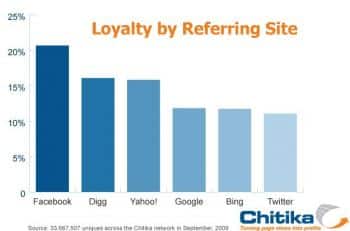
There is a new study out that shows that people who visit Digg and Facebook are more loyal readers than on other web sites. Visitors to Bing.com and Twitter.com are not as loyal. Twitter, in fact, was shown to have visitors that are not as loyal as other web sites.
The study, based on a sample of 33 million users on the online ad network Chitika, compared the number of visitors coming from major traffic sources. According to the results of the study, it showed that “Facebook was far and away the best provider of loyal users – over 20% of all visitors from Facebook visited the site four or more times per week. Digg came in second place with slightly over 16%.”
Amongst the search engines, Yahoo! had by far the most loyal readers with 15% of referrals being loyal. Google and Bing were just about in a tie with slightly below 12%, and Twitter came in last place overall with barely over 11%. Here are the actual numbers:
Loyalty by Referring Site:
————————–
Facebook 20.69%
Digg 16.09%
Yahoo! 15.89%
Google 11.84%
Bing 11.74%
Twitter 11.08%
Source: 33,667,507 uniques across the Chitika network in September, 2009
Does being a loyal reader mean that you’re a loyal consumer? Maybe Twitter users are not as loyal because they’re more internet savvy and just tend to follow links on Twitter that their friends tell them to click on? From what I can tell based on my own personal use of Twitter, when someone “tweets” something to their friends, they’re pointing out something: and while Twitter can certainly bring a lot of traffic to a website, those visitors will tend to click on an outgoing link in a Tweet and view it; apparently rarely do they go back to that website.
For Twitter users to be labeled as “not loyal” to other web sites (as a referral to that website), it makes sense to me. Twitter is all about “in the moment” and “real time” and what people are talking about “right now”. If you follow 100 people, you’re seeing exactly what they’re talking about right now. And if you see a link that you’re interested in you’ll click on it: and personally I don’t see myself searching Twitter for that link later on. It’s just not something that I’m going to go back to once I’ve seen it and clicked on it. For example, if someone I’m following, like @vizionweb, says something and points out a great tool then I am going to go to that tool: and if I like it then I will most likely bookmark that tool. But if there is something that they tweet about that’s kind of random (not in a conversation I’m having with them), then sure I may follow the link or click on the link: but I don’t recall any time where I’ve gone back to it again and again, even more than once.
So, it makes sense to me that Twitter users, when seen as a referral, are not very loyal to other websites. In fact, isn’t that the way Twitter works?
But what about Digg users and Facebook users? Perhaps you need to pay attention to Digg and Facebook a bit more. I’m kind of surprised about Digg users. Especially since Digg is designed to be a site where a story that goes popular sticks around for a while, but not necessarily for more than 24 hours. After 12 hours or so it tends to fall off the face of the earth and then the traffic just tends to die after that. But, when it comes to Facebook, the Facebook users are following their “friends”. In fact, if someone who is a friend of yours recommends something to you then there’s a good chance that you’ll go visit it: and, frankly, since your friend or relative or other contact on Facebook is recommending it to you, then there’s probably going to be more “trust” there than on other websites.
So, does that mean that we trust our Facebook friends more than we trust those who we follow on Twitter? Perhaps. Or maybe it isn’t about trust at all, it’s about how the website is designed: on Twitter, there’s not a good chance that you’re going to be a loyal visitor and click on a link again. Especially because in a few minutes that link will be gone from your view.
What is the bottom line? I think Chitika sums it up nicely:
While Google naturally wins in sheer numbers, if a website owner can drive a thousand people to their site via Google, or they can drive the same number via Facebook, Facebook seems to be the way to go for creating a loyal reader.