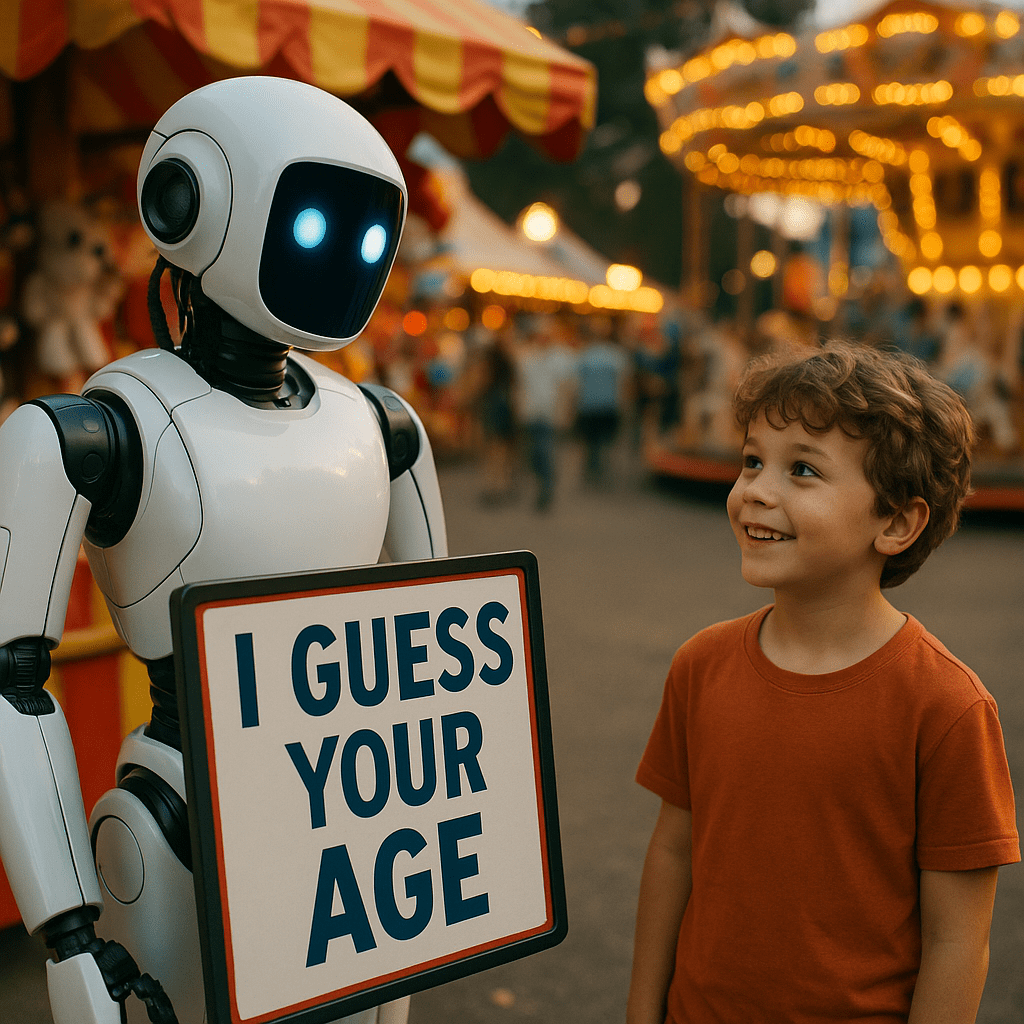
Google has started rolling out a new machine learning model designed to estimate the age of signed-in users in the U.S. And no, it’s not asking your birthday—it’s using your behavior to make a calculated guess.
This update is part of a broader push to better protect kids and teens online. If Google thinks you’re under 18, it’s going to quietly flip some switches in the background—turning off personalized ads, limiting sensitive content, and adding some digital wellness tools, like YouTube reminders to “go to bed” (yes, really).
This system, which Google calls “age assurance,” is already running in select countries. Now, it’s creeping into U.S. accounts, starting with a small group of users. Google says it’ll closely monitor how well it works before rolling it out further.
How Does Google Guess Your Age?
They’re not asking. They’re inferring.
Google’s AI uses a combination of age estimation and age verification:
- Estimation involves machine learning models analyzing signals tied to your Google account—think search history, the YouTube content you binge, and other usage patterns.
- Verification comes into play if the model gets it wrong. In those cases, users can challenge the assumption by uploading a government ID or a selfie to prove their actual age.
- So if you’re watching a lot of Bluey and searching for “how to do algebra,” Google might assume you’re a teen. If you disagree, you’ll have to prove otherwise.
What Happens If Google Thinks You’re a Minor?
For users it believes are under 18, Google automatically applies a set of protections:
- Ad Personalization is disabled.
- Age-sensitive ads won’t show.
- YouTube will gently nudge users to take breaks or call it a night.
- Google Maps Timeline is turned off.
- Apps rated for adults on Google Play? No access.
From an advertising standpoint, this changes the game. If your business relies on personalized targeting via Google’s publisher products (like AdSense, AdMob, or Ad Manager), and your audience includes minors, expect reduced reach and tighter creative restrictions.
Why Now?
The move comes amid increasing scrutiny on Big Tech’s responsibility to protect young users online. Google’s not alone—other platforms are also leaning into age-assurance models, especially as regulations and lawsuits pile up.
This is Google’s way of saying: we see the problem, and we’re using AI to get ahead of it.
What Should Advertisers Know?
Right now, there’s nothing for you to do. Google says no action is needed on your part—these protections apply automatically to signed-in users where age estimation kicks in.
But it’s a wake-up call for brands that market to younger audiences. If your strategy leans heavily on behavioral targeting, expect less data and fewer options to personalize.
Privacy Concerns? Google Says It’s Covered
One of the more eyebrow-raising aspects of this is the whole “guessing your age based on what you do online” thing. But Google is quick to point out: it’s not collecting new data. It’s using existing data from your signed-in activity and not sharing any granular information with third-party sites.
Still, anytime AI is involved in making assumptions about identity, expect debate.
Google is using AI to determine who’s under 18—and applying sweeping changes based on those predictions. It’s an ambitious attempt to protect younger users, but it also raises questions about how accurately tech can make assumptions about our personal identities.
Whether you’re a parent, an advertiser, or just someone who watches a lot of cat videos, it’s worth keeping an eye on what Google’s AI thinks it knows about you. Because soon, it might be shaping your entire online experience—without you even realizing it.
Anonymous Age Verification by AI: Needed, But Not Without Risks
The idea is one where they will be estimating a user’s age using AI—without asking for a birthdate, government ID, or any personally identifiable information. On the surface, this sounds like exactly what we’ve always needed: a frictionless, anonymous way to protect kids online without invading user privacy.
But let’s pump the brakes. Anonymous or not, handing that job over to AI opens up a whole other can of worms. Here’s where things start to get complicated.
Where AI Age Verification Can Go Sideways
Even if you’re not handing over your ID or credentials, you’re still trusting a machine to decide whether you’re old enough to access something. That’s a big ask. Here’s why it’s not always as safe—or as anonymous—as it sounds:
Accuracy is still a problem. AI models trained to estimate age based on facial features or behavior patterns can be wildly inconsistent. Some adults get flagged as teens. Some teens look 25. What happens when someone gets locked out of a service they have every right to use?
Bias is baked in. These models don’t come out of a vacuum. If the training data isn’t balanced across races, ages, genders, and more, the output won’t be either. That opens the door to discriminatory outcomes and reputational risk—especially for companies adopting these systems blindly.
Anonymity doesn’t mean invisibility. Just because you’re not uploading an ID doesn’t mean the system isn’t tracking you. Persistent identifiers, behavioral signals, and browser/device fingerprints could all be quietly logged and linked back to a profile. That’s surveillance by stealth.
What Could Possibly Go Wrong? (Plenty)
Let’s say the AI gets it wrong. What then?
You’ve got the possibility of legitimate users getting locked out—or worse, minors slipping through the cracks. Neither scenario ends well. And let’s not kid ourselves: if there’s a system to defeat, teenagers will find it. Filters, deepfakes, or spoofing attacks could be used to trick the AI. The smarter the detection system gets, the more creative the workarounds become.
There’s also the risk of overblocking. If AI misclassifies someone as underage, they may be denied access to perfectly legal content—political discussions, mental health resources, even educational platforms. That’s a real chilling effect on speech.
Legal Exposure: You’re Not Off the Hook
Disclaimer: I’m not an attorney, and this isn’t legal advice. But here’s what I’m seeing from a digital strategy and compliance perspective.
Just because it’s anonymous doesn’t mean it’s legally bulletproof. If you’re deploying AI-based age verification, here’s what you still need to watch out for:
Privacy laws still apply. Under U.S. laws like COPPA—or global laws like GDPR—any system that infers age, especially under 13, could still trigger parental consent or data protection requirements. Inferring sensitive characteristics, even anonymously, can get you in hot water.
Discrimination lawsuits are a real possibility. If your AI system treats people differently based on race, gender, or disability—even unintentionally—you could be facing civil rights complaints or regulatory action. And yes, that includes AI that underestimates the age of certain groups more often than others.
Due process matters. If AI says you’re not old enough and blocks your access, what then? Platforms could be on the hook for failing to offer recourse or human review. That’s a major red flag with regulators, and it erodes user trust fast.
Liability doesn’t disappear just because you used AI. If a platform is legally required to restrict minors and it relies on AI that fails to do the job—guess what? You’re still liable. Using “anonymous” AI isn’t a free pass.
AI-based age verification could be one of the best tools we’ve got to reduce online abuse, especially against kids. But there’s a fine line between protective and invasive, between anonymous and opaque.
If you’re going to implement this tech—or rely on it—you’d better understand the risks. Transparency, accountability, and real user recourse aren’t optional. They’re the baseline.
Because once you start letting machines decide who sees what, how old someone looks becomes a gatekeeper for speech, commerce, and access. And that’s a line we shouldn’t cross lightly.