GoDaddy and LegalZoom have announced a partnership that targets a growing issue: trust in AI agents operating across the open web. The announcement signals a shift in how businesses, platforms, and users will verify AI-driven interactions.
The two companies are backing the Agent Name Service (ANS), an open standard that gives AI agents a verifiable identity. The goal is straightforward. If an AI agent acts on behalf of a business, users should know exactly who built it and whether it can be trusted.
Why AI Agents Need Identity—Now More Than Ever
AI agents have moved beyond simple chat tools. They now complete tasks, interact with other systems, and make decisions without direct human input. That shift introduces risk. If an agent behaves unpredictably or impersonates a legitimate business, users have little recourse.
This is where ANS enters the picture. It creates a system where each AI agent is assigned a unique, human-readable name and a verifiable identity backed by cryptography.
In practical terms, this mirrors how websites are verified today. DNS (Domain Name System) acts as the internet’s directory. PKI (Public Key Infrastructure) certificates confirm ownership and authenticity. ANS applies those same principles to AI agents.
What ANS Actually Does
ANS is not abstract theory. It introduces specific, actionable capabilities:
It publishes each AI agent as a DNS record, making it discoverable globally within seconds.
It allows verification through a simple DNS query, which confirms where the agent originated.
It attaches cryptographic proof to each agent, linking it directly to a verified domain.
It supports interoperability across registries, including GoDaddy ANS.
GoDaddy Moves First with a Public Implementation
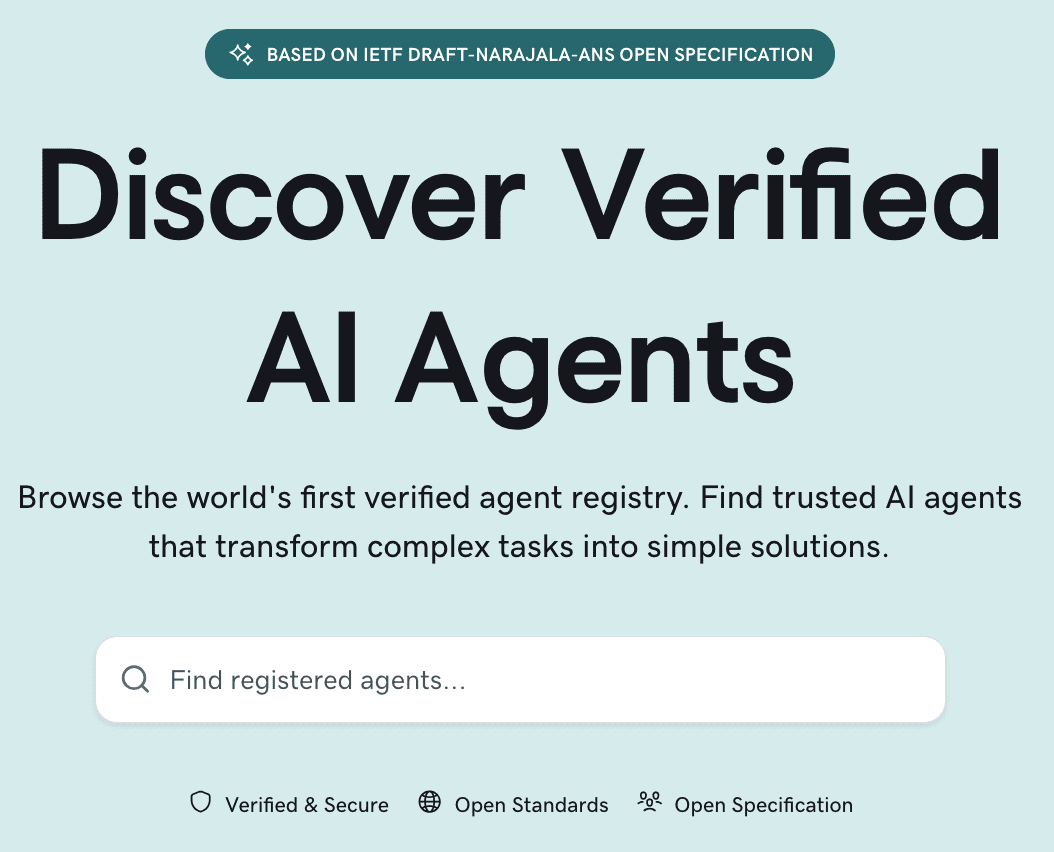
GoDaddy did more than support the concept. It launched GoDaddy ANS, the first public implementation of the standard. This allows businesses to publish and verify AI agents quickly, without building custom infrastructure.
From an industry perspective, this is a notable move. Standards often stall without real-world deployment. GoDaddy closed that gap by turning a framework into a working system.
This also aligns with GoDaddy’s long-standing position in domain management. DNS has always been its foundation. Extending that foundation into AI identity feels like a natural progression.
LegalZoom Becomes an Early Adopter
LegalZoom has already registered its first AI agent through GoDaddy ANS. This agent operates as a Model Context Protocol (MCP) server, which connects LegalZoom’s services directly into AI platforms.
For context, MCP (Model Context Protocol) enables AI systems to interact with structured services. In this case, it allows users to access legal tools through AI assistants like Anthropic’s Claude.
What the LegalZoom Agent Can Do
The LegalZoom AI agent is not a basic chatbot. It performs several functions tied directly to legal services:
It connects users with licensed attorneys.
It scans and processes legal documents.
It supports consultation management within AI interfaces.
Each of these actions requires trust. Legal advice carries legal and financial consequences. Without identity verification, users would have no reliable way to confirm they are interacting with the real LegalZoom.
DNS as the Root of Trust
GoDaddy ANS uses DNS as the root of trust. This is an important detail. DNS has been the backbone of the internet for decades. It translates domain names into machine-readable addresses.
By anchoring AI agent identity in DNS, ANS builds on infrastructure that is already globally distributed and widely trusted.
That decision reduces friction. Developers do not need to adopt an entirely new system. They extend an existing one.
Industry Perspective: Trust Becomes the Differentiator
Travis Muhlestein, GoDaddy’s Chief Technology Officer of Product AI, framed the issue clearly. Trust drives online business. Without it, transactions stall and adoption slows.
This partnership places identity at the center of AI deployment. That shift matters. Businesses deploying AI agents now face a new expectation: prove ownership, prove authenticity, and prove accountability.
Aaron Stibel from LegalZoom reinforced this point. AI may scale legal services, but trust determines whether users accept those services.
Why This Matters for SMBs and the Open Web
Small and medium-sized businesses often face a disadvantage when new technologies emerge. Larger companies build custom systems. Smaller organizations rely on shared infrastructure.
ANS levels that field. It offers a standardized way for any business to publish and verify AI agents.
This has two immediate effects. It reduces the risk of impersonation. It increases confidence in automated interactions.
It also opens the door for agent-to-agent communication at scale. Verified agents can interact with each other without constant human oversight. That is where efficiency gains start to compound.
The Bigger Picture: A New Identity Layer for the Internet
This announcement points to something larger than a single partnership. It signals the emergence of a new identity layer for the internet.
In the early web, identity centered on domain names. Later, SSL certificates added encryption and verification. Now, AI agents require their own identity framework.
ANS fills that gap.
It connects AI systems to domains. It ties actions to ownership. It introduces accountability where ambiguity once existed.
Where This Is Headed
The success of ANS will depend on adoption. Standards gain strength as more participants join. Each registered agent reinforces the system.
There is also a competitive angle. Companies that verify their AI agents may gain an advantage. Users will favor interactions that feel secure and transparent.
That trend is already visible in other areas. Verified domains rank higher in trust signals. Verified identities influence user behavior. AI will follow the same pattern.
GoDaddy and LegalZoom have taken an early step. Others will likely follow. The question is not whether AI agents will need identity. That is already clear. The question is who will define the standard.
This partnership offers one answer. It builds on infrastructure that already works. It introduces verification where it is needed most. And it sets expectations for how AI should operate in a business context.
For professionals watching the intersection of AI, domains, and digital trust, this is worth attention. The foundation is being laid now. What comes next will depend on how quickly the industry responds.