SkrewAI has launched a camera app that flips the script on digital authenticity. Instead of scanning content after it spreads, the app creates proof at the moment of capture. That shift matters. It changes the question from “Is this fake?” to “Can this be proven real?”
The product, called SkrewAI Camera, is free on iOS and Android. It replaces the default phone camera. It records more than images and video. It records physics.
That last point is the entire pitch. Pixels can be generated. Physics cannot.
A Different Approach to the Deepfake Problem
Most tools today focus on detection. They scan media after it has been published. They look for inconsistencies. They flag potential manipulation.
SkrewAI takes a different path. It captures sensor data during recording. That includes accelerometer data, gyroscope data, and magnetometer readings. These sensors track motion, orientation, and environmental factors.
The system then compares that sensor data with the visual content. If the movement in the video matches the movement recorded by the device, the content passes verification.
It is a simple concept. Hard to fake. Even harder to replicate at scale.
What Gets Recorded and Why It Matters
Every capture includes synchronized telemetry. That telemetry is a stream of physical data tied to each frame of video or photo.
Examples include compass direction, motion patterns, and device orientation. The app also logs the physical button press used to start recording. That detail may sound small. It is not. It adds another layer of proof that a human interacted with the device.
AI can generate realistic visuals. It cannot produce matching sensor data that aligns frame-by-frame with those visuals. That gap is where SkrewAI positions its value.
Verification Is Public, Transparent, and Shareable
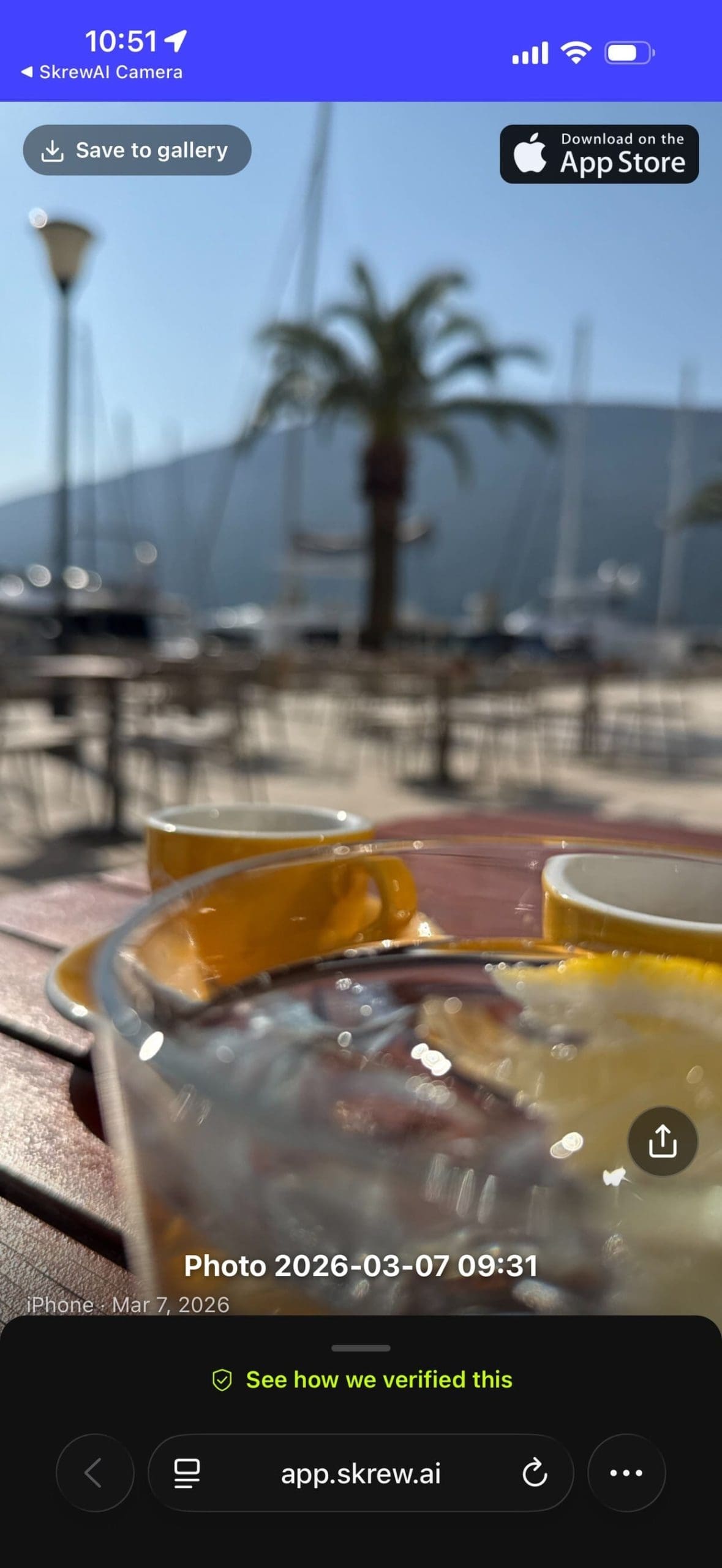
Every piece of content captured with the app receives a public verification page. That page includes the media itself, device information, timestamps, and a detailed breakdown of sensor data.
Users can share a URL. Anyone can open it. No app required.
This matters for distribution. Content can travel across platforms. The proof travels with it.
From a digital marketing perspective, this introduces a new type of trust signal. It is similar to verified domains or SSL certificates. It tells the viewer that the content has a traceable origin.
How This Fits Into Existing Content Workflows
The app integrates directly with the phone’s gallery. Users shoot content. It saves locally. It syncs in the background. No extra steps.
This is a practical decision. Tools fail when they disrupt workflows. SkrewAI avoids that problem.
Creators can continue posting on platforms like TikTok, YouTube, or Instagram. They simply include the verification link. The content remains familiar. The proof adds context.
Feature Set Goes Beyond Basic Recording
SkrewAI Camera is not limited to verification. It functions as a full camera replacement.
- Video, photo, slow-motion, and timelapse modes
- Cinematic stabilization and exposure control
- Face-aware focus and filters
- Screen recording detection to flag re-recorded content
These features matter because users will not switch tools unless the experience matches or exceeds what they already use. Verification alone is not enough. Usability drives adoption.
Copyright and Ownership Implications
The app also introduces a new layer of copyright protection. Each piece of content is timestamped and linked to verified sensor data. That creates a record of origin.
In disputes over ownership, that record could serve as evidence. It provides more than a claim. It provides supporting data.
For creators, journalists, and brands, that has real value. Content theft is common. Proof of origin is often weak. This approach strengthens that position.
AI Models Built on Verified Human Content
SkrewAI is also building machine learning models trained only on verified recordings. That dataset is different from typical training data. It excludes synthetic content.
This creates a feedback loop. Verified content trains the system. The system improves verification. The dataset grows stronger over time.
Few companies can replicate that dataset. It requires both technology and adoption at scale.
Future Development Signals Broader Ambitions
The company plans to introduce blockchain-backed proof certificates and compatibility with C2PA (Coalition for Content Provenance and Authenticity) standards. These additions point to a larger goal: standardizing how authenticity is verified across platforms.
Social features are also on the roadmap. That includes browsing verified content and interacting with verification pages. The idea is to make authenticity visible and shareable.
That is a subtle but important shift. Verification becomes part of the content experience, not just a backend process.
Leadership Background Adds Context
SkrewAI founder Uroš Joji? brings a long history in video and internet platforms. His past work includes ActionTrip, SpringBoard Video Platform, and Brid.TV, which was later acquired.
That background shows a pattern. Build platforms. Scale distribution. Solve infrastructure problems.
SkrewAI follows that pattern. It addresses a growing issue in digital media: trust.
What This Means for Digital Media and Marketing
From an SEO (Search Engine Optimization) and content strategy standpoint, verified media introduces a new dimension. Search engines and platforms may begin to favor content with proof of origin.
That would not be surprising. Platforms already prioritize trust signals. Verified domains, author credibility, and structured data all play a role.
Verified media could become another signal. It could influence ranking, visibility, and distribution.
For brands, this raises a strategic question. Should verified content become part of standard publishing workflows?
The answer may shift over time. Early adopters often gain an edge.
SkrewAI is betting that proof will matter more than detection. It is a reasonable bet. Detection is reactive. Proof is proactive.
In a space filled with synthetic content, proof stands out.
And right now, proof is in short supply.
The app does not try to chase every fake. It removes the need to ask the question in the first place. That approach is direct. It is practical. It may be exactly what the industry needs next.