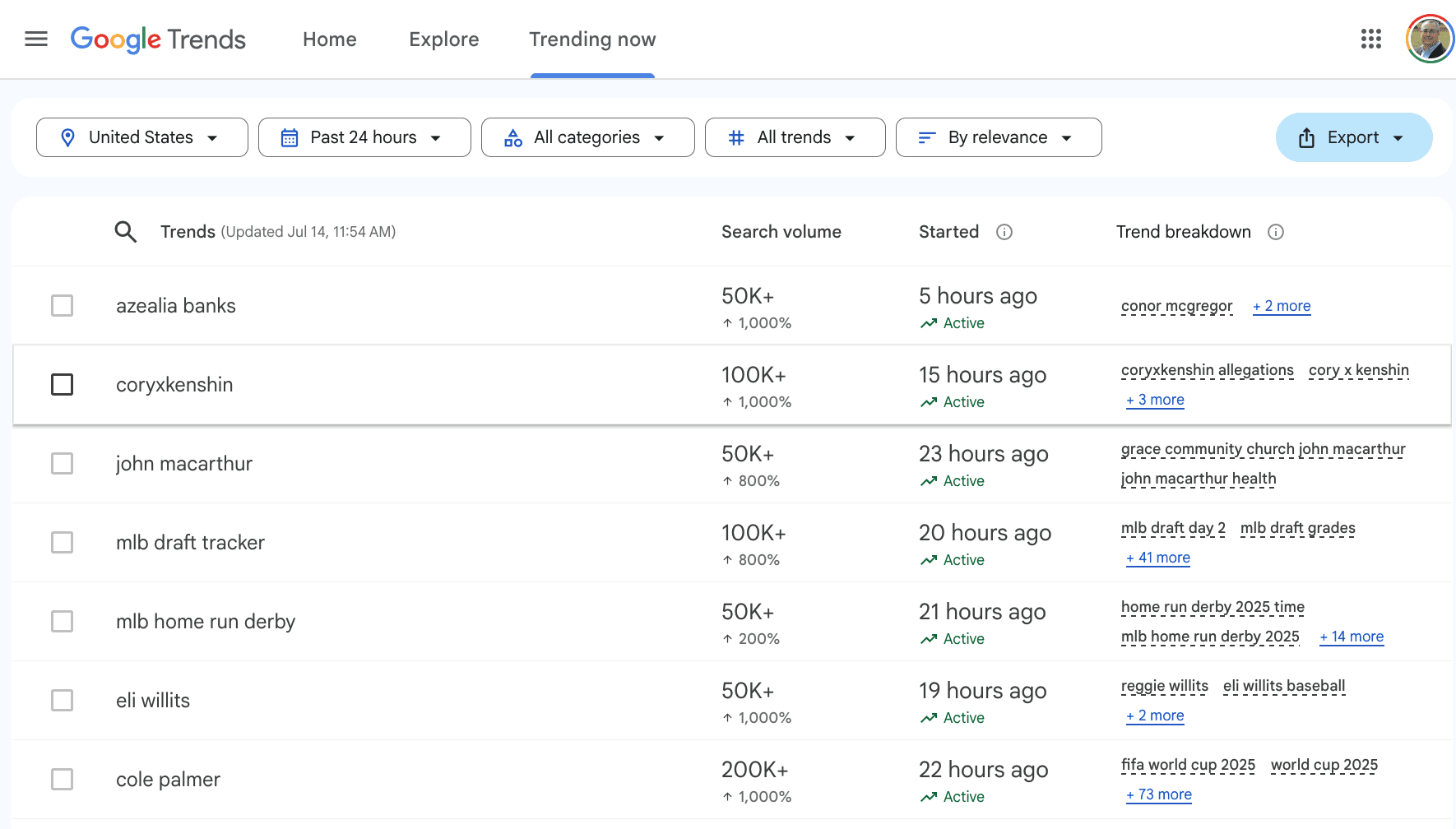
If you’ve been watching Google Trends lately, you’ve probably noticed something strange: it’s no longer about headlines or major events—it’s about people. And not just politicians or celebrities in the news, but influencers, athletes, and even viral names you’ve never heard before.
This shift didn’t happen overnight, but it’s now impossible to ignore. What used to be a barometer for breaking stories has become a real-time leaderboard of individuals—often outpacing actual global news in visibility. Let’s break down why this happened, what it says about the internet in 2025, and why marketers and SEOs should pay close attention.
Then vs. Now: A Clear Contrast
In the early years, Google Trends gave us quick insight into breaking news and major moments:
-
“COVID vaccine near me”
-
“Oscars 2019 winners”
-
“Super Bowl halftime show”
Now, we’re seeing names like:
-
Azealia Banks (50K+ searches, +1000%)
-
CoryxKenshin (100K+, +1000%)
-
John MacArthur (50K+, +800%)
-
Cole Palmer (200K+, +1000%)
-
Olivia Culpo (20K+, +500%)
-
Shannen Doherty (20K+, +600%)
It’s not that news is gone from Google Trends—you’ll still spot events like the Grand Canyon Lodge North Rim fire or the Kentucky shooting—but they’re often outpaced by people who happen to be in the spotlight for a viral moment.
What’s Driving the Shift to Names?
This evolution is about more than just celebrity culture. Several powerful trends are converging behind the scenes:
1. Social Media Drives Search Behavior
Platforms like TikTok, Instagram, and X (formerly Twitter) have become search engines in their own right. A user sees a viral clip of CoryxKenshin or hears about Olivia Culpo’s wedding—they immediately Google the name.
Names are now the trigger point for search, not the events surrounding them.
2. Entity-Based Search Is the New Standard
Google’s algorithms now prioritize entities—things it can clearly identify and track—such as people, places, or organizations. Instead of surfacing vague keyword phrases like “latest celebrity news,” Google detects surging interest in a specific person and prioritizes their name in trending results.
This shift makes search cleaner, more semantically structured, and aligned with how users consume content.
3. Influencer and Creator Culture
We live in a personality-driven economy. Micro-influencers, YouTubers, streamers, and reality show contestants are household names to millions—even if they never appear in legacy media.
Case in point: names like Eli Willits, Ethan Holliday, and Kang Seo Ha are trending now because their audiences are fiercely loyal and hyper-engaged.
4. News Has Fragmented
Gone are the days when everyone was watching the same nightly news broadcast. Today, information comes in a firehose of tweets, TikToks, Reddit posts, and YouTube recaps. That means the event often gets overshadowed by the person involved in it.
Example: Instead of “Kentucky shooting,” searchers want to know about the individuals involved or the police department—like “Taylor Police Department.”
5. Real-Time Curiosity
With everything moving faster, people no longer wait for the story—they search for the name they just saw on a trending reel or TikTok. Google Trends is surfacing these real-time bursts of curiosity.
What This Means for Marketers and SEOs
This change isn’t just cosmetic. It reflects a deeper shift in user behavior and search patterns—one that should change how content creators, marketers, and SEOs think about search intent.
Keyword Targeting Needs to Adapt:
You can’t just optimize for “music awards 2025.” You’ll need to optimize for the individual names generating the interest—e.g., “Cole Palmer music award performance” or “CoryxKenshin reaction video.”
Reputation Management Is More Critical Than Ever:
If names dominate search trends, then personal brand SEO becomes mission-critical. Whether you’re an influencer, executive, or public figure, Google Trends is proof that names carry more weight than ever.
Trend Tracking Should Include Entity Monitoring:
SEOs and PR teams should track named entities as part of their trend discovery—not just phrases or topics. Think: people > topics.
Content Strategy Needs More Agility:
Since trending names can skyrocket in under an hour, brands need content systems that can pivot fast. If a name related to your industry hits the charts, you should be ready to ride the wave.
Final Thought: It’s a People-First Internet Now
Google Trends didn’t just shift—it adapted to a people-powered internet. In 2025, it’s not events, issues, or even keywords that drive search volume. It’s names. And that tells you something fundamental about our culture: curiosity is personal now.
We want to know who before we understand why.
Whether you’re in digital marketing, SEO, media, or tech, this shift is worth your attention. It changes how information spreads, how trends catch fire, and how reputations are made (or broken) overnight.
If you’ve got a name, you’ve got a trend—whether you’re ready for it or not.