
GoDaddy updated its Terms of Service on February 2, 2026. The change looks small on paper. The impact could be large in practice. At the end of Section 1, the registrar states that its services “are not intended for private, personal or household use.” The clause also says this limitation overrides any conflicting policy or product description.
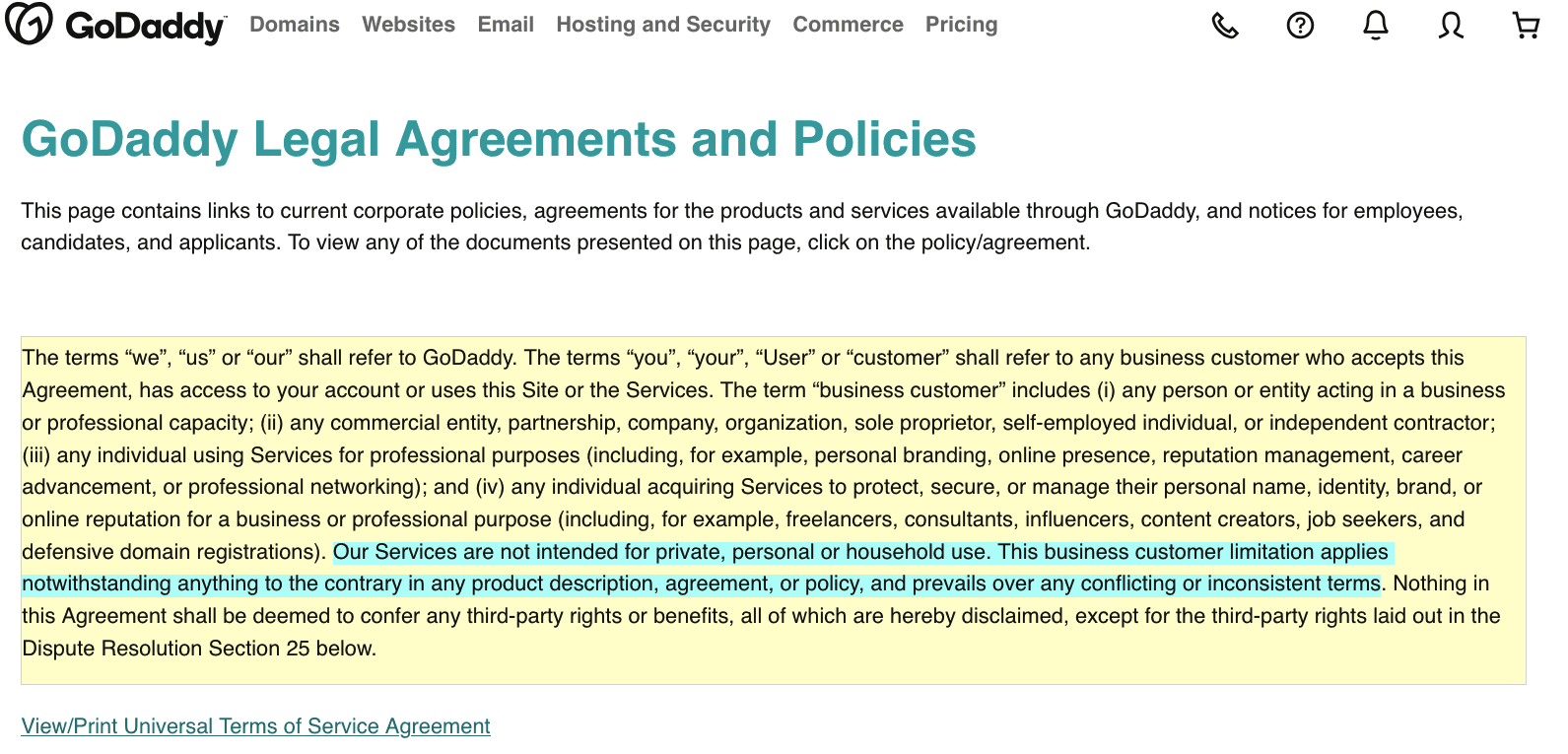
In plain English, customers are treated as business users. Even if the domain supports a hobby site, personal email, or family project.
That single paragraph may reshape how disputes, privacy claims, and consumer protections apply to millions of domain holders.
A Clause That Overrides Everything Else
The language does not sit quietly beside other policies. It explicitly prevails over any inconsistent terms.
This matters because domain ownership often intersects with legal frameworks such as the UDRP (Uniform Domain-Name Dispute-Resolution Policy), the international process used to resolve trademark conflicts.
Domain name attorney John Berryhill flagged the issue publicly. He warned that personal use defenses — long accepted in UDRP proceedings — may now be weakened for domains registered at GoDaddy.
If the registrar itself says domains are not for personal use, a registrant claiming “personal name” or “noncommercial use” may face new scrutiny.
Berryhill described the clause as overriding inconsistent policies. That includes policies external to GoDaddy, such as dispute rules incorporated by reference.
Why Personal Use Has Always Mattered
Historically, individuals could register domains for family sites, blogs, personal branding, or simple email addresses.
Many legal defenses rely on that premise. For example, a person using their own name in a domain often argues legitimate interest under UDRP standards.
If the registrar’s contract says the service is business-only, opposing counsel could argue the registrant admitted commercial use by agreeing to the terms.
Whether that argument succeeds remains uncertain. It will likely depend on arbitration panels, courts, and future test cases.
Privacy and Data Classification Questions
The change also raises data-protection concerns.
Brady, Head of Product and Growth at Unstoppable Domains, asked Berryhill on X whether the move attempts to bypass consumer protections. Berryhill responded bluntly: yes.
The reasoning is straightforward. If customers are labeled business users, their information may be treated as business data rather than personal data.
That distinction can affect privacy rights, marketing permissions, and legal remedies.
Business data typically receives fewer protections under many regulatory regimes. Companies often assume business users can negotiate terms, accept risk, and waive certain rights.
Arbitration Versus Court Access
Critics also point to dispute resolution clauses.
David Michaels argued that redefining customers as business users could reduce access to consumer-friendly remedies. He suggested the company prefers binding arbitration over lawsuits, possibly to limit exposure to class actions.
Arbitration clauses are common in technology contracts. They can speed resolution. They can also restrict discovery, appeals, and collective claims.
For individuals with small disputes, arbitration may be practical. For large-scale issues affecting many users, class litigation often provides leverage that individual cases lack.
What This Means for Everyday Domain Owners
Most domain holders will not notice an immediate change. Websites will continue to function. Registrations will renew as usual.
The difference appears when something goes wrong. A dispute over ownership. A trademark complaint. A privacy issue. A billing conflict. A data incident.
In those moments, the contract defines the playing field. If the agreement frames the registrant as a business customer, expectations shift. The company may argue that consumer-level safeguards do not apply.
Personal Email and Hobby Sites in the Crosshairs
Berryhill highlighted an example that resonates widely: personal email. Many people use domain names solely for family communication or small personal projects. These uses have never resembled traditional business activity.
Under the new wording, those uses fall outside the stated intent of the service. That does not automatically invalidate registrations. It does create ambiguity. Ambiguity invites litigation.
A Signal to the Industry
GoDaddy remains the largest domain registrar globally. Its policies often influence competitors.
If other registrars adopt similar language, the industry could shift from consumer-friendly framing toward enterprise-style contracts for everyone. Such a shift would align with broader trends in technology services. Platforms increasingly treat users as commercial participants, even when the activity is personal.
From a risk-management perspective, companies prefer uniform rules over case-by-case distinctions. From a user perspective, that simplicity may come at the cost of flexibility and legal protection.
The long-term effect will depend on how courts, regulators, and dispute panels interpret the clause. One paragraph rarely settles an issue of this scale.
Still, contracts shape outcomes long before cases reach a courtroom.
Domain owners should review the terms governing assets tied to brand identity, reputation, and communication. A domain name often controls email, website access, customer trust, and revenue streams. Losing it can feel like losing the front door to a business — or a home.
For now, the update serves as a reminder that digital property exists inside someone else’s legal framework. Ownership and control are related but not identical concepts.
Smart registrants pay attention to both.
Whether this change proves harmless housekeeping or a strategic repositioning will become clear only after the first major dispute tests the language. Until then, millions of domain holders remain bound by terms they likely never read — terms that now describe them as businesses whether they operate one or not.
That is a subtle shift. It may also be a meaningful one.
For individuals who use domains to express identity, manage reputation, or maintain private communications, the stakes extend far beyond a website address. A domain can anchor an online life. Any policy that reframes that relationship deserves careful attention.
The update does not take domains away. It does redefine the relationship between the registrar and the registrant. In contract law, definitions often determine outcomes long before facts are argued.
In short, nothing has changed — until something does. And when it does, the fine print will likely decide who wins.
Considering a Transfer of Personal Domain Names to Another Registrar
Some individual domain owners may conclude that their intended use no longer aligns with the registrar’s stated business-only framework. In that situation, transferring a personal or private domain name to another registrar becomes a practical risk-management step rather than a technical exercise.
A domain transfer is the process of moving sponsorship of a domain name from one accredited registrar to another. The domain itself does not move physically. Control records change within the registry database, and the new registrar becomes responsible for billing, management tools, and contractual terms.
Why Personal Users May Consider Moving
Individuals using domains for family email, personal branding, nonprofit projects, or hobby sites often expect consumer-style protections. If the governing contract characterizes all customers as business users, some registrants may prefer a provider whose terms explicitly recognize personal use.
The motivation is rarely emotional. It is legal and operational. Contract language determines dispute procedures, privacy handling, refund rights, and remedies if something goes wrong.
For high-value personal assets — such as domains tied to an individual’s name or long-standing online identity — clarity matters.
Key Factors to Evaluate Before Initiating a Transfer
Not all registrars offer identical protections or policies. A careful review of the destination registrar’s terms should precede any transfer request.
Important considerations include:
Contract Language Regarding Personal Use
Confirm that the registrar permits noncommercial registrations. Look for explicit references to individual customers or consumer rights rather than generic “business customer” language.
Privacy and Data Handling Practices
Most registrars provide WHOIS privacy services, which mask personal contact information in public records. Review how personal data is stored, processed, and disclosed.
Dispute Resolution Terms
Check whether the registrar requires binding arbitration, allows court actions, or limits class proceedings. These provisions can materially affect legal options.
Security Controls
Domain theft remains a real threat. Evaluate features such as multi-factor authentication, registrar lock services, transfer verification procedures, and account recovery protocols.
Reputation and Operational Stability
Choose an ICANN-accredited registrar with a long operating history, clear support channels, and transparent policies.
Technical Steps in the Transfer Process
Moving a domain typically involves a standardized sequence:
Unlock the domain at the current registrar.
Obtain the authorization code (also called an EPP code).
Initiate the transfer request at the new registrar.
Approve confirmation emails from both parties.
Wait for registry completion, usually within five to seven days.
Email service and website hosting remain operational during a properly executed transfer because DNS (Domain Name System) records continue to function unless intentionally modified.
Situations Where Immediate Transfer May Not Be Possible
ICANN rules restrict transfers within sixty days of initial registration or a recent transfer. Active disputes, unpaid balances, or registrar locks can also delay the process.
In those cases, registrants should document their intended personal use and review contractual obligations before taking further action.
Risk Management for Personal Digital Assets
A domain name often serves as the anchor for email accounts, authentication systems, and public identity. Losing control can disrupt communication, financial accounts, and online reputation simultaneously.
Transferring to a registrar whose policies align with personal usage can reduce uncertainty. It does not eliminate risk, but it clarifies expectations.
Some individuals also maintain domains at multiple registrars to avoid concentration risk. Diversification limits the impact of policy changes at any single provider.
Ultimately, the decision to move a domain is strategic. It reflects how the registrant values stability, privacy, legal protections, and long-term control over a digital asset that may carry personal, professional, or financial significance.
For private domain holders who rely on their names for identity rather than commerce, alignment between actual use and contractual terms is more than a technical detail. It is a matter of preserving autonomy over one’s online presence.